
LES-103 · Lesson 9 of 12 · 23 min
Property offences: theft, break and enter, robbery and fraud
▶ Video coming soon A video version of this lesson is on the way.
Property crime fills more of a patrol officer's shift than any other kind of offence. In Port Ardent, theft and property calls made up about 5,900 of the 54,300 calls for service in 2025, more than domestic and assault calls combined, and alarms and suspicious person calls added thousands more that often turned out to be property matters. Ms. Liu tells the class that property files look simple and are not. A shoplifting case can turn on whether the person had left the store, a break and enter on whether anyone was likely to be home, a robbery on whether a push counted as violence, and a fraud on what the victim believed when the money changed hands. The grade of the offence, and sometimes whether there is an offence at all, depends on these details. This lesson works through the main property offences in the order officers meet them: theft and possession of stolen property, break and enter, robbery, fraud and mischief.
Theft
Theft is defined in section 322 of the Criminal Code. Everyone commits theft who fraudulently and without colour of right takes, or fraudulently and without colour of right converts to his or her use or to the use of another person, anything, whether animate or inanimate, with intent to deprive the owner, temporarily or absolutely, of it or of a property or interest in it, among other listed intents. The key ideas are these. Taking means moving the thing: under section 322(2), theft is committed when the person moves it or causes it to move, so a shoplifter who conceals goods with intent to steal has committed theft even before reaching the door. Conversion covers a person who lawfully has the thing and then deals with it as his or her own, like an employee who keeps the day's deposit. Fraudulently means intentionally and dishonestly. Colour of right means an honest belief in a legal right to the property, even a mistaken one, and it is a complete answer: a person who takes back a bicycle he honestly believes is his own does not commit theft, even if he is wrong. Section 334 grades the offence by value: theft over five thousand dollars is an indictable offence with a maximum of ten years, and theft of five thousand dollars or less is a hybrid offence with a maximum of two years on indictment.
Because grading turns on value, officers must establish it with evidence: a receipt, a price tag, a store's loss prevention report, or an owner's statement about the replacement or market value at the time of the theft. Canadian courts generally value stolen goods at their market value at the time of the offence, and officers should not inflate it by including inconvenience or lost profits. Priya Sandhu, who spent years tracing fraud losses at a bank, says the valuation is the number defence counsel attacks first, so it is worth getting right.
Possession of stolen property is the offence that catches the people who buy, sell or hold the proceeds. Under section 354, everyone commits an offence who has in his or her possession any property or thing, or proceeds of it, knowing that it was obtained by an indictable offence. Knowledge can be proved by wilful blindness, and the doctrine of recent possession allows a judge or jury to infer that a person found in possession of recently stolen property, who gives no explanation that might reasonably be true, knew it was stolen or stole it. The offence is graded by the same five-thousand-dollar line as theft.
| Value of property | Theft | Maximum penalty |
|---|---|---|
| Five thousand dollars or less | Theft under, s. 334(b) | Hybrid: two years on indictment, or summary |
| Over five thousand dollars | Theft over, s. 334(a) | Indictable: ten years |
| A motor vehicle, any value | Theft of a motor vehicle, s. 333.1 | Hybrid: ten years on indictment, minimum six months on a third offence |
| Any value, breaking in to steal a firearm | Breaking and entering to steal a firearm, s. 98 | Indictable: life |
Shoplifting and arrest by property owners
Shoplifting is the theft officers handle most often, and it raises a special question: what can store staff do before police arrive? Under section 494 of the Criminal Code, anyone may arrest without warrant a person found committing an indictable offence, and the owner or a person in lawful possession of property, or a person authorized by them, may arrest a person found committing a criminal offence on or in relation to that property. Since the Citizen's Arrest and Self-defence Act of 2012, which followed the case of a Toronto grocer who detained a repeat shoplifter an hour after a theft, the owner may also arrest within a reasonable time after the offence, if he or she believes on reasonable grounds that it is not feasible for a peace officer to make the arrest. The person making the arrest must deliver the arrested person to a peace officer forthwith, and may use only as much force as is reasonable. Officers arriving at a store should take statements from the staff who saw the offence, obtain the video before it is overwritten, check how the person was detained and whether any force was used, and remember that the store's report is not a substitute for their own assessment of the evidence.
Break and enter
Break and enter, under section 348, is committed by a person who breaks and enters a place with intent to commit an indictable offence in it, who breaks and enters a place and commits an indictable offence in it, or who breaks out of a place after committing an indictable offence in it or after entering with intent to do so. Breaking is defined in section 321 to include opening anything used to close an opening, such as pushing open an unlocked door or lifting a latch, and section 350 adds that a person enters as soon as any part of his or her body, or any instrument used, is inside. Entering by a threat, by artifice or through collusion with someone inside also counts as breaking. The offence is most serious for a dwelling-house: break and enter of a dwelling-house is indictable with a maximum of life imprisonment, while for any other place it is a hybrid offence with a maximum of ten years on indictment. Section 348(2) creates a presumption: evidence that the accused broke and entered, or attempted to, is proof that he or she intended to commit an indictable offence inside, unless there is evidence to the contrary. Being unlawfully in a dwelling-house with intent to commit an indictable offence, under section 349, covers the person who enters without breaking, and possession of break-in instruments, under section 351, covers the person caught with tools such as a slim jim or a pry bar in circumstances that show they were meant for breaking in.
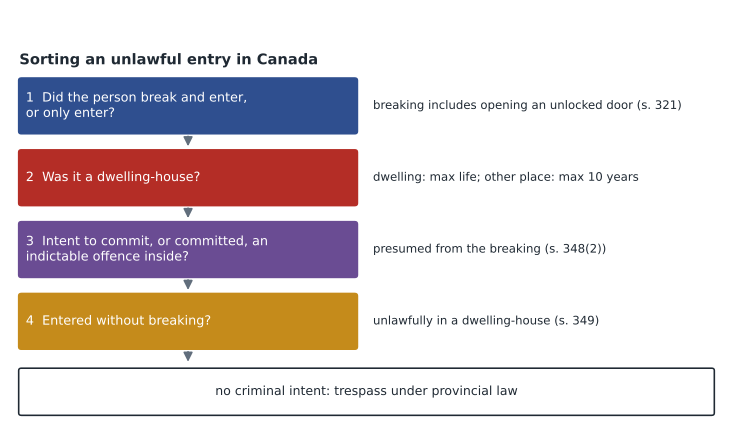
For officers, the investigation of a break and enter starts at the point of entry. A careful officer photographs pry marks, broken glass and footwear impressions before anyone touches them, asks the owner what is missing and what was disturbed, canvasses neighbours for doorbell and security camera video, and records serial numbers so that property can be flagged in the Canadian Police Information Centre (CPIC) and pawn databases. Fingerprints and DNA are often found on items the offender handled inside, such as a dresser drawer or a drink taken from the fridge, and the scene should be protected for an identification officer where the service has one. Marco DiSanto asks why so few burglaries are solved, and Professor Desjardins says the clearance rate is low everywhere, which is exactly why the first officer's work at the scene matters so much.
Robbery
Robbery, under section 343, is theft plus violence or threats. A person commits robbery who steals, and for the purpose of extorting whatever is stolen or to prevent or overcome resistance to the stealing, uses violence or threats of violence to a person or property; who steals from a person and, at the time or immediately before or after, wounds, beats, strikes or uses personal violence; who assaults a person with intent to steal from him or her; or who steals from a person while armed with an offensive weapon or imitation of one. The violence can be slight: a purse snatch that involves a push or a struggle can be a robbery, while a purse snatch so quick that the victim feels nothing may be only a theft. Robbery is an indictable offence with a maximum of life imprisonment, and when a firearm is used there are mandatory minimum sentences under section 344. A theft in a store that turns violent when staff try to stop the thief can become a robbery, because the violence was used to overcome resistance to the stealing. Officers should therefore record exactly when force was used and why.
Fraud and identity crime
Fraud, under section 380, is committed by anyone who, by deceit, falsehood or other fraudulent means, whether or not it is a false pretence, defrauds the public or any person of any property, money or valuable security or any service. In R. v. Théroux (1993), the Supreme Court held that the prohibited act has two parts, a dishonest act, meaning deceit, falsehood or other fraudulent means, and deprivation caused by that act, which includes actual loss and also putting the victim's economic interests at risk. The mental element is subjective knowledge of the dishonest act and knowledge that it could cause deprivation. Fraud over five thousand dollars carries up to fourteen years, with a two-year minimum where the value exceeds one million dollars. Identity theft, under section 402.2, covers obtaining or possessing another person's identity information with intent to use it to commit an indictable offence involving fraud or deceit, and identity fraud, under section 403, covers fraudulently personating another person to gain advantage, obtain property or avoid arrest. Priya Sandhu explains that most fraud reported to local police now comes through phones and computers: romance scams, fake investment sites, emergency scams aimed at grandparents, and invoice fraud aimed at businesses. Victims are often embarrassed, and the money has often been moved overseas within hours, so the first officer's job is to take a detailed report quickly, preserve the messages and transaction records, help the victim contact the bank, and report the scam to the Canadian Anti-Fraud Centre so it can be linked with other complaints.
Mischief and arson
Mischief, under section 430, is committed by a person who wilfully destroys or damages property, renders property dangerous, useless, inoperative or ineffective, or obstructs, interrupts or interferes with the lawful use, enjoyment or operation of property. Mischief that causes actual danger to life carries up to life imprisonment; mischief over five thousand dollars carries up to ten years; and mischief of five thousand dollars or less is a hybrid offence. Graffiti, smashed windows, slashed tires and blocking access to a building can all be mischief, and section 430(4.1) creates a more serious offence for mischief to religious property, schools and community centres motivated by hate. Arson, under sections 433 and 434, covers intentionally or recklessly causing damage by fire or explosion, and is most serious, with a maximum of life, where the accused knows or is reckless that the property is inhabited or occupied.
The grading problem is the same for every property offence: the officer must find the facts that set the level. Linh Tran writes a function that applies the grading rules to a few files Ms. Liu brought in, and the class checks each answer against the statute.
# Grade property files under the Criminal Code (simplified)
def grade(f):
    if f["violence_or_threat_to_steal"] or f["armed"]:
        return "robbery, s. 343 (indictable, max life)"
    if f["broke_and_entered"]:
        if f["dwelling"]:
            return "break and enter of a dwelling-house, s. 348(1)(d) (max life)"
        return "break and enter of another place, s. 348(1)(e) (hybrid, max 10 years)"
    if f["deceit"]:
        return "fraud over 5000, s. 380(1)(a)" if f["value"] > 5000 else "fraud 5000 or under, s. 380(1)(b)"
    if f["damage_only"]:
        return "mischief over 5000, s. 430(3)" if f["value"] > 5000 else "mischief 5000 or under, s. 430(4)"
    if f["vehicle"]:
        return "theft of a motor vehicle, s. 333.1"
    return "theft over 5000, s. 334(a)" if f["value"] > 5000 else "theft under 5000, s. 334(b)"
base = dict(violence_or_threat_to_steal=False, armed=False, broke_and_entered=False, dwelling=False,
            deceit=False, damage_only=False, vehicle=False, value=0)
files = {
    "hid two phones in a bag, stopped at door": {"value": 1800},
    "pushed clerk who grabbed the bag": {"violence_or_threat_to_steal": True, "value": 1800},
    "pried rear door of a closed shop": {"broke_and_entered": True, "value": 300},
    "entered home through unlocked window": {"broke_and_entered": True, "dwelling": True, "value": 2500},
    "fake invoice paid by a business": {"deceit": True, "value": 18400},
    "spray-painted bus shelter": {"damage_only": True, "value": 650},
    "took keys from hook, drove car away": {"vehicle": True, "value": 22000},
}
for name, facts in files.items():
print(f"{name:40s} -> {grade({**base, **facts})}")hid two phones in a bag, stopped at door -> theft under 5000, s. 334(b) pushed clerk who grabbed the bag -> robbery, s. 343 (indictable, max life) pried rear door of a closed shop -> break and enter of another place, s. 348(1)(e) (hybrid, max 10 years) entered home through unlocked window -> break and enter of a dwelling-house, s. 348(1)(d) (max life) fake invoice paid by a business -> fraud over 5000, s. 380(1)(a) spray-painted bus shelter -> mischief 5000 or under, s. 430(4) took keys from hook, drove car away -> theft of a motor vehicle, s. 333.1
The same seven files land in different places as soon as one fact changes. The phones taken at 1,800 dollars are theft under; add a push against the clerk and the same event is a robbery carrying a maximum of life imprisonment. The unlocked window is still a break and enter, because opening anything used to close an opening is a breaking. This is why officers write down the facts precisely and do not reach for the charge first.
Worked problem
The store that turned into a robbery
Loss prevention staff at a Port Ardent hardware store watch a man put two cordless drill kits, priced at 349 dollars each, into a duffel bag and walk past the last checkout. A staff member steps in front of him outside the door and takes hold of the bag. The man shoves her hard enough that she falls, and runs. Officers arrest him two blocks away with the bag. What offences are made out?
Show solution
- Theft: he moved the drills with intent to deprive the owner, and concealing them in a bag and passing the checkouts is strong evidence of that intent; the value is 698 dollars, so it is theft under five thousand dollars.
- Robbery: he used violence, the shove, to prevent or overcome resistance to the stealing, at the time of the theft, which makes the offence robbery under section 343(a).
- Assault: the shove is also an assault, but it is the violence that makes the theft a robbery, and the rule against multiple convictions for the same delict from R. v. Kienapple (1975) would usually prevent separate convictions for both.
- Evidence: obtain the store video, the staff member's statement and any injury photographs, recover the drills as evidence or photograph them for return, and document the price.
- Detention by staff: check how the staff member stopped him and whether her actions were within section 494, which affects her protection, not the man's liability.
Answer: A shove turned a minor theft into a robbery with a maximum of life imprisonment. The officer's notes must show when the force was used and why, because that timing is what connects the violence to the stealing.
Common mistakes
MistakeTheft is only complete when the thief leaves the store.
InsteadTheft is complete when the person moves the item with the required intent (s. 322(2)). Leaving the store is evidence of intent, not an element.
MistakePushing open an unlocked door is not breaking.
InsteadBreaking includes opening anything used to close an opening, locked or not (s. 321).
MistakeAny theft with a struggle is just theft and assault.
InsteadViolence used to steal, or to overcome resistance to stealing, makes the offence robbery.
MistakeThe value of stolen property is whatever the victim says.
InsteadValue must be proved with evidence such as receipts or price tags, and it sets the grade of the offence.
Summary and key terms
- Theft (s. 322) is taking or converting property fraudulently and without colour of right, with intent to deprive; it is graded at five thousand dollars.
- Possession of stolen property (s. 354) covers those who hold or deal in the proceeds, and knowledge can be inferred from recent unexplained possession.
- Break and enter (s. 348) is most serious for a dwelling-house, and intent is presumed from the breaking.
- Robbery (s. 343) add violence, threats or weapons to theft.
- Fraud (s. 380) requires a dishonest act and deprivation, including risk of loss (Théroux).
- Mischief and arson cover damage to property, graded by value and danger to people.
- Colour of right
- An honest belief in a legal right to the property, which is a defence to theft.
- Conversion
- Dealing with property lawfully held as if it were one's own.
- Recent possession
- An inference that a person found with recently stolen property, without a reasonable explanation, knew it was stolen.
- Breaking
- Opening anything used to close an opening, or entering by threat, artifice or collusion.
- Dwelling-house
- A building or structure kept or occupied as a permanent or temporary residence.
- Deprivation
- In fraud, actual loss or a risk of prejudice to the victim's economic interests.
Practice problems
Work each problem on paper first, then reveal the answer to check.
What is colour of right, and why does it matter?
Show answer
An honest belief in a legal right to property, even mistaken; it is a complete defence to theft.
A man shoplifts a jacket and, when stopped, pulls free and runs without touching anyone. Is it robbery?
Show answer
Probably not: pulling free without violence or threats toward a person is usually still theft, though the facts must be examined closely.
What does section 348(2) presume?
Show answer
That a person who broke and entered intended to commit an indictable offence inside, unless there is evidence to the contrary.
What should a first officer do on a fraud report?
Show answer
Take a detailed report quickly, preserve messages and transaction records, help the victim contact the bank and report to the national fraud reporting centre.
Lesson quiz · 5 questions
Score 60% or more to complete this lesson.
Create a free account to save your progress, take quizzes and earn a certificate.