
LES-103 · Lesson 6 of 12 · 21 min
Assault and offences against the person
▶ Video coming soon A video version of this lesson is on the way.
Assault is the offence Port Ardent officers charge more than any other violent crime, and it comes in every form: a shove outside a bar, a punch in a schoolyard, a slap during an argument at home, a bottle swung at a stranger, a bite, a kick to the head of someone already on the ground. Ms. Liu tells the class that in her office, assault files outnumber every other violence file several times over, and that most of the arguments in court are about three questions: was there really an application of force or a threat, did the victim consent, and how serious was the harm or the weapon. The answers decide whether a case is a simple assault prosecuted summarily or an aggravated assault carrying fourteen years. This lesson covers the definition of assault, consent, the aggravated forms and related offences against the person.
What counts as an assault
Section 265(1) of the Criminal Code defines assault in three ways. A person commits an assault when, without the consent of another person, he or she applies force intentionally to that person, directly or indirectly; when he or she attempts or threatens, by an act or a gesture, to apply force to another person, if he or she has, or causes the other person to believe on reasonable grounds that he or she has, present ability to effect that purpose; or when, while openly wearing or carrying a weapon or an imitation of one, he or she accosts or impedes another person or begs. Section 265(2) says these definitions apply to all forms of assault, including sexual assault and aggravated assault.
The force involved can be slight. Any intentional application of force without consent can be an assault, including a push, a poke in the chest, spitting on someone or throwing a drink at them, and force can be applied indirectly, as by setting a dog on someone or pulling a chair out from under them. The threat form requires more than words alone. A threat must be by an act or gesture, and words can accompany it; a person who says I'm going to punch you while raising a fist commits an assault, but the same words shouted from across a parking lot with no ability to carry them out do not. A threat of future harm, such as I'll get you next week, is not an assault but may be uttering threats under section 264.1.
Consent
Consent turns many touchings that would otherwise be assaults into lawful acts: a handshake, a tackle in a football game, a haircut, surgery. Section 265(3) says no consent is obtained where the complainant submits or does not resist because of the application of force, threats or fear of force, fraud, or the exercise of authority. In R. v. Jobidon (1991), the Supreme Court held that adults cannot consent to the intentional application of force causing serious hurt or non-trivial bodily harm in a fist fight or brawl. Consent to a fair fight is therefore no defence once one participant intends and causes real injury. Consent in sports is limited to the force within the rules and normal conduct of the game: a hockey player consents to body checks but not to a deliberate stick to the head after the whistle. Consent must also come from someone capable of giving it. Children, people who are unconscious or severely intoxicated, and people with some cognitive disabilities may be unable to consent, an issue that becomes central in the sexual offences of lesson 8.
Parents and teachers have a narrow additional protection. Section 43 of the Criminal Code justifies a schoolteacher, parent or person standing in the place of a parent in using force by way of correction toward a child, if the force does not exceed what is reasonable. In Canadian Foundation for Children, Youth and the Law v. Canada (2004), the Supreme Court upheld the section but read strict limits into it: it applies only to minor corrective force of a transitory and trifling nature, never to children under two or teenagers, never with objects such as belts or rulers, never with blows to the head, and teachers may use force only to restrain or remove a child, not to punish. The Truth and Reconciliation Commission called for section 43 to be repealed, and bills to do so have been introduced in Parliament. Officers called to a report of a parent striking a child must assess the force used, the injury, the child's age and the circumstances, and involve child protection services where required.
The aggravated forms of assault
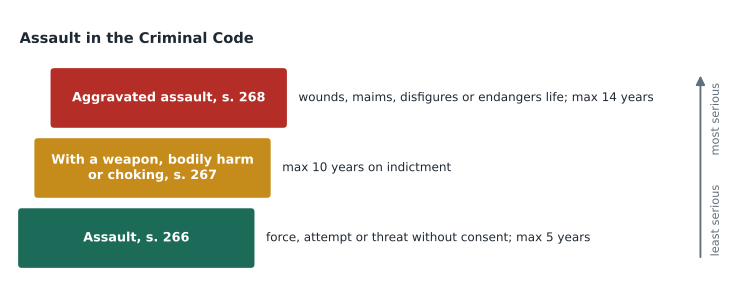
Above simple assault under section 266, which carries up to five years on indictment, the Code builds a ladder of more serious offences. Section 267 makes it an offence, carrying up to ten years, to commit an assault while carrying, using or threatening to use a weapon or an imitation of one, to commit an assault that causes bodily harm, or to choke, suffocate or strangle the complainant, a form added in 2019 because strangulation is a strong predictor of later homicide in intimate partner violence. Bodily harm is defined in section 2 as any hurt or injury that interferes with the health or comfort of the person and that is more than merely transient or trifling in nature; bruises, cuts needing stitches, a broken nose and serious psychological harm can all qualify. Section 268 defines aggravated assault, carrying up to fourteen years, as an assault that wounds, maims, disfigures or endangers the life of the complainant. Section 269 punishes unlawfully causing bodily harm, which covers injuries caused by another unlawful act, such as a dangerous shove that causes a fall. Weapon is defined broadly in section 2 to include anything used, designed to be used or intended for use in causing death or injury or in threatening or intimidating any person, so a beer bottle, a boot or a car can be a weapon depending on how it is used.
The aggravating facts decide the charge, so they must be documented with care. Injuries should be photographed, with a scale, when first seen and again a day or two later, when bruising often becomes more visible. Medical records should be obtained with consent or proper authority, because they describe injuries in clinical detail that can establish bodily harm, wounding or endangering life. Any object used should be seized and described, including how it was held and used, because whether it was a weapon can depend on its use. And in strangulation cases, officers should ask specific questions and look for signs such as voice changes, difficulty swallowing, petechiae, which are tiny red spots in the eyes or on the face, and loss of consciousness or bladder control, because visible marks are often absent.
| Offence and section | Key added element | Maximum on indictment |
|---|---|---|
| Assault, s. 266 | Force or threat without consent | 5 years |
| Assault with a weapon or causing bodily harm, s. 267(a), (b) | Weapon used or threatened; or bodily harm | 10 years |
| Choking, suffocating or strangling, s. 267(c) | Impeding breathing or blood flow | 10 years |
| Aggravated assault, s. 268 | Wounds, maims, disfigures or endangers life | 14 years |
| Assaulting a peace officer, s. 270 | Victim is a peace officer engaged in the execution of duty | 5 years |
Assaults on police and other public safety workers
Section 270 makes it an offence to assault a public officer or peace officer engaged in the execution of his or her duty, or a person acting in aid of such an officer, and to assault a person with intent to resist or prevent the lawful arrest or detention of himself or another. Sections 270.01 and 270.02 add aggravated forms for assaults with weapons or causing bodily harm, and for aggravated assaults on peace officers. A key element is that the officer was engaged in the execution of duty, which requires that the officer was acting lawfully. If the officer was making an unlawful arrest or search, the accused may be acquitted of the peace officer offence, though perhaps not of simple assault. The June 2026 sentencing reforms also made assaulting first responders and transit workers an aggravating factor at sentencing.
These provisions exist because officers face assault at rates few other workers do, and because attacks on officers threaten the rule of law itself. But Ms. Liu cautions the class that judges and juries examine these charges closely, and that a charge of assaulting police laid after a struggle that began with an unlawful stop, or that seems to be added to justify force used by the officer, can damage the officer's credibility in every later case. The best protection is a lawful, well-documented reason for every contact, and body-worn camera footage that shows the whole encounter.
Other offences against the person
Several related offences fill out this part of the Code. Kidnapping, under section 279(1), involves confining a person with intent to hold for ransom, send the person out of Canada or hold the person against his or her will, and forcible confinement, under section 279(2), covers confining, imprisoning or forcibly seizing another person without lawful authority, which arises often in intimate partner violence, as when a partner blocks the door or takes away the victim's phone. Administering a noxious thing, under section 245, covers drugging someone's drink. Criminal negligence causing bodily harm, under section 221, covers serious injuries caused by wanton or reckless disregard. And in June 2026, Bill C-225, known as Bailey's Law, created a new offence of violence, threatened violence or attempted violence against an intimate partner, as part of a package of intimate partner violence reforms, some of which come into force on dates set later.
The code below classifies a set of Port Ardent assault files by applying the ladder in order from the most serious level down, which is how a Crown reviews a charge: start with the most serious offence the facts could support, and step down until every element is met.
# Classify an assault file by stepping down the ladder (Criminal Code ss. 266 to 268, simplified)
def classify(f):
    if not f["force_or_threat"] or f["consent_valid"]:
        return "no assault"
    if f["wounds_maims_disfigures_or_endangers_life"]:
        return "aggravated assault, s. 268 (max 14 years)"
    if f["choking"]:
        return "assault by choking, s. 267(c) (max 10 years)"
    if f["weapon"] or f["bodily_harm"]:
        return "assault with a weapon or causing bodily harm, s. 267 (max 10 years)"
    return "assault, s. 266 (hybrid; max 5 years on indictment)"
base = dict(force_or_threat=True, consent_valid=False, weapon=False, bodily_harm=False, choking=False,
            wounds_maims_disfigures_or_endangers_life=False)
files = {
    "shove outside bar, no injury": {},
    "punch, broken nose": {"bodily_harm": True},
    "bottle swung, missed": {"weapon": True},
    "hands on throat during argument": {"choking": True},
    "stabbed in abdomen, surgery": {"weapon": True, "wounds_maims_disfigures_or_endangers_life": True},
    "body check within the rules of hockey": {"consent_valid": True},
}
for name, facts in files.items():
print(f"{name:40s} -> {classify({**base, **facts})}")shove outside bar, no injury -> assault, s. 266 (hybrid; max 5 years on indictment) punch, broken nose -> assault with a weapon or causing bodily harm, s. 267 (max 10 years) bottle swung, missed -> assault with a weapon or causing bodily harm, s. 267 (max 10 years) hands on throat during argument -> assault by choking, s. 267(c) (max 10 years) stabbed in abdomen, surgery -> aggravated assault, s. 268 (max 14 years) body check within the rules of hockey -> no assault
Real classification decisions are more nuanced than a function can capture. Whether a broken nose is bodily harm or a wound, whether a bottle was used as a weapon, and whether a provocation was serious enough are questions of fact for the court. Under Ohio law, for example, a broken nose has been held to be serious physical harm in many cases because it involves temporary substantial incapacity or disfigurement, but not every injury of that type will be. The code is a reminder of the order of the questions, which is the habit Ms. Liu wants the students to take into the field.
Worked problem
A choking complaint
At 11:40 p.m., Dev Malhotra and his partner attend a townhouse after a 911 call from a neighbour who heard screaming. A woman says her boyfriend pushed her against the wall and squeezed her throat with one hand for a few seconds during an argument about money, then left. She has faint red marks on her neck and a hoarse voice, and says she felt dizzy. She does not want him charged. What should the officers do?
Show solution
- Safety and care first: check for injury, offer medical assessment, because strangulation injuries can be serious and delayed, and locate the boyfriend.
- Identify the offence: squeezing the throat is choking under section 267(c), carrying up to ten years; it is assault even if the marks are faint.
- Document the elements: exact words used by the woman, the duration of pressure, voice changes, dizziness, any loss of consciousness, photographs of the marks now and a follow-up photograph later, and the neighbour's statement.
- Charging: Ontario's charging policy for intimate partner violence directs officers to lay a charge where there are reasonable grounds, whatever the victim's wishes, because victims are often under pressure and strangulation is a strong predictor of later homicide.
- Safety planning: connect her with victim services, explain bail or protection order conditions, and do a risk assessment.
Answer: The officers should treat this as a serious assault, document it thoroughly, arrest the boyfriend when located and connect the victim with support, explaining that the decision to charge rests with the police and Crown rather than with her.
Common mistakes
MistakeIf there is no visible injury, it is not an assault.
InsteadAny intentional application of force without consent is an assault; injury raises the offence but is not required.
MistakeConsent to a fight is a full defence.
InsteadAdults cannot consent to force intended to cause and causing serious hurt in a fight (R. v. Jobidon).
MistakeA weapon must be designed as a weapon.
InsteadOrdinary objects such as bottles, boots or cars can be weapons depending on how they are used.
MistakeAssaulting police applies to any assault on any officer.
InsteadThe officer must have been engaged in the execution of his or her duty, which requires lawful conduct.
Summary and key terms
- Assault under section 265 is the intentional application of force without consent, an attempt or threat with present ability, or accosting while carrying a weapon.
- Consent is vitiated by force, threats, fraud and authority, and adults cannot consent to serious hurt in a fight.
- The ladder runs from assault (s. 266) to assault with a weapon, causing bodily harm or choking (s. 267) to aggravated assault (s. 268).
- Aggravating facts such as injuries, weapons and strangulation must be documented carefully, including follow-up photographs and medical records.
- Assaulting a peace officer requires that the officer was acting lawfully in the execution of duty.
- Prosecutors review assault charges from the most serious possible offence downward until every element is met.
- Assault
- The intentional application of force without consent, or an attempt or threat to apply it with present ability.
- Bodily harm
- Any hurt or injury that interferes with health or comfort and is more than merely transient or trifling.
- Weapon
- Anything used, designed to be used or intended for use in causing injury or in threatening or intimidating.
- Aggravated assault
- An assault that wounds, maims, disfigures or endangers the life of the complainant.
- Forcible confinement
- Confining or imprisoning another person without lawful authority.
- Execution of duty
- Lawful performance of a peace officer's duties, an element of assaulting a peace officer.
Practice problems
Work each problem on paper first, then reveal the answer to check.
Give the three ways of committing assault under section 265(1).
Show answer
Intentionally applying force without consent; attempting or threatening by act or gesture with present ability; accosting or begging while openly carrying a weapon or imitation.
Why are strangulation cases treated so seriously?
Show answer
Because strangulation is a strong predictor of later homicide in intimate partner violence and can cause serious internal injury with few visible marks.
What makes an ordinary object such as a bottle a weapon?
Show answer
Its use, or intended use, to cause injury or to threaten or intimidate.
Why must officers document their lawful grounds when charging an assault on police?
Show answer
Because the charge requires the officer to have been acting lawfully, and the defence will challenge the grounds for the contact.
Lesson quiz · 5 questions
Score 60% or more to complete this lesson.
Create a free account to save your progress, take quizzes and earn a certificate.