
LES-103 · Lesson 2 of 12 · 19 min
Classifying offences: summary, indictable, hybrid and provincial
▶ Video coming soon A video version of this lesson is on the way.
In week two Ms. Liu brings in a stack of real charging documents from Port Ardent, with the names blacked out, and asks the students to sort them into piles. Marco sorts them by how serious they look: a stolen bicycle in one pile, a stabbing in another. Priya sorts them by type: violence, property, drugs. Ms. Liu says both are reasonable but neither is how the system sorts them. The legal classification of an offence decides which court hears it, how the accused can be arrested and released, how long the police have to lay the charge, what the maximum sentence is and what kind of record follows the person afterward. An officer who does not know whether an offence is summary, indictable or hybrid cannot know whether he or she may arrest without a warrant. This lesson is about that sorting system.
The three kinds of Criminal Code offence
Criminal Code offences fall into three groups. Summary conviction offences are the least serious, such as causing a disturbance or trespassing at night. Indictable offences are the most serious, such as robbery, break and enter of a dwelling house and murder. Hybrid offences, also called dual or Crown-option offences, can be prosecuted either way, and the Crown chooses, or elects, which way to proceed after considering the facts and the accused's record. Most offences in the Code are hybrid, including assault, theft under 5,000 dollars, mischief, uttering threats and sexual assault. Until the Crown elects, a hybrid offence is deemed to be indictable, which matters for police powers of arrest and fingerprinting.
The maximum sentence depends on the kind of offence. Since September 2019, when Parliament reformed the Code, every summary conviction offence carries the same general maximum of two years less a day in jail, a fine of up to 5,000 dollars, or both, unless a section sets a different penalty; a few, such as sexual assault after the June 2026 amendments, now carry that maximum expressly. Indictable offences carry the maximum stated in the section: two, five, ten or fourteen years, or life imprisonment. When a hybrid offence is prosecuted by indictment, the higher indictable maximum applies. Assault under section 266, for example, carries up to five years on indictment but the summary maximum if the Crown proceeds summarily.
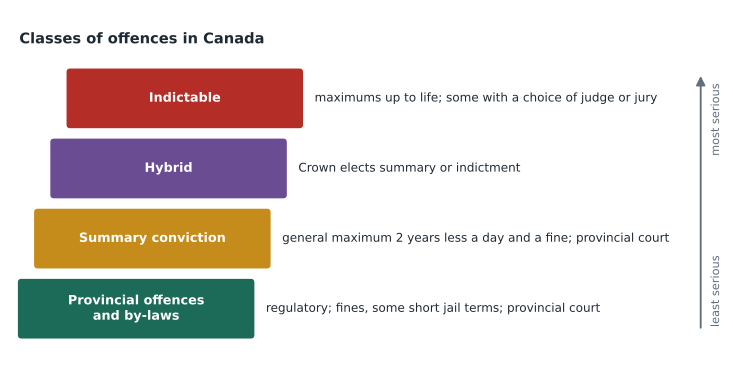
| Class | Example | Maximum penalty | Usual court |
|---|---|---|---|
| Provincial offence | Speeding under the Highway Traffic Act | Fine set by the statute; jail only for some serious provincial offences | Ontario Court of Justice (provincial offences court) |
| Summary conviction | Causing a disturbance | 2 years less a day and/or 5,000 dollars, unless the section says otherwise | Ontario Court of Justice |
| Hybrid | Theft under 5,000 dollars; assault | Summary maximum or the indictable maximum, depending on the Crown's election | Either, depending on election |
| Indictable | Robbery; break and enter of a dwelling | As stated in the section, up to life | Provincial or superior court, often at the accused's election |
Which court tries the case
The kind of offence also decides the court. Summary conviction offences are tried by a judge of the provincial court, in Ontario the Ontario Court of Justice, without a jury. For indictable offences there are three possibilities. A few offences listed in section 553, such as theft and mischief under 5,000 dollars and keeping a common gaming house, are in the absolute jurisdiction of a provincial court judge. A short list in section 469, including murder, treason and piracy, must be tried in the superior court, normally by judge and jury. For everything else, the accused chooses under section 536 among a provincial court judge, a superior court judge alone, or a superior court judge and jury. Since 2019, a preliminary inquiry, the hearing at which a judge decides whether there is enough evidence to go to trial, is available only for offences punishable by fourteen years or more. Section 11(f) of the Charter guarantees a jury trial for offences punishable by five years or more.
Limitation periods: how long police have to lay a charge
Canada has no general limitation period for indictable offences. A sexual assault reported thirty years later can still be prosecuted by indictment, and many historical abuse cases are. Summary conviction proceedings, however, must begin within twelve months of the offence under section 786(2), unless the prosecutor and the defence agree otherwise. For a hybrid offence, this means that after twelve months the Crown can proceed only by indictment. Provincial offences have their own limits; under Ontario's Provincial Offences Act, most Part I and Part III proceedings must start within six months. For an investigator, these limits are a reason to complete a file promptly. An officer who sits on a minor assault complaint for a year has quietly taken the summary option away from the Crown.
The code below checks a list of cases from the Port Ardent file room against the time limits. Priya points out that it is the same kind of calculation her bank used to decide whether a fraud claim was still within its window, and Ms. Liu says that prosecutors' offices run exactly this kind of check when files are transferred.
# Can a summary charge still be laid? Section 786(2): 12 months for summary proceedings.
from datetime import date
def add_months(d, months):
    y, m = divmod(d.month - 1 + months, 12)
    return date(d.year + y, m + 1, min(d.day, 28))
kinds = {"theft under 5,000": "hybrid", "assault": "hybrid", "cause disturbance": "summary",
         "break and enter of a dwelling": "indictable", "uttering threats": "hybrid"}
files = [("theft under 5,000", date(2025, 2, 10)), ("assault", date(2025, 11, 2)),
         ("cause disturbance", date(2025, 3, 30)), ("break and enter of a dwelling", date(2016, 5, 4)),
         ("uttering threats", date(2025, 8, 19))]
today = date(2026, 2, 16)
for charge, when in files:
    kind = kinds[charge]
    summary_ok = today <= add_months(when, 12)
    if kind == "indictable":
        options = "indictment only (no limit)"
    elif kind == "summary":
        options = "summary, still in time" if summary_ok else "summary, TIME EXPIRED"
    else:
        options = "Crown may elect either way" if summary_ok else "indictment only (summary time expired)"
print(f"{charge:31s} {when} {kind:10s} {options}")theft under 5,000 2025-02-10 hybrid indictment only (summary time expired) assault 2025-11-02 hybrid Crown may elect either way cause disturbance 2025-03-30 summary summary, still in time break and enter of a dwelling 2016-05-04 indictable indictment only (no limit) uttering threats 2025-08-19 hybrid Crown may elect either way
The output shows why classification is the first thing a file reviewer checks. The February 2025 theft is now more than twelve months old, so if the Crown proceeds at all it must be by indictment, which is a heavier process for a minor theft, and the Crown may decide it is no longer in the public interest. The disturbance charge, a pure summary offence, can no longer be laid at all. Delay costs cases, and the cost falls on victims.
Provincial offences and by-laws
Most of the offences police deal with day to day are not in the Criminal Code at all. Provincial statutes create offences for traffic, liquor, cannabis sales and use, trespass and many regulatory matters, and they are prosecuted under each province's procedure statute, in Ontario the Provincial Offences Act. Under Part I of that act, an officer issues a certificate of offence, commonly called a ticket, with a set fine; the person can pay, request a meeting with a prosecutor or ask for a trial. More serious provincial offences, such as driving while suspended, are prosecuted under Part III by an information and summons, with higher fines and in some cases jail. Most provincial offences are strict liability offences, a category explained in lesson 4, meaning the prosecution does not have to prove a guilty mind but the defendant can avoid conviction by proving that he or she took all reasonable care.
These offences are lighter, but they are not trivial. They are how the law regulates the ordinary risks of daily life, such as speeding, and they are often the first contact a person has with police. They also lead to more serious matters. A routine Highway Traffic Act stop can reveal a suspended driver, an impaired driver or a person wanted on a warrant. Officers should know the most common provisions well enough to explain them to the people they stop, because an explanation is part of procedural justice, the idea from LES-101 that people accept outcomes more readily when they feel the process was fair.
Why classification matters to an officer
Classification affects police powers directly. Under section 495, an officer may arrest without a warrant a person who has committed an indictable offence or who, on reasonable grounds, the officer believes has committed or is about to commit one, but may arrest for a summary conviction offence only if the officer finds the person committing it. Because hybrid offences are treated as indictable until the Crown elects, an officer can arrest for a hybrid offence on reasonable grounds even after it is over. Classification also affects release: for most offences, officers must release the person with an appearance notice or an undertaking unless detention is necessary in the public interest, a rule strengthened by the June 2026 bail reforms that direct police to hold an accused for a bail hearing when that is needed to protect the public. Fingerprints and photographs may be taken under the Identification of Criminals Act only for indictable offences, including hybrid offences. And a conviction affects a person's future: a record suspension, formerly called a pardon, can be sought five years after a summary sentence is completed and ten years after an indictable one.
Classification also shapes how a case is investigated. The more serious the offence, the more resources it receives and the more carefully every step is documented, because it is more likely to be contested at trial. A minor theft may be handled entirely by the patrol officer who took the call; a robbery is handed to investigators; a homicide becomes a major case with a team, a file coordinator and Crown involvement from the start. Knowing the class of offence helps officers set priorities and know when to call for help.
Worked problem
A late report
On 16 February 2026, a store manager tells Constable Dev Malhotra that a former employee stole about 900 dollars of merchandise in January 2025, more than a year ago. He has receipts and video. What should Dev consider?
Show solution
- Identify the offence: theft under 5,000 dollars, section 334(b), a hybrid offence.
- Check the time limit: more than twelve months have passed, so a summary proceeding is out of time; the Crown can proceed only by indictment.
- Consider the consequence: proceeding by indictment for a minor first-offence theft is possible but heavy; the Crown will weigh the public interest, and diversion may be considered.
- Document: secure the video and receipts, record exactly when the manager learned of the theft and why it was reported late, and identify the value of each item, because value determines the level of the offence.
Answer: The theft can still be prosecuted by indictment, but the delay has reduced the Crown's options. Dev should complete the file quickly and note the reasons for the late report.
Common mistakes
MistakeA hybrid offence is a summary offence until the Crown decides otherwise.
InsteadA hybrid offence is deemed indictable until the Crown elects to proceed summarily.
MistakeClassification only matters to lawyers and judges.
InsteadIt determines arrest powers, release, fingerprinting, the court, the time limit and the maximum sentence.
MistakeThere is no time limit for laying any criminal charge.
InsteadSummary proceedings must begin within twelve months; only indictable offences have no general limit.
MistakeMinor offences are not real law enforcement.
InsteadTraffic and other minor offences regulate daily risks, are the public's most common contact with police and often lead to more serious matters.
Summary and key terms
- Criminal Code offences are summary, indictable or hybrid; hybrid offences are deemed indictable until the Crown elects.
- The general summary maximum is two years less a day and/or 5,000 dollars; indictable maximums are stated in each section.
- Summary offences are tried in provincial court; for most indictable offences the accused elects the mode of trial.
- Summary proceedings must start within twelve months; indictable offences have no general limit.
- Classification determines arrest and release powers, the court, the time limit, the sentence and the record.
- Provincial offences are mostly strict liability and are prosecuted by ticket under the Provincial Offences Act.
- Summary conviction offence
- The least serious class of Criminal Code offence, tried in provincial court with a general maximum of two years less a day.
- Indictable offence
- The most serious class of offence, with the maximum penalty stated in its section.
- Hybrid offence
- An offence the Crown may prosecute summarily or by indictment; it is deemed indictable until the election.
- Crown election
- The prosecutor's choice of how to proceed on a hybrid offence.
- Limitation period
- The time within which a prosecution must begin; twelve months for summary proceedings.
- Certificate of offence
- A ticket issued under Part I of Ontario's Provincial Offences Act.
Practice problems
Work each problem on paper first, then reveal the answer to check.
Why does it matter for arrest powers that a hybrid offence is deemed indictable?
Show answer
Because an officer may arrest on reasonable grounds for an indictable offence even after it is over, but may arrest for a summary offence only when finding the person committing it.
What happens to the Crown's options on a hybrid offence after twelve months?
Show answer
Summary proceedings are out of time, so the Crown can proceed only by indictment.
Give two consequences of classification other than the maximum sentence.
Show answer
Examples: the court that tries the case, the time limit, arrest and release powers, fingerprinting and the effect on the person's record.
Why should an officer complete a minor file promptly?
Show answer
Delay can push a case past a time limit or reduce the prosecutor's options, which harms victims and wastes the investigation.
Lesson quiz · 5 questions
Score 60% or more to complete this lesson.
Create a free account to save your progress, take quizzes and earn a certificate.