
LES-103 · Lesson 11 of 12 · 22 min
Defences: self-defence, necessity, duress, mental disorder and intoxication
▶ Video coming soon A video version of this lesson is on the way.
Every lesson so far has asked whether the elements of an offence are proved. This lesson asks a different question: even when the prohibited act and the guilty mind are both there, does the law excuse or justify what the person did? Professor Desjardins tells the class about a call early in his career. A woman had stabbed her husband in the kitchen of their apartment. She had the knife in her hand when he arrived, and she said so. On the elements alone it was an aggravated assault. But the apartment also held the evidence of years of abuse, a fresh injury on her neck and a 911 recording that captured the husband's threats seconds before the stabbing. The case was never charged. Officers do not decide defences, which are for the Crown and the courts, but they must recognize them, because the evidence that supports a defence is gathered at the scene or not at all, and Crown charging standards take likely defences into account.
Justifications and excuses
Defences fall into a few families. Some deny an element: a mistake of fact, from lesson 4, can show the accused lacked the required mental state, and an alibi denies the act. Justifications say the act was right or at least permitted in the circumstances, as with self-defence, where society accepts the use of force to repel an attack. Excuses say the act was wrong but the person should not be blamed, as with duress, where a threat leaves no realistic choice, or mental disorder, where illness prevents the person from understanding the act. The distinction matters because justified acts, unlike excused ones, can be lawfully resisted only in limited ways and do not carry the same moral weight. In Canada, once there is an air of reality to a defence, meaning some evidence on which a properly instructed jury could find in the accused's favour, the Crown must disprove it beyond a reasonable doubt; mental disorder is the main exception, because the party raising it must prove it on a balance of probabilities.
Self-defence after the 2013 reforms
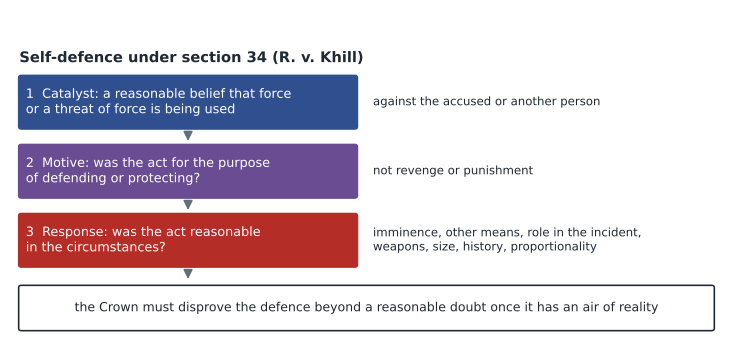
The Citizen's Arrest and Self-defence Act replaced the old, complicated self-defence provisions with a single section 34 in 2013. A person is not guilty of an offence if he or she believes on reasonable grounds that force is being used against him or her or another person, or that a threat of force is being made; the act is committed for the purpose of defending or protecting himself, herself or the other person; and the act is reasonable in the circumstances. In R. v. Khill (2021), the Supreme Court called these the catalyst, the motive and the response, and held that the third question requires the judge or jury to look at the accused's role in the incident, including conduct that provoked or escalated it. Section 34(2) lists factors for deciding reasonableness: the nature of the force or threat; the extent to which the use of force was imminent and whether other means were available to respond; the person's role in the incident; whether a weapon was used or threatened; the size, age, gender and physical capabilities of the parties; the nature, duration and history of the relationship, including prior force or threats; any history of interaction or communication; the proportionality of the response; and whether the act was in response to a use or threat of force the person knew was lawful. There is no rigid duty to retreat, but the availability of other means is one of the factors.
Section 35 deals separately with defence of property. A person in peaceable possession of property who believes on reasonable grounds that another person is about to enter it, is entering it, has entered it without being entitled to, or is about to take, damage or destroy it, may act for the purpose of protecting the property if the act is reasonable in the circumstances. Force used only to protect property must be modest; deadly force to protect property alone is almost never reasonable. The Supreme Court's emphasis in Khill on the accused's own role means officers should record how the encounter started, who escalated it, what each person said and any history between them.
Necessity and duress
Necessity is a narrow common law excuse. In Perka v. The Queen (1984), the Supreme Court held that it applies only in urgent situations of clear and imminent peril where compliance with the law is demonstrably impossible, and in R. v. Latimer (2001) it set out three requirements: imminent peril or danger, no reasonable legal alternative to breaking the law, and proportionality between the harm inflicted and the harm avoided. The first two are judged on a modified objective standard that takes account of the accused's situation, and the third on a purely objective standard. Latimer, who killed his severely disabled daughter, was denied the defence because there was no imminent peril and he had legal alternatives. A driver who speeds to take a person in a medical emergency to hospital is the textbook case where necessity might succeed.
Duress has two sources. Section 17 of the Criminal Code covers a principal offender who commits an offence under compulsion by threats of immediate death or bodily harm from a person present, but it excludes a long list of offences including murder, robbery and sexual assault; the Supreme Court held in R. v. Ruzic (2001) that the immediacy and presence requirements violated the Charter. The common law defence applies to parties and, in practice, to principals too. In R. v. Ryan (2013), the Court described the requirements: an explicit or implicit threat of death or bodily harm against the accused or a third person; a reasonable belief that it would be carried out; no safe avenue of escape; a close temporal connection between the threat and the harm; proportionality between the harm threatened and the harm inflicted; and that the accused was not a party to a conspiracy or association in which he or she knew threats and coercion were likely. Duress cannot be used by a person who was threatened by someone she was trying to escape through crime rather than being coerced into the crime, as Ryan herself was.
Mental disorder
Section 16 of the Criminal Code says no person is criminally responsible for an act committed or an omission made while suffering from a mental disorder that rendered the person incapable of appreciating the nature and quality of the act or omission or of knowing that it was wrong. In R. v. Chaulk (1990) and R. v. Oommen (1994), the Supreme Court held that wrong means morally wrong by the standards of society, not merely illegal, and that a person who knows the act is legally wrong but, because of illness, believes it is morally justified may be found not criminally responsible. A verdict of not criminally responsible on account of mental disorder (NCRMD) is not an acquittal; the person is referred to a provincial review board, which can order detention in a hospital, a conditional discharge or an absolute discharge, considering public safety, the person's mental condition and reintegration. Fitness to stand trial, under section 2, is a separate question: whether the accused can understand the proceedings and communicate with counsel now.
For patrol officers, the important point is that the evidence of a person's mental state at the time of the offence is gathered by the first people on scene. Officers who apprehend a person under the provincial mental health act should record exactly what the person said and did, how he or she appeared, and any statements about voices, beliefs or medication. Linh Tran asks whether that information will be used against the person. Professor Desjardins says it is used to find the truth, which sometimes supports a defence and sometimes undermines one, and that careful notes are fair to everyone.
Intoxication and automatism
Intoxication is the defence that comes up most often, and its rules depend on the kind of offence. For specific intent offences, which require a further purpose beyond the act itself, such as murder, robbery or theft, evidence of intoxication can raise a reasonable doubt about whether the accused formed the intent, as the Supreme Court held in R. v. Daley (2007). For general intent offences, such as assault, sexual assault and mischief, intoxication short of automatism is no defence. Extreme intoxication akin to automatism is the hard case: in R. v. Daviault (1994) the Court held it could be a defence even to general intent offences, Parliament responded with section 33.1, and in R. v. Brown (2022) the Court struck down that section. Parliament then enacted a new section 33.1 in June 2022, under which a person in a state of extreme intoxication that was self-induced can be convicted of a violent offence if he or she departed markedly from the standard of care expected of a reasonable person in consuming the intoxicating substances, considering the objective foreseeability of the risk of extreme intoxication and of harm to others. Automatism more generally, under R. v. Stone (1999), covers involuntary conduct, such as acts during a seizure, a concussion or sleepwalking; the accused must prove it on a balance of probabilities, and if it comes from a mental disorder it leads to an NCRMD finding rather than an acquittal. For officers, this means recording a suspect's observed level of intoxication carefully: slurred speech, balance, the smell of alcohol, what the person said about consumption, and how he or she performed tasks, rather than writing simply that the person was drunk.
Entrapment and police conduct
Entrapment is a defence that focuses on police conduct rather than on the accused's guilt. In R. v. Mack (1988), the Supreme Court held that police entrap a person when they offer an opportunity to commit an offence without reasonable suspicion that the person is already engaged in criminal activity, or without a bona fide inquiry into a place where crime is reasonably suspected; or when, even with reasonable suspicion, they go beyond providing an opportunity and induce the commission of an offence. In R. v. Ahmad (2020), the Court applied the test to dial-a-dope investigations, holding that police who call a phone number given by a tipster must have reasonable suspicion about that number before offering to buy drugs. A successful entrapment claim leads to a stay of proceedings, not an acquittal, and the judge decides it after a finding of guilt. Separately, section 25 of the Criminal Code protects officers who use as much force as is necessary in enforcing the law, if they act on reasonable grounds, and section 25.1 sets out a limited justification for designated officers in undercover work.
The class builds a checklist for the questions an officer should be able to answer in the notes whenever a defence may arise. Marco says it is the same idea as a pre-flight checklist: not deciding the outcome, just making sure nothing is missed.
# Which defences do the scene notes need to address? (Canadian law, simplified)
notes = {
    "force or threat by complainant first": True,
    "accused statement about why force was used": True,
    "injuries photographed on both parties": True,
    "relationship history recorded": True,
    "weapon found and position recorded": True,
    "signs of intoxication described (not just 'drunk')": False,
    "statements suggesting voices or delusions": False,
    "threats made to the accused by a third person": False,
}
defences = {
    "self-defence (s. 34)": ["force or threat by complainant first", "accused statement about why force was used",
                             "injuries photographed on both parties", "relationship history recorded",
                             "weapon found and position recorded"],
    "intoxication": ["signs of intoxication described (not just 'drunk')"],
    "mental disorder (s. 16)": ["statements suggesting voices or delusions"],
    "duress (Ryan)": ["threats made to the accused by a third person"],
}
for name, needs in defences.items():
    done = [n for n in needs if notes[n]]
    print(f"{name:24s} {len(done)}/{len(needs)} items recorded")
    for n in needs:
        if not notes[n]:
print(f" check: {n}")self-defence (s. 34) 5/5 items recorded
intoxication 0/1 items recorded
check: signs of intoxication described (not just 'drunk')
mental disorder (s. 16) 0/1 items recorded
check: statements suggesting voices or delusions
duress (Ryan) 0/1 items recorded
check: threats made to the accused by a third personThe output shows that the self-defence questions are covered but three other possible defences are not addressed at all. Even if none of them turns out to apply, a note that the suspect showed no signs of intoxication, made no statements suggesting delusions and reported no threats from anyone else closes those questions for the Crown. Noting where the incident happened matters less in Canada, where location is simply one of the circumstances; in Ohio, whether it occurred in a residence or occupied vehicle can trigger the castle doctrine presumption.
Worked problem
The kitchen stabbing
Officers are called to an apartment where a man has a stab wound to his abdomen. His wife, sitting on the floor with a knife beside her, says he was choking her and she grabbed the knife from the counter. She has red marks on her neck. A neighbour says she has heard shouting and banging from the apartment many times, and the 911 call recorded a man yelling I'm going to kill you seconds before a scream. What should the officers do, and what evidence matters?
Show solution
- Safety and medical care: render first aid and get paramedics for the man, secure the knife, and have the woman examined, including for strangulation injuries that may not be visible at first.
- Treat it as a serious assault investigation, with the woman as a suspect, but recognize the clear signs of self-defence: the catalyst of choking, a defensive statement, visible injuries and a history of violence.
- Gather the evidence that bears on the defence: photographs of her injuries over the following days, the 911 recording, the neighbour's statement, prior calls to the address, and the position of the knife and both people.
- Record the relationship history and any prior force or threats, because section 34(2)(f) makes them factors in deciding reasonableness.
- Interview carefully: give rights advice, let her speak with counsel, and do not suggest the defence or argue her out of it; record exactly what she says.
Answer: Officers do not decide whether self-defence succeeds, but the evidence they gather in the first hour decides whether the Crown can make that judgment fairly. In Professor Desjardins's case, that evidence led to no charge.
Common mistakes
MistakeOfficers decide whether a defence applies before laying a charge.
InsteadOfficers gather the evidence; Crown and courts decide defences, though likely defences affect charging decisions.
MistakeThere is always a duty to retreat before using force.
InsteadOther means of responding are one factor in reasonableness, not a rigid rule.
MistakeBeing drunk is a defence to any crime.
InsteadIntoxication can only negate specific intent; it is no defence to general intent offences short of automatism.
MistakeA finding of mental disorder or insanity means the person goes free.
InsteadAn NCRMD finding leads to a review board that may order hospital detention.
Summary and key terms
- Defences may deny an element, justify the act or excuse the actor.
- Self-defence under s. 34 asks about the catalyst, the motive and the reasonableness of the response (Khill).
- Necessity and duress are narrow excuses for situations of imminent danger with no reasonable legal alternative.
- Mental disorder under s. 16 asks whether illness made the person incapable of appreciating the act or knowing it was wrong.
- Intoxication can negate specific intent; extreme self-induced intoxication is governed by the new s. 33.1.
- Entrapment focuses on police conduct, and officers' notes must capture the facts that support or rule out every possible defence.
- Air of reality
- The threshold of evidence that puts a defence before the jury.
- Justification
- A defence that treats the act as permitted, such as self-defence.
- Excuse
- A defence that accepts the act was wrong but excuses the actor, such as duress.
- NCRMD
- Not criminally responsible on account of mental disorder under section 16.
- Specific intent
- An intent going beyond the act itself, which intoxication may negate.
- Entrapment
- Police offering an opportunity without reasonable suspicion or inducing an offence; leads to a stay.
Practice problems
Work each problem on paper first, then reveal the answer to check.
What are the three questions of self-defence under R. v. Khill?
Show answer
The catalyst (a reasonable belief in force or threat), the motive (a defensive purpose) and the response (reasonableness in the circumstances).
What are the requirements of necessity?
Show answer
Imminent peril, no reasonable legal alternative and proportionality between the harm caused and the harm avoided.
Why should officers describe signs of intoxication rather than writing drunk?
Show answer
Because the degree of intoxication bears on intent and defences, and specific observations can be tested in court.
Is an undercover drug purchase entrapment?
Show answer
Not if officers merely provide an opportunity with reasonable suspicion; it becomes entrapment when they lack reasonable suspicion or induce the offence.
Lesson quiz · 5 questions
Score 60% or more to complete this lesson.
Create a free account to save your progress, take quizzes and earn a certificate.