
LES-103 · Lesson 10 of 12 · 21 min
Weapons, drugs and public order offences
▶ Video coming soon A video version of this lesson is on the way.
Some of the offences officers deal with most often have no individual victim at the scene. A person carrying a knife in a bar, a car with a loaded handgun under the seat, a bag of pills in a jacket pocket, a crowd that refuses to disperse, a man who gives a false name to avoid a warrant: each is a crime against public safety or the administration of justice rather than against a particular person. These offences give officers a great deal of discretion, and they are also the offences most often challenged in court, because the evidence usually comes from a search, a stop or a conversation with police. Professor Desjardins tells the class that he has seen more weapons and drug cases lost on Charter grounds than on the elements, and that the law of search covered in LES-111 and LES-112 goes hand in hand with this lesson. Here the focus is on what the offences are and what officers must prove.
Weapons
The Criminal Code defines a weapon in section 2 as anything used, designed to be used or intended for use in causing death or injury to any person, or for the purpose of threatening or intimidating any person, and the definition includes a firearm. The definition turns on use and intent, so a kitchen knife, a baseball bat or a bottle can be a weapon if it is carried or used for those purposes. Possession of a weapon for a dangerous purpose, under section 88, covers carrying or possessing a weapon, imitation or prohibited device for a purpose dangerous to the public peace or for the purpose of committing an offence. Carrying a concealed weapon, under section 90, covers carrying a weapon concealed unless authorized. Some weapons are prohibited outright by regulation, including switchblades and other automatically opening knives, brass knuckles, nunchaku and certain other items, and possessing them without lawful excuse is an offence under section 91 or 92 regardless of purpose.
Firearms are regulated mainly by the Firearms Act and Part III of the Criminal Code. Firearms are classified as non-restricted, such as most hunting rifles and shotguns; restricted, such as most handguns; or prohibited, a class that includes many short-barrelled handguns, fully automatic firearms and, since an Order in Council in May 2020, about 1,500 models of assault-style firearms. A person must hold a possession and acquisition licence (PAL) to possess firearms, with a restricted endorsement for restricted firearms, and restricted and prohibited firearms must be registered. In December 2023, Bill C-21 received royal assent, putting into law a national freeze on the sale, purchase and transfer of handguns. The key offences for patrol officers are unauthorized possession of a firearm under sections 91 and 92, possession of a loaded prohibited or restricted firearm with readily accessible ammunition under section 95, careless use and unsafe storage under section 86, and the firearm-use offences that add mandatory minimum sentences to violent crimes.
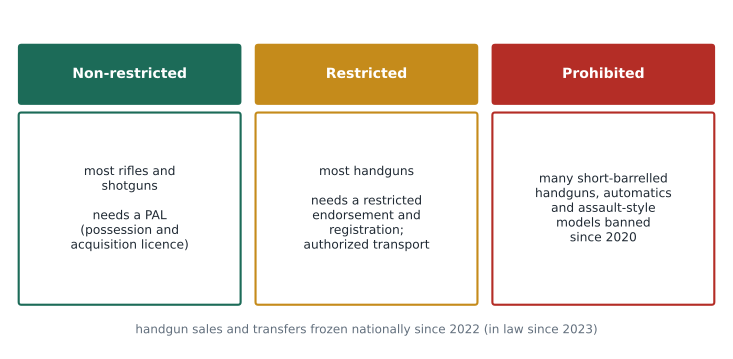
When a patrol officer finds a firearm, the first questions are whether the person is licensed and whether the firearm is registered where registration is required, which the officer checks through the Canadian Firearms Program and CPIC, and whether the firearm is stored and transported as the regulations require: unloaded, with trigger locks or in a locked container, and for restricted firearms only along an authorized route. Ms. Liu reminds the class that section 95 offences are among the most serious possession charges officers lay, but that they are also frequently challenged, so the officer's notes must record exactly where the firearm was found, whether it was loaded and how close the ammunition was.
Possession, constructive and joint
Weapons and drug offences both depend on possession, and the law of possession from lesson 3 applies directly. A person has personal possession of what is on his or her body or under direct control. Under section 4(3) of the Criminal Code, a person also has possession of a thing that he or she knowingly keeps in any place for his or her own use or benefit or that of another, and where one of two or more persons has a thing in their custody with the knowledge and consent of the rest, each of them has it in possession. In every case, possession requires knowledge of the thing and some measure of control over it. A handgun found under the passenger seat of a car with three occupants is the classic hard case. The officer must look for evidence that links a particular person to it: ownership of the car, the person's position, fingerprints or DNA, admissions, the gun's appearance in the person's phone, or items such as a holster on the person.
Drug offences
The Controlled Drugs and Substances Act (CDSA) regulates drugs in Canada through schedules: Schedule I includes opioids such as heroin and fentanyl, and cocaine and methamphetamine; Schedule II includes synthetic cannabinoids; Schedule III includes hallucinogens such as LSD and psilocybin; and Schedule IV includes some prescription drugs such as benzodiazepines when held without authorization. The main offences are possession under section 4, trafficking and possession for the purpose of trafficking under section 5, importing and exporting under section 6, and production under section 7. Trafficking means selling, giving, transferring, transporting, sending or delivering the substance, or offering to do so, and it does not require a profit. Possession for the purpose of trafficking is proved by circumstantial evidence such as quantity, packaging in individual doses, scales, cash and debt lists, and messages arranging sales. Cannabis was legalized for adults under the Cannabis Act in October 2018, with limits that include possessing no more than 30 grams of dried cannabis in public, a minimum age of 18 or higher set by each province, and offences for selling to youth and selling without a licence.
In 2017, Parliament passed the Good Samaritan Drug Overdose Act, which adds section 4.1 to the CDSA: a person who seeks emergency medical or law enforcement help because he or she or another person is suffering a medical emergency involving a drug, and anyone at the scene when help arrives, cannot be charged or convicted of simple possession, or of breaching conditions related to simple possession, based on evidence obtained because of that call. British Columbia ran a three-year pilot from January 2023 that removed criminal penalties for adults possessing small amounts of certain drugs for personal use, and narrowed it in 2024 to exclude most public places. Courts and Crown policy also favour diversion for simple possession: since 2020, federal prosecutors have been directed to prosecute simple possession only in the most serious cases, and the 2022 amendments in Bill C-5 require officers and prosecutors to consider warnings, referrals to treatment and diversion. Jesse Morningstar says the overdose crisis has hit his community hard, and that people there are more likely to call for help when they know they will not be charged.
The difference between simple possession and possession for the purpose of trafficking is often the most important judgment in a drug file, and it is made from the circumstances. Priya Sandhu writes a short program that scores the indicators from an officer's notes. The weights are not law; they reflect the kinds of facts courts and expert witnesses consider, and the class discusses which ones the notes must prove.
# Indicators of possession for the purpose of trafficking (illustrative weights, not law)
indicators = {
    "quantity beyond personal use": 3,
    "packaged in individual doses": 3,
    "digital scale": 2,
    "debt list or customer ledger": 3,
    "messages arranging sales": 4,
    "large amount of cash in small bills": 2,
    "more than one phone": 1,
    "no smoking or injecting equipment": 1,
}
files = {
    "A: 1.2 g in one bag, pipe in pocket": [],
    "B: 14 baggies, scale, 860 in cash": ["packaged in individual doses", "digital scale",
                                          "large amount of cash in small bills"],
    "C: 28 g, two phones, sales texts, no pipe": ["quantity beyond personal use", "more than one phone",
                                                  "messages arranging sales", "no smoking or injecting equipment"],
}
for name, found in files.items():
    score = sum(indicators[i] for i in found)
    view = "supports trafficking" if score >= 6 else "consistent with personal use"
    print(f"{name:45s} score {score:2d}  {view}")
    for i in found:
print(f" {i}")A: 1.2 g in one bag, pipe in pocket score 0 consistent with personal use
B: 14 baggies, scale, 860 in cash score 7 supports trafficking
packaged in individual doses
digital scale
large amount of cash in small bills
C: 28 g, two phones, sales texts, no pipe score 9 supports trafficking
quantity beyond personal use
more than one phone
messages arranging sales
no smoking or injecting equipmentFile A has no indicators at all; file B is a typical street-level trafficking file; and file C is strong even without packaging, because messages arranging sales are direct evidence of the purpose. The point of the exercise, Professor Desjardins says, is not the score but the habit of writing down every indicator, with photographs of the packaging, the scale and the cash, so that an expert can later explain what they mean.
Public order offences
Several offences protect public order. Causing a disturbance, under section 175, is committed by a person who, not being in a dwelling-house, causes a disturbance in or near a public place by fighting, screaming, shouting, swearing, singing or using insulting or obscene language, by being drunk, or by impeding or molesting other persons. In R. v. Lohnes (1992), the Supreme Court held that the disturbance must be an externally manifested disturbance of the public peace, an interference with the ordinary and customary use of the premises by the public, and not merely annoyance or mental upset. Unlawful assembly and riot, under sections 63 to 65, cover three or more people assembled in a way that causes reasonable fear that they will disturb the peace tumultuously, and a riot is an unlawful assembly that has begun to do so. Most provinces also have liquor licence and trespass to property acts that let officers deal with public intoxication and unwanted persons without a criminal charge.
Offences against the administration of justice
Officers lay these charges against people who interfere with police work or the courts. Obstructing or resisting a peace officer in the execution of duty, under section 129, requires that the officer was acting lawfully in the execution of duty and that the accused wilfully obstructed or resisted, for example by physically struggling against a lawful arrest or by giving a false name when lawfully required to identify himself or herself. Failing to comply with a release order or undertaking, under section 145, covers breaching conditions of bail, and failing to comply with a probation order is an offence under section 733.1. Public mischief, under section 140, covers making a false report to police that another person has committed an offence, or reporting an offence that did not happen, with intent to mislead, and personating a peace officer is an offence under section 130. Bill C-75 in 2019 created an option for police to refer some minor breaches of release conditions to a judicial referral hearing rather than laying a new charge, to reduce charges that only pile up against people already in the system.
In every one of these offences, the lawfulness of the officer's own conduct is an element or a central issue. A person cannot be guilty of obstructing an officer if the officer was not acting lawfully, for example in an arrest without grounds. Amara Okafor notes that this makes the officer's notes on grounds for each step, the stop, the detention and the arrest, part of the proof of the offence itself.
Worked problem
The bag under the seat
Officer Malhotra stops a car for running a red light at 11:40 p.m. The driver, the registered owner, is alone. As he approaches, the officer sees the driver lean toward the passenger side. When the driver opens the glovebox for his documents, the officer sees a handgun inside with a magazine beside it. A records check shows the driver has no firearms licence. What offences are possible, and what must the officer prove?
Show solution
- Safety: control the situation and secure the firearm before anything else, following the service's procedure for armed occupants and calling for backup.
- Possession: the driver is alone, owns the car and opened the glovebox in which the handgun sat in plain view, and he leaned toward the passenger side as the officer approached; together these support knowledge and control.
- The offence: possession of a handgun without a licence is an offence under sections 91 and 92, and if the handgun is loaded or the magazine is readily accessible, possession of a loaded restricted or prohibited firearm under section 95 also applies. Most handguns are restricted or prohibited, so the officer should check the classification.
- Grounds: record the reason for the stop, the movement toward the passenger side, what was in plain view and when, and the results of the records check, because the search and seizure will be challenged.
- Evidence: photograph the handgun in place before removing it, make it safe, record the serial number, check whether it was stolen and submit it for fingerprints, DNA and ballistic comparison.
Answer: The charge depends on the person and the firearm, but the proof depends on the officer's notes: where the gun was, who controlled it, how the officer came to see it, and what the records showed.
Common mistakes
MistakeA kitchen knife can never be a weapon.
InsteadAny object becomes a weapon when it is carried or used to cause injury or to threaten or intimidate.
MistakeA gun found in a car belongs to everyone in it.
InsteadPossession requires knowledge and control; officers must find evidence that links a particular person to the firearm.
MistakeA large amount of drugs automatically proves trafficking.
InsteadPurpose is proved from all the circumstances: quantity, packaging, scales, cash, ledgers and messages.
MistakeSwearing at police is always causing a disturbance.
InsteadThere must be an external disturbance of the public peace (Lohnes).
Summary and key terms
- A weapon is anything used, designed or intended to cause injury or to threaten (s. 2).
- Firearms are non-restricted, restricted or prohibited; possession requires a licence, and section 95 targets loaded prohibited and restricted firearms.
- Possession requires knowledge and control, and can be personal, constructive or joint.
- The CDSA creates possession, trafficking, import and production offences; cannabis is legal for adults within limits.
- Overdose Good Samaritan laws protect people who call for help from simple possession charges.
- Causing a disturbance, obstructing a peace officer and breaching release conditions protect public order and the justice system, and depend on the lawfulness of police action.
- Weapon
- Anything used, designed or intended to cause death or injury or to threaten or intimidate.
- Restricted firearm
- A class including most handguns, requiring a restricted licence and registration.
- Trafficking
- Selling, giving, transferring, transporting or delivering a controlled substance, or offering to.
- Constructive possession
- Knowingly keeping a thing in a place for one's own or another's use.
- Causing a disturbance
- An external disturbance of the public peace in or near a public place.
- Execution of duty
- Lawful police activity; obstruction requires that the officer was acting lawfully.
Practice problems
Work each problem on paper first, then reveal the answer to check.
Why does the definition of a weapon turn on use and intent?
Show answer
Because ordinary objects such as knives and bats are lawful to own; they become weapons when carried or used to harm or threaten.
Name four indicators of possession for the purpose of trafficking.
Show answer
Quantity, packaging in doses, scales, cash, debt lists and messages arranging sales.
Who is protected by an overdose Good Samaritan law?
Show answer
A person who calls for help for an overdose and, depending on the law, others at the scene, from simple possession charges based on evidence from that call.
Why is the lawfulness of the officer's conduct part of an obstruction or resisting charge?
Show answer
Because the offence requires that the officer was acting lawfully in the execution of duty; resisting an unlawful arrest is not the offence.
Lesson quiz · 5 questions
Score 60% or more to complete this lesson.
Create a free account to save your progress, take quizzes and earn a certificate.