
BAR-216 · Lesson 1 of 12 · 16 min
Becoming a lawyer in Iowa
▶ Video coming soon A video version of this lesson is on the way.
Amos Dvorak joins Hollis Marchetti's study group in the fall of 2026 with a clear deadline and an unusual exam in front of him. He grew up in Cedar Rapids, where his grandparents ran a small bakery in the Czech Village neighborhood, and he finished law school at one of Iowa's two law schools in May 2026. He now works as a law clerk for a four-lawyer firm in Cedar Rapids that handles farm leases, estates, small business work and personal injury cases. He chose not to sit the July 2026 exam because his father was recovering from surgery, so in October he filed for the February 2027 exam instead, well before the November 1 filing deadline. His supervising attorney, Lorna Pettit, wants him licensed by late spring so he can take over the firm's probate filings.
'You picked a year that will be remembered,' Marchetti tells him at their first session. 'February 2027 is the last time Iowa gives the old Uniform Bar Examination. In July 2027 Iowa switches to the NextGen exam. You are sitting the final legacy exam, and the passing score just dropped from 266 to 260. That is good news, but it also means you have no second chance on this version. If you miss in February, your retake will be a different exam with a different format. So we plan to pass the first time.'
This lesson maps the whole path to an Iowa law license: the bodies involved, the routes to admission, the requirements on the examination route and the order in which most applicants meet them. Later lessons take each step in detail and then turn to the Iowa law that matters most to new lawyers, from comparative fault to farm leases and the Iowa Probate Code.
Who controls admission
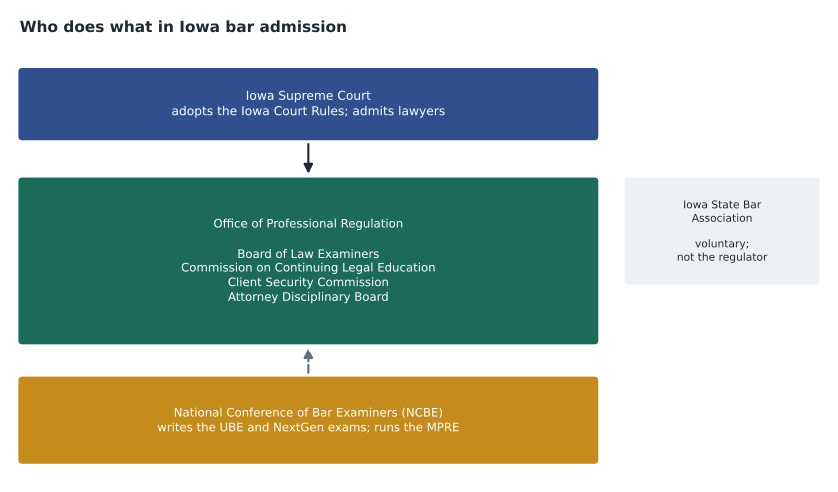
Admission to practice law in Iowa is controlled by the Iowa Supreme Court. Like the highest courts of most states, it treats the regulation of lawyers as part of its constitutional authority over the courts, and it exercises that authority through the Iowa Court Rules. Chapter 31 of those rules governs admission to the bar. When the court changes the admission rules, it does so by order, usually after publishing a proposal for public comment, and it posts the change on the Iowa Judicial Branch website and sends the amended chapter to the legislature's online collection of court rules.
The day-to-day work is done by the Office of Professional Regulation, an office of the Iowa Supreme Court. The office is the administrative home for several boards and commissions that regulate lawyers, including the Board of Law Examiners, the Commission on Continuing Legal Education, the Client Security Commission and the Attorney Disciplinary Board. For applicants, the Board of Law Examiners and its staff matter most. The board receives applications, runs the character and fitness review, gives the bar exam in Polk County, which is the Des Moines area, grades the written portions with Iowa lawyers and recommends successful applicants to the court for admission.
Iowa's arrangement differs from states with a unified bar. In Iowa, membership in the Iowa State Bar Association is voluntary. The association is a private professional organization that offers continuing education, publications and committees, and it has played a large role in debates about the bar exam, but it does not admit anyone and it is not the regulator. The regulator is the court, acting through the Office of Professional Regulation. A new Iowa lawyer pays annual fees and files annual reports with the court's office, not with the voluntary association.
The National Conference of Bar Examiners (NCBE) also plays a part, but it does not admit anyone either. NCBE writes the Uniform Bar Examination components that Iowa gives through February 2027, writes the NextGen exam that Iowa will give starting in July 2027, runs the Multistate Professional Responsibility Examination (MPRE) and scales scores. Iowa's rules allow the board to ask NCBE for a character investigation report in some cases, such as an applicant transferring a score whose application raises substantial concerns, but the decision on character and fitness belongs to the board.
The routes to admission
The Iowa Court Rules offer three main routes. The first is admission by examination: you file an application, pass the Iowa bar exam, earn a scaled score of at least 80 on the MPRE and satisfy the board on character and fitness. The second is admission by transferred score under rule 31.4: if you earned a qualifying Uniform Bar Examination or NextGen score in another jurisdiction recently enough, you can transfer it instead of sitting again. The third is admission on motion under rule 31.12 for lawyers admitted elsewhere who have practiced for at least five of the seven years before applying.
The rules also provide narrower forms of permission to practice: registration as house counsel for lawyers working in-house for an Iowa employer, pro hac vice permission for a single case, licenses for military spouses and limited practice by law students under the student practice rule. Lesson 11 returns to the transfer and motion routes. This course focuses on the examination route, because that is the one Amos is on.
| Route | Where it is in the rules | Who uses it | Key requirement |
|---|---|---|---|
| Admission by examination | Rules 31.1 to 31.3 and related rules | Recent graduates and others without a qualifying score | Pass the Iowa exam (260 on the legacy UBE through February 2027; 610 on NextGen from July 2027); MPRE 80 |
| Transferred score | Rule 31.4 | Applicants who sat a UBE or NextGen exam elsewhere | A qualifying score (260 or 266 legacy, depending on the date; 610 NextGen) earned within the time limit |
| Admission on motion | Rule 31.12 | Lawyers admitted in another US jurisdiction | Practice for five of the seven years before applying |
| House counsel registration | Rules for in-house lawyers | In-house lawyers for an Iowa employer | Admission elsewhere; practice limited to the employer |
The requirements on the examination route
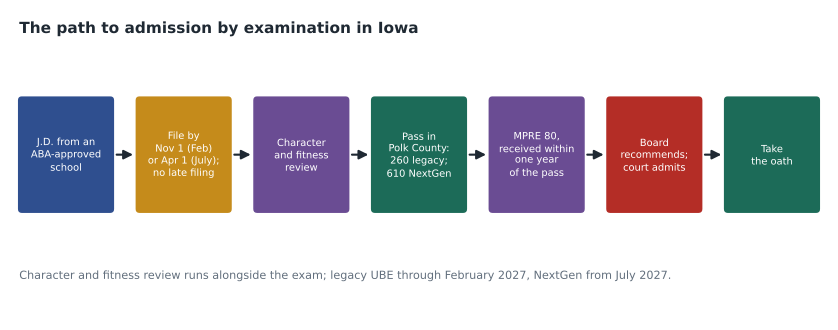
For an applicant seeking admission by examination, the requirements come down to five. You must hold a J.D. from a law school approved by the American Bar Association; NCBE's information for Iowa states that graduates of foreign law schools are not eligible to sit. You must file a complete application by the deadline and pay the fee. You must satisfy the board on character and fitness. You must pass the Iowa bar exam: through February 2027 that means a combined scaled score of at least 260 on the legacy Uniform Bar Examination, and from July 2027 it means a score of at least 610 on the NextGen exam. And you must earn a scaled score of at least 80 on the MPRE, which the board must receive within one year after your bar exam pass is posted. Once the board recommends you and the court approves, you take the attorney's oath, normally in person before a justice of the Iowa Supreme Court.
Look at what is not on the list. Iowa does not add a separate test of Iowa law to the legacy Uniform Bar Examination, and it does not require an Iowa law course before admission. NCBE's jurisdiction information lists no Iowa-specific component for the legacy exam, and for the NextGen exam the question is listed as to be announced. Iowa law still matters a great deal, both because Iowa lawyers will grade your written answers and because you will practice under it from your first day, and Lessons 6 through 10 cover the Iowa law a new lawyer needs most.
Three numbers to remember: 260, 610 and 80
Iowa's passing score on the legacy Uniform Bar Examination was 266 for many years. By an order adopted February 24, 2026, and effective July 1, 2026, the Iowa Supreme Court lowered it to 260 for legacy exams given after July 1, 2026. That covers the July 2026 exam and the February 2027 exam, which is the last legacy administration in Iowa. Rule 31.3 states both numbers, which matters for applicants who sat earlier exams: a score earned on or before July 1, 2026, is measured against 266, and a score earned afterward is measured against 260.
For the NextGen exam, which Iowa first gives in July 2027, the passing score is 610. That is at the low end of the range of 610 to 620 that NCBE recommended to jurisdictions in its November 2025 guidance, and it is the same score chosen by several other early NextGen jurisdictions, including Missouri, New Mexico, North Dakota and Washington. NCBE's guidance treats legacy scores of 260 to 270 as roughly corresponding to NextGen scores of 610 to 620, so Iowa's two numbers, 260 and 610, sit at the same point on the scale.
The MPRE requirement of 80 is in the middle of the national range of 75 to 86. Amos scored 88 on the MPRE in the spring of his third year, so he is clear. Marchetti points out that Iowa's timing rule is generous in one way and strict in another: there is no time limit on how old the MPRE score can be, but the board must receive a passing score within one year after the bar exam pass is posted, or the pass becomes void for purposes of Iowa admission. Lesson 3 explains how to avoid that trap.
The order of events
Most Iowa applicants move through the process in a predictable order. During law school they take the MPRE, usually in the second or third year. In the final year they gather what the application asks for: residence and employment histories, references, records for anything that requires a yes answer on the character questions and proof of graduation. They file through the board's electronic application system by November 1 for the February exam or April 1 for the July exam. Iowa lists no late filing deadline, so a missed deadline means waiting for the next exam. They sit the exam in the Des Moines area, wait for results, and if they pass and have satisfied the board on character and fitness, they are recommended for admission, approved by the court and sworn in.
After admission the obligations continue. A new Iowa lawyer must file an annual report with the Office of Professional Regulation and pay the annual fee, earn fifteen hours of continuing legal education each calendar year, keep client money in a trust account under the court's trust account rules and follow the Iowa Rules of Professional Conduct. Lesson 11 covers those duties.
Worked problem
Planning Amos's path
Amos graduated in May 2026 from an ABA-approved law school in Iowa and scored 88 on the MPRE in his third year. He filed for the February 2027 exam on October 20, 2026. What must he still do before he can be admitted, and what must he do after?
Show solution
- Eligibility: his J.D. is from an ABA-approved school, so he is eligible to sit.
- Filing: he filed before the November 1 deadline; Iowa has no late filing period, so filing early was the right call.
- Character and fitness: he must answer the board's inquiries promptly and keep his answers current until admission.
- MPRE: his 88 exceeds Iowa's 80; he should make sure NCBE reports it to the board, because the board must receive a passing score within one year after his pass is posted.
- Exam: he must earn a combined scaled score of at least 260 on the February 2027 legacy UBE.
- After admission: he takes the oath, files the annual report, pays the annual fee and earns fifteen CLE hours each calendar year.
Answer: Amos needs character and fitness approval and a passing legacy UBE score; his MPRE is done but must be reported; the oath and annual duties follow.
Common mistakes
MistakeThe Iowa State Bar Association admits lawyers.
InsteadThe Iowa Supreme Court admits lawyers, acting through the Board of Law Examiners in its Office of Professional Regulation; the ISBA is a voluntary association.
MistakeIowa's passing score is still 266.
InsteadFor legacy exams given after July 1, 2026, Iowa's passing score is 260; for the NextGen exam from July 2027 it is 610.
MistakeIowa will keep giving the UBE until 2028.
InsteadIowa gives its last legacy UBE in February 2027 and its first NextGen exam in July 2027.
MistakeThere is a late filing period if you miss the deadline.
InsteadNCBE's information for Iowa lists no late filing deadline; missing November 1 or April 1 means waiting for the next exam.
Keeping a single source file
Marchetti asks Amos to keep one document for the whole admission process, which she calls his source file. Every rule he relies on goes in with its citation: rule 31.3 for the exam and passing score, rule 31.4 for transfers, rule 31.12 for admission on motion and the board's published instructions for deadlines and fees. Next to each entry he writes the date he last checked it. When a rule changes, as the passing score did in February 2026, he updates the entry and notes the change, rather than relying on what he remembers from law school or from a classmate.
The habit has a second purpose. The Office of Professional Regulation communicates by email and through its online system, and messages about a file, such as a request for an additional reference or a question about an old traffic matter, have deadlines of their own. Amos files each message in the same document with the date he answered it. If a question about his file ever arises, he can show exactly what he was asked and when he responded. Marchetti calls this the cheapest insurance an applicant can buy, and the most often skipped.
Summary and key terms
- The Iowa Supreme Court controls admission through chapter 31 of the Iowa Court Rules and admits lawyers.
- The Board of Law Examiners, part of the court's Office of Professional Regulation, handles applications, character and fitness and the exam.
- Iowa gives its last legacy UBE in February 2027, with a passing score of 260; the NextGen exam starts in July 2027 with a passing score of 610.
- The MPRE requirement is a scaled score of 80, which the board must receive within one year after the bar pass is posted.
- The main routes are examination, transferred score and admission on motion after five of the last seven years in practice.
- Iowa Court Rules
- The rules adopted by the Iowa Supreme Court; chapter 31 governs admission to the bar.
- Office of Professional Regulation
- The office of the Iowa Supreme Court that houses the boards and commissions regulating lawyers.
- Board of Law Examiners
- The board that reviews applications, gives the bar exam and recommends applicants for admission in Iowa.
- Voluntary bar
- A bar association that lawyers may choose to join; in Iowa, the Iowa State Bar Association.
- Legacy UBE
- The Uniform Bar Examination in its pre-NextGen form, given in Iowa from 2016 through February 2027.
Lesson quiz · 5 questions
Score 60% or more to complete this lesson.
Create a free account to save your progress, take quizzes and earn a certificate.