
BAR-216 · Lesson 12 of 12 · 26 min
Capstone: Iowa practice questions and an exam-day plan
▶ Video coming soon A video version of this lesson is on the way.
On the morning of Saturday, November 21, 2026, Amos sits at his kitchen table in Cedar Rapids with a timer, a legal pad and a set of questions Marchetti wrote for him. Half test the general law that the February exam will test. The other half test the Iowa rules he will use the week he is sworn in. 'The point,' she told him when she sent them, 'is to practice switching. On the exam you answer from the general law. In the office you answer from the Iowa Code. You need to know which hat you are wearing before you read the first sentence.'
This capstone gathers the course into practice. It begins with ten original multiple-choice questions, each followed by an explanation, then one original essay question with a model outline, and ends with a plan for the weeks before the February 23 and 24, 2027 exam and for the two exam days in Des Moines. Work the questions under time before reading the explanations.
Part one: ten practice questions
Each question below is labeled with the source of law it tests. Questions marked exam rule should be answered from the general law and the NCBE defaults, as on the legacy UBE. Questions marked Iowa practice should be answered from the Iowa rules covered in this course. Allow about two minutes for each question.
Practice problems
Work each problem on paper first, then reveal the answer to check.
Question 1 (exam rule). A pedestrian crossing against a light is struck by a speeding driver. The jury finds the pedestrian 60 percent at fault and the driver 40 percent at fault, with damages of 50,000 dollars. The question does not state the jurisdiction's comparative fault rule. How much does the pedestrian recover?
Show answer
20,000 dollars. On the MBE, unless the question says otherwise, assume pure comparative negligence, so the pedestrian recovers 40 percent of 50,000 dollars. Under Iowa's chapter 668, she would recover nothing, but that is not the tested rule.
Question 2 (Iowa practice). The same facts arise in Iowa district court in Linn County. How much does the pedestrian recover?
Show answer
Nothing. Under Iowa Code section 668.3, a claimant whose fault is greater than the combined fault of the parties against whom recovery is sought is barred. Sixty percent is greater than forty percent.
Question 3 (Iowa practice). A jury finds a plaintiff 10 percent at fault, defendant A 55 percent and defendant B 35 percent. Damages are 100,000 dollars: 40,000 economic and 60,000 noneconomic. A is insolvent. What can the plaintiff collect from B?
Show answer
35,000 dollars. B is less than 50 percent at fault, so under section 668.4 B is only severally liable for its own 35 percent share of all damages. If B had been 55 percent at fault and A 35 percent, B could have been made to pay all of the economic damages, reduced by the plaintiff's share, plus its own share of the noneconomic damages.
Question 4 (exam rule). In a federal diversity case, a defendant moves to dismiss a complaint that alleges, in conclusory terms, that the defendant conspired to restrain trade, without facts suggesting an agreement. Under the Federal Rules of Civil Procedure, how should the court rule?
Show answer
Grant the motion. Under the plausibility standard of Twombly and Iqbal, conclusory allegations are not enough; the complaint must plead facts that make the claim plausible. An Iowa state court applying notice pleading might rule differently, but the exam tests the federal standard.
Question 5 (Iowa practice). A client wants to appeal a final judgment of the Polk County District Court. Where does the notice of appeal go, and which court will decide the appeal?
Show answer
The appeal is taken to the Iowa Supreme Court under the Iowa Rules of Appellate Procedure, generally within thirty days of the final judgment. The Supreme Court will either retain the case or transfer it to the Court of Appeals; a party who loses there may seek further review.
Question 6 (exam rule, MPRE). A lawyer receives a 5,000-dollar advance fee and deposits it in the firm's operating account, intending to bill against it. Under the ABA Model Rules, is this proper?
Show answer
No. An advance fee belongs to the client until earned and must be deposited in a client trust account and withdrawn only as earned under Model Rule 1.15. Iowa rule 32:1.15 is to the same effect.
Question 7 (Iowa practice). A landowner wants to end an oral farm lease with a tenant who has rented the ground for six years. It is August 15. What must she do, and when will the tenancy end?
Show answer
She must serve written notice of termination on the tenant by September 1, in the manner chapter 562 requires. If she does, the tenancy ends on March 1 of the following year. If she misses September 1, the lease renews for another year.
Question 8 (Iowa practice). A lawyer passed the legacy UBE in Minnesota in July 2025 with a score of 264 and has not practiced. In November 2026 she applies to transfer the score to Iowa. Will the score qualify?
Show answer
No. For a legacy exam given on or before July 1, 2026, rule 31.4 requires 266. Her score is less than two years old, so timing is not the problem; the score is. Had she sat after July 1, 2026, 260 would have sufficed.
Question 9 (exam rule). A testator signs a typed will in front of one witness, who signs. A second witness signs the next day, outside the testator's presence. Under a typical attested-will statute requiring two witnesses who sign in the testator's presence, is the will valid?
Show answer
No. The second witness did not sign in the testator's presence. On the exam, apply the formalities stated in the question or the general rule. Iowa's chapter 633 also requires two witnesses signing in the testator's presence and in each other's presence, so the result is the same in Iowa.
Question 10 (Iowa practice). A client was injured when a city snowplow struck her parked car and pushed it into her. She wants to sue the city for compensatory and punitive damages. What statute governs, and what limits should the lawyer flag?
Show answer
The Iowa Municipal Tort Claims Act, chapter 670, governs. The lawyer should check the immunities in section 670.4, including those relating to snow and ice removal and discretionary functions, calendar the limitation period and any notice of claim, and tell the client that punitive damages are not available against a municipality. Comparative fault under chapter 668 also applies.
Score yourself. Marchetti's rule of thumb is that seven or more right on the first attempt means the switch between exam rules and Iowa rules has become a habit. Fewer than seven means more practice with the Iowa divergence list from Lesson 6 before each MBE set.
Part two: an original essay question
Allow thirty minutes. Write an answer as you would on the MEE, applying the general law of business associations and agency, and then add a short note on any Iowa rules that a practicing Iowa lawyer would also check.
Facts. Three friends, Rosalind, Theo and Wen, open a coffee roastery in Ames without signing any agreement. They share profits equally and each works in the business. Theo, without telling the others, signs a two-year lease for a second location in Ankeny in the roastery's name. Rosalind and Wen learn of the lease a month later and refuse to honor it. The landlord sues all three for unpaid rent. Separately, Wen, while driving the roastery's van to make a delivery, runs a red light and injures a cyclist.
Questions. First, what kind of business entity have the three formed, and what are its consequences? Second, is the roastery bound by the Ankeny lease, and are the three personally liable on it? Third, who is liable to the injured cyclist?
Model outline. First, by carrying on as co-owners a business for profit, the three have formed a general partnership, whether or not they intended to, under the Revised Uniform Partnership Act. Profit sharing raises a presumption of partnership. Each partner is an agent of the partnership for apparently carrying on in the ordinary course its business, and partners are jointly and severally liable for partnership obligations, subject to the rule that a creditor generally must first exhaust partnership assets.
Second, Theo had no actual authority to sign the lease, because the others did not agree. Whether the partnership is bound depends on apparent authority: whether signing a lease for a second location is apparently carrying on the business in the ordinary course, and whether the landlord knew or had notice that Theo lacked authority. A good answer argues both sides: opening a new location is arguably an extraordinary act requiring the consent of all partners, but a landlord dealing with a partner who signs in the business's name may reasonably believe the partner has authority. If the partnership is bound, all three are personally liable, subject to exhaustion; Theo may owe the others indemnity for exceeding his authority.
Third, the partnership is liable for Wen's tort, because she was acting in the ordinary course of partnership business when she made the delivery, and the partners are jointly and severally liable for that obligation as well. Wen is personally liable as the tortfeasor. The cyclist's recovery may be reduced under the jurisdiction's comparative fault rule if the cyclist was also at fault.
Iowa note. Iowa has adopted the Uniform Partnership Act in chapter 486A of the Iowa Code, so the general analysis applies in Iowa practice. A practicing lawyer would add that Iowa's chapter 668 applies to the cyclist's claim, so a cyclist more at fault than the defendants combined recovers nothing, and that the partners might consider converting the business to a limited liability company under chapter 489 or registering as a limited liability partnership to limit future personal liability.
Part three: the exam-day plan
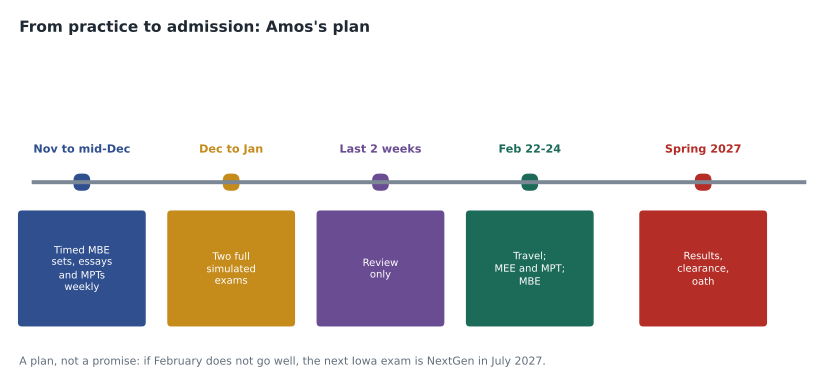
Marchetti's plan for Amos covers three periods: the weeks before the exam, the two exam days and the period after. It is written as a plan, not a promise. Things will go wrong, and the plan includes what to do when they do.
| When | What to do |
|---|---|
| Now to mid-December | Two timed MBE sets of 50 a week; two timed MEE essays a week; one MPT a week; review the Iowa divergence list before each MBE set |
| Mid-December to late January | Two full simulated exams on consecutive days; increase MEE and MPT practice; reduce clerk hours as the firm allows |
| Last two weeks | Review outlines and error logs; no new material; confirm laptop software, admission instructions and hotel |
| February 22, 2027 | Drive to Des Moines before the weather turns; check the route to the test site; light review; early night |
| February 23, 2027 | MEE in the morning, six essays in three hours; MPT in the afternoon, two tasks in three hours; do not discuss answers at lunch |
| February 24, 2027 | MBE in two sessions of 100 questions; pace at about 1.8 minutes per question; mark and move on |
| After the exam | Rest; respond promptly to any character and fitness inquiries; return to work; wait for results |
On the two days
Marchetti's advice for the exam days is practical. Bring only what the admission instructions allow, and bring all of it: the admission ticket, identification, the laptop with the exam software tested, and any permitted items. Eat breakfast. Arrive early enough that a slow security line does not cost writing time. On the MEE, read each question's call before the facts, outline for five minutes, write for twenty-five and move on when the time is up, even mid-sentence. On the MPT, spend about forty-five minutes reading and organizing and the rest writing, and follow the task memo's format exactly.
On the MBE, keep a steady pace and do not let a hard question consume the time for three easier ones. Answer every question, because there is no penalty for wrong answers. At the start of each set, remind yourself of the defaults: pure comparative negligence, joint and several liability, the Federal Rules. Iowa's rules can wait until Thursday morning at the office.
If something goes wrong, such as a software problem, a fire alarm or an illness, tell the proctors immediately and follow their instructions. Problems reported at the time can often be addressed; problems mentioned for the first time after the exam rarely can.
After the exam
Results for the February exam are typically released in the spring. If Amos passes, he will finish character and fitness, take the oath, file his first annual report and start earning CLE hours. If he does not pass, his next Iowa exam will be the NextGen exam in July 2027, with a filing deadline of April 1, and he will need to prepare for a different format. Marchetti does not dwell on that possibility, but she makes sure he knows it, so that the deadline does not come as a surprise.
Worked problem
A final self-check
The evening of the capstone, Amos reviews his results: eight of ten multiple-choice questions right, including all five Iowa practice questions, and a solid essay that missed the exhaustion rule. What should he do with the next three weeks?
Show solution
- Eight of ten shows the switch between exam rules and Iowa rules is working.
- Both misses were exam-rule questions, so the next weeks should weight general law practice over Iowa review.
- The essay miss suggests rewriting his business associations checklist to include exhaustion and indemnity.
- He should keep the schedule in the plan and add one extra MEE business associations essay a week.
Answer: Keep the plan, weight practice toward general law and fix the business associations checklist.
Common mistakes
MistakeIowa practice knowledge should be used to answer exam questions.
InsteadOn the exam, answer from the general law, NCBE defaults or any rule stated in the question.
MistakeThe last two weeks are for learning new material.
InsteadUse them for review of outlines and error logs, and for logistics.
MistakeProblems on exam day can be raised after the exam.
InsteadReport problems to the proctors immediately.
MistakeFailing in February means retaking the same exam in July.
InsteadIowa's July 2027 exam is NextGen, with an April 1 filing deadline and a different format.
Summary and key terms
- Label each question as exam rule or Iowa practice before answering.
- The exam uses pure comparative negligence and federal rules; Iowa uses chapter 668 and the Iowa rules.
- Practice under time: MBE sets, MEE essays and MPTs weekly, with two full simulations before the exam.
- On exam day, follow the admission instructions, keep pace and report problems at once.
- After the exam, finish character and fitness and prepare for the oath; a retake in Iowa would be NextGen.
- Exam rule
- The general law or NCBE default that a bar exam question tests.
- Iowa practice rule
- The Iowa statute or court rule that governs the same issue in an Iowa case.
- Simulated exam
- A full-length practice exam taken under timed exam conditions.
- Error log
- A record of practice questions missed and why, used to target review.
- Exhaustion rule
- The rule that a partnership creditor generally must first pursue partnership assets before a partner's personal assets.
Lesson quiz · 5 questions
Score 60% or more to complete this lesson.
Create a free account to save your progress, take quizzes and earn a certificate.