
BAR-216 · Lesson 8 of 12 · 15 min
Iowa tort law: comparative fault under chapter 668 and claims against government
▶ Video coming soon A video version of this lesson is on the way.
The first case Lorna Pettit hands Amos after the bar results come out will almost certainly be a tort case. Her firm in Cedar Rapids does a steady business in car crashes, falls and farm injuries, and many of those cases involve more than one party at fault, and some involve a city or a county. 'In Iowa,' she tells him, 'you cannot value a tort case until you have done two things: put a percentage of fault on everybody, including your own client, and checked whether a government is involved. Get either wrong and the case is worth nothing.'
This lesson covers the parts of Iowa tort law that new lawyers meet first: Iowa's comparative fault act in chapter 668 of the Iowa Code, the limits on joint and several liability, and the statutes that govern claims against the state and local governments. As Lesson 6 explained, the legacy UBE does not test these Iowa rules. They matter for practice, and they are the clearest example of why an Iowa clerk must answer exam questions from the general law rather than from habit.
From contributory negligence to comparative fault
Iowa once followed the common law rule of contributory negligence, under which any negligence by the plaintiff barred recovery. In Goetzman v. Wichern, decided in 1982, the Iowa Supreme Court abandoned that rule and adopted pure comparative negligence by judicial decision. Two years later the legislature replaced the court's rule with the Comparative Fault Act, now chapter 668 of the Iowa Code, which adopted a modified form of comparative fault. The statute, not the 1982 decision, governs today.
Chapter 668 uses the word fault broadly. Fault includes negligent or reckless acts and omissions, conduct that subjects a person to strict tort liability, breach of warranty, unreasonable assumption of risk not constituting an enforceable express consent, misuse of a product and unreasonable failure to avoid an injury or to mitigate damages. All of these are compared in a single allocation, so a jury can weigh a negligent driver against a manufacturer whose product was defective and a plaintiff who was not wearing proper safety equipment.
The greater-than rule
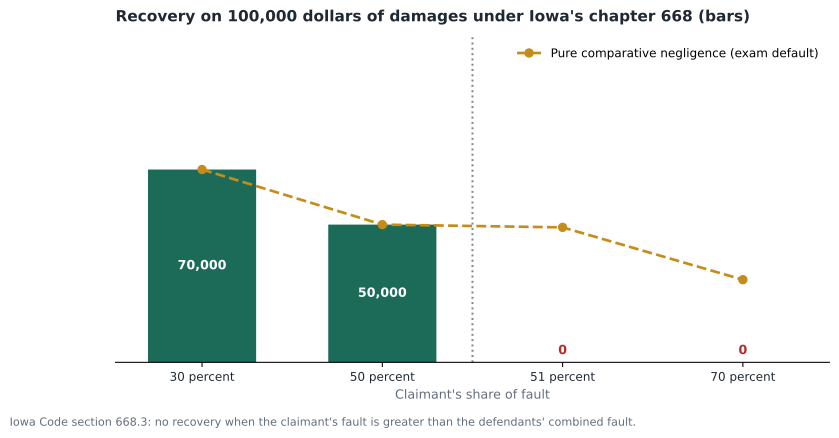
Under section 668.3, a claimant's contributory fault does not bar recovery unless the claimant bears a greater percentage of fault than the combined percentage of fault of the parties against whom recovery is sought. Any damages the claimant does recover are reduced in proportion to the claimant's share of fault. Iowa's threshold is therefore commonly described as a 51 percent bar: a claimant who is 50 percent at fault still recovers half of the damages, but a claimant who is 51 percent at fault recovers nothing.
Two features of the rule deserve attention. First, the claimant's fault is compared with the combined fault of the defendants, not with each defendant separately. A plaintiff 40 percent at fault can recover from two defendants each found 30 percent at fault, even though the plaintiff's fault exceeds each one's individually. Second, the jury makes the allocation by answering special interrogatories that ask for each party's percentage, and the court then applies the statute to those findings. Iowa juries are told the effect of their percentages, so they know that a finding above 50 percent will bar the claimant.
Joint and several liability
At common law, each defendant whose negligence caused an indivisible injury was jointly and severally liable for the whole of it, so a plaintiff could collect the entire judgment from any one of them. Chapter 668 limits that rule. Under section 668.4, a defendant found to bear less than 50 percent of the total fault is liable only for its own share of the damages. A defendant found to bear 50 percent or more of the fault is jointly and severally liable, but only for economic damages; for noneconomic damages, such as pain and suffering, every defendant pays only its own share.
The limit matters most when one defendant cannot pay. Suppose a driver with minimum insurance and a city that failed to repair a stop sign are both at fault. If the driver is 60 percent at fault and insolvent and the city is 40 percent at fault, the city pays only its 40 percent share, and the plaintiff bears the loss of the driver's unpaid share. If the city were 60 percent at fault, it could be made to pay the full economic damages, though still only its share of noneconomic damages. Iowa lawyers therefore spend considerable effort building the fault case against the defendant who can pay.
| Defendant's share of total fault | Economic damages | Noneconomic damages |
|---|---|---|
| Less than 50 percent | Several only: own share | Several only: own share |
| 50 percent or more | Joint and several: may be liable for all | Several only: own share |
Allocating fault to others
Chapter 668 allows fault to be allocated among the claimants, the defendants, third-party defendants and persons who have been released by the claimant. Fault is not allocated to persons who were never parties and were not released. When a plaintiff settles with one defendant before trial, the jury still assigns that released party a percentage, and the remaining defendants' liability is reduced by the released party's share rather than by the dollar amount of the settlement. Iowa practitioners call this the pro rata credit, and it shapes settlement strategy: a plaintiff who settles cheaply with a defendant who turns out to be heavily at fault loses that defendant's whole share.
Claims against the state: the Iowa Tort Claims Act
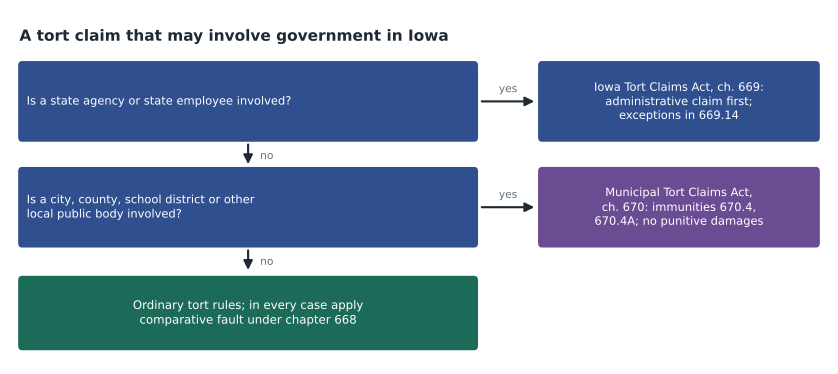
Sovereign immunity once barred tort suits against the State of Iowa. The Iowa Tort Claims Act, chapter 669 of the Iowa Code, waives that immunity for claims arising from the negligent or wrongful acts of state employees acting within the scope of their employment, subject to a list of exceptions. A claimant must first present the claim administratively to the state, through the state appeal board, before suing, and suits are tried to the court rather than to a jury. The exceptions, found in section 669.14, include claims based on the exercise of a discretionary function, certain intentional torts and claims arising from specific government activities. The act sets its own time limits, which a lawyer must check against the current statute when a file is opened.
Claims against cities, counties and school districts
The Iowa Municipal Tort Claims Act, chapter 670 of the Iowa Code, governs tort claims against municipalities, a term the act defines to include cities, counties, townships, school districts and many other local public bodies. The act makes every municipality subject to liability for its torts and those of its officers and employees acting within the scope of their employment or duties, except as the act provides otherwise.
Section 670.4 lists the claims for which a municipality is not liable. They include claims based on the exercise or performance of a discretionary function, whether or not the discretion is abused; claims based on an act or omission of an officer or employee exercising due care in carrying out a statute or ordinance; and a series of specific exemptions, such as certain claims involving snow and ice removal on public ways and claims arising from the failure to make an inspection. In 2021 the legislature added section 670.4A, which gives municipal employees qualified immunity from certain claims for damages, including claims under the Iowa Constitution, unless the right was clearly established, and imposes heightened pleading requirements for such claims.
Chapter 670 also contains procedural rules. The act sets a limitation period for actions against municipalities, and a claimant who files a written notice of claim with the municipality may in some circumstances gain additional time. Damages against a municipality are not subject to punitive awards. Because these rules have been amended several times, Pettit's firm keeps a one-page checklist for every government claim, updated each year after the legislative session.
Damages limits
Iowa caps some damages by statute. Medical malpractice actions are subject to a cap on noneconomic damages, which the legislature revised in 2023 to set different limits for claims against hospitals and other providers and to provide exceptions for certain serious injuries. In 2023 the legislature also limited noneconomic damages in certain actions against commercial motor vehicle operators. Punitive damages are governed by section 668A.1, which requires proof by a preponderance of clear, convincing and satisfactory evidence that the defendant's conduct showed willful and wanton disregard for the rights or safety of another, and which may direct a share of a punitive award to a civil reparations trust fund. As with the government claim rules, the numbers change, and a lawyer should read the current statute rather than rely on a figure remembered from law school.
Worked problem
Allocating fault with an insolvent driver
Pettit's client was hit at an intersection where the county had let a stop sign fall. The jury finds the client 20 percent at fault, the other driver 50 percent and the county 30 percent. Damages are 200,000 dollars: 80,000 economic and 120,000 noneconomic. The driver has no assets. What can the client collect from the county?
Show solution
- The client's 20 percent is not greater than the defendants' combined 80 percent, so recovery is allowed, reduced by 20 percent.
- The county, at 30 percent, is below 50 percent, so under section 668.4 it is liable only for its own share.
- The county's share is 30 percent of 200,000 dollars: 60,000 dollars.
- Before collecting, the firm must have complied with chapter 670's procedures and confirmed that no immunity in section 670.4 applies.
Answer: The client can collect 60,000 dollars from the county; the driver's 100,000-dollar share is likely uncollectible.
Common mistakes
MistakeIowa follows pure comparative negligence because of Goetzman v. Wichern.
InsteadGoetzman adopted pure comparative negligence in 1982, but the 1984 Comparative Fault Act replaced it with Iowa's modified greater-than rule.
MistakeA claimant must be less at fault than each defendant.
InsteadThe claimant's fault is compared with the combined fault of the parties against whom recovery is sought.
MistakeAny defendant can be made to pay the whole judgment.
InsteadOnly a defendant 50 percent or more at fault is jointly and severally liable, and only for economic damages.
MistakeA city is immune from all tort suits.
InsteadChapter 670 makes municipalities liable except as it provides, with specific immunities such as the discretionary function exception.
Settlement strategy under chapter 668
Because Iowa limits joint and several liability, settlement decisions in multi-defendant cases require care. A plaintiff who settles with one defendant releases that defendant, and the jury will still allocate a percentage of fault to the released party. The remaining defendants' liability is then reduced by that percentage. If the released party turns out to be heavily at fault, the plaintiff may recover much less from the others than expected. Plaintiffs' lawyers therefore try to estimate each party's likely share before settling, and defense lawyers for the remaining defendants often try to shift fault to the settled party at trial.
The same rules affect defendants. A defendant whose share is likely to be below 50 percent has a strong position, because it cannot be made to pay for others. A defendant whose share may reach 50 percent faces exposure for the economic damages of the whole case. That threshold often drives settlement value, and Iowa lawyers on both sides spend much of their case preparation on the evidence that will move a defendant's share above or below it.
Workers' compensation and third parties
Many Iowa injuries happen at work, on farms, in factories and on construction sites. Iowa's workers' compensation law, chapter 85 of the Iowa Code, generally makes compensation the exclusive remedy against the employer, but an injured worker may also sue third parties, such as the manufacturer of defective equipment or another contractor on the site. In those suits chapter 668 applies, and the employer's workers' compensation carrier usually has a lien on the recovery. New Iowa lawyers handling injury cases should check for a workers' compensation claim at the first meeting with the client.
Recreational and agricultural immunities
Iowa's statutes also limit liability in specific settings important to a rural state. A landowner who opens land to the public for recreational purposes without charge is protected from most negligence claims by the user, under chapter 461C. Iowa also limits the liability of persons involved in domesticated animal activities, such as horseback riding, under chapter 673. These statutes have exceptions, including for willful or malicious conduct and for charges to the user, and their scope has been litigated. Pettit's firm reviews them in every case involving an injury on farmland, at a stable or on a recreational trail.
Dram shop liability
Iowa's dram shop statute, section 123.92, allows a person injured by an intoxicated person to sue a licensee or permittee who sold and served alcohol to that person when the licensee knew or should have known the person was intoxicated, or who sold to a person to the point of intoxication. The statute has its own notice requirements, and the licensee's liability is subject to the comparative fault rules. Social hosts who serve adults are generally not liable under Iowa law, though limited liability exists for serving minors. These claims often appear alongside car crash cases in Iowa practice.
Summary and key terms
- Iowa's Comparative Fault Act, chapter 668, bars a claimant whose fault is greater than the combined fault of the defendants.
- Recovery is reduced by the claimant's share; a claimant 50 percent at fault still recovers half.
- A defendant less than 50 percent at fault pays only its share; a defendant at 50 percent or more is jointly and severally liable for economic damages only.
- Claims against the state go through the Iowa Tort Claims Act, chapter 669, starting with an administrative claim.
- Claims against municipalities fall under chapter 670, with immunities in sections 670.4 and 670.4A and no punitive damages.
- Comparative fault
- A system that reduces a claimant's recovery by the claimant's share of fault.
- Greater-than rule
- Iowa's rule barring a claimant whose fault exceeds the combined fault of the defendants.
- Several liability
- Liability limited to a defendant's own share of the damages.
- Pro rata credit
- A reduction of the remaining defendants' liability by a released party's share of fault.
- Discretionary function exception
- Immunity for government decisions involving the exercise of policy judgment.
Lesson quiz · 5 questions
Score 60% or more to complete this lesson.
Create a free account to save your progress, take quizzes and earn a certificate.