
BAR-216 · Lesson 9 of 12 · 16 min
The Iowa Constitution and the Iowa Rules of Professional Conduct
▶ Video coming soon A video version of this lesson is on the way.
Two documents sit on the corner of Lorna Pettit's desk, both worn soft at the spine: a pocket copy of the Iowa Constitution and a printout of chapter 32 of the Iowa Court Rules, the Iowa Rules of Professional Conduct. 'The first one tells you what the government cannot do to your client,' she says. 'The second tells you what you cannot do to your client, or for your client. You will open the second one more often.'
This lesson covers both. It gives an overview of the Iowa Constitution and of the way the Iowa Supreme Court has interpreted it, both independently of and alongside the federal Constitution. It then turns to the Iowa Rules of Professional Conduct: how they relate to the ABA Model Rules that the MPRE tests, how lawyer discipline works in Iowa and the trust account and reporting rules that new Iowa lawyers must follow from their first day.
The Iowa Constitution
Iowa's current constitution was adopted in 1857, eleven years after statehood, and it has been amended many times since. Article I, the Bill of Rights, protects many of the same rights as the federal Bill of Rights, often in similar words: freedom of speech and of the press, free exercise of religion, protection against unreasonable searches and seizures, due process and the rights of the accused. Other articles establish the legislative, executive and judicial departments, set rules for elections and taxation and govern amendment.
Iowa's constitution can be amended in two ways. The usual route is legislative: a proposed amendment must be agreed to by two successive general assemblies and then approved by the voters. The constitution also requires that the question of calling a constitutional convention be put to voters every ten years. In November 2022, voters approved an amendment adding a right to keep and bear arms to article I and directing that any restriction on that right be subject to strict scrutiny.
Independent interpretation
State courts may interpret their own constitutions to give more protection than the federal Constitution provides, though not less where federal law sets a floor. The Iowa Supreme Court has done so in several areas. Varnum v. Brien, decided in 2009 and discussed in Lesson 7, rested entirely on the Iowa Constitution's equal protection guarantee, six years before the United States Supreme Court reached the same result under the federal Constitution. In criminal procedure, the court held in State v. Ochoa in 2010 that the Iowa Constitution's search and seizure clause did not permit a suspicionless search of a parolee's motel room, and in State v. Short in 2014 it required a warrant for the search of a probationer's home.
The court's approach has changed over time, and the same court can move in different directions. In Godfrey v. State in 2017, the court recognized a damages claim directly under certain provisions of the Iowa Constitution. In Burnett v. Smith in 2023, it overruled Godfrey, holding that the Iowa Constitution does not itself create a damages remedy and that such remedies are for the legislature. The legislature had already acted in 2021 by adding qualified immunity and heightened pleading rules for constitutional claims against government employees, as Lesson 8 noted. An Iowa lawyer who raises a state constitutional claim must therefore research the current state of the law carefully and should brief the Iowa provision separately rather than assume it tracks the federal one.
For the bar exam, the Iowa Constitution is not tested. The MBE and MEE test federal constitutional law. But the habit of separating state and federal grounds is useful on the NextGen exam's skills questions and in practice, where an argument under the Iowa Constitution may survive even when a federal argument fails.
The Iowa Rules of Professional Conduct
The Iowa Rules of Professional Conduct, chapter 32 of the Iowa Court Rules, govern the conduct of Iowa lawyers. The Iowa Supreme Court adopted them effective July 1, 2005, replacing the older Iowa Code of Professional Responsibility for Lawyers, and based them closely on the ABA Model Rules of Professional Conduct. The rules use the Model Rules' structure, with an Iowa chapter prefix: Iowa rule 32:1.7 corresponds to Model Rule 1.7 on concurrent conflicts, rule 32:1.6 to Model Rule 1.6 on confidentiality and so on. The court has amended the rules from time to time, often to follow changes in the Model Rules.
Because the Iowa rules follow the Model Rules so closely, an applicant who studies the Model Rules for the MPRE learns most of Iowa's rules at the same time. The MPRE tests the Model Rules, the ABA Model Code of Judicial Conduct and generally accepted principles, not the Iowa rules, so where Iowa differs the exam answer follows the Model Rules. The differences that do exist tend to be in comments, in specific provisions on advertising and solicitation, in the details of trust account administration and in procedural rules elsewhere in the Iowa Court Rules. New Iowa lawyers should read the Iowa version of any rule before relying on it in practice.
| Topic | Where to look in Iowa | Exam source |
|---|---|---|
| Conduct rules | Iowa Rules of Professional Conduct, chapter 32 | ABA Model Rules on the MPRE |
| Discipline procedure | Iowa Court Rules, chapters 34 and 35 | Not tested |
| Trust accounts | Rule 32:1.15 and chapter 45 of the Iowa Court Rules | Model Rule 1.15 on the MPRE |
| Client Security reporting and fee | Chapter 39 of the Iowa Court Rules | Not tested |
| Judicial conduct | Iowa Code of Judicial Conduct, chapter 51 | ABA Model Code of Judicial Conduct on the MPRE |
Lawyer discipline in Iowa
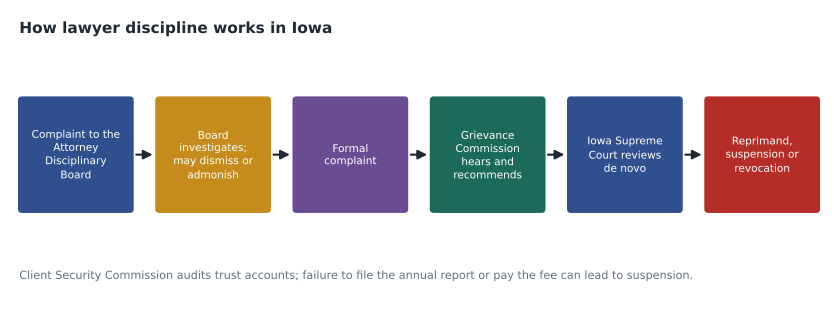
Discipline in Iowa follows a three-step structure. The Iowa Supreme Court Attorney Disciplinary Board, part of the Office of Professional Regulation, receives complaints, investigates and decides whether to file a formal complaint. Formal complaints are heard by a division of the Grievance Commission, a body of lawyers and nonlawyers appointed by the court, which takes evidence, makes findings and recommends a sanction. The Iowa Supreme Court then reviews the record de novo and decides on the discipline, which may range from a public reprimand through suspension to revocation of the license. The board may also issue private admonitions for minor misconduct without a formal complaint.
The court's disciplinary opinions are published, and they are a practical guide to how the Iowa rules are applied. Common grounds for discipline in Iowa, as elsewhere, include neglect of client matters, failure to communicate, trust account violations, conflicts of interest and dishonesty. Iowa opinions repeatedly emphasize that misappropriation of client funds usually leads to revocation, and that a lawyer who fails to cooperate with the board's investigation commits a separate violation.
Trust accounts and annual reporting
Iowa lawyers who hold client or third-party funds must keep them in a trust account that meets the requirements of rule 32:1.15 and chapter 45 of the Iowa Court Rules. Funds that are nominal in amount or held for a short time go into a pooled interest-bearing account, an IOLTA account, whose interest supports civil legal aid through the Iowa Lawyer Trust Account Commission. Larger amounts held for longer periods go into separate interest-bearing accounts for the client's benefit. Lawyers must keep detailed records, reconcile their accounts regularly and never mix their own money with client money except as the rules allow, for example to cover bank charges.
Every Iowa lawyer must also file an annual report and pay an annual fee through the Office of Professional Regulation. The report covers matters such as the lawyer's trust accounts, malpractice insurance coverage and CLE compliance, and the fee supports the Client Security Commission, which reimburses clients for losses caused by lawyer dishonesty, and the disciplinary system. The Client Security Commission also conducts random and targeted audits of trust accounts. A lawyer who fails to file the report or pay the fee by the deadline may be suspended by court order until the default is cured.
Rules that matter in the first year
Pettit's list for new lawyers at her firm is short. Read rule 32:1.1 on competence and accept only the work you can do or learn to do. Communicate with clients under rule 32:1.4, which is the rule most often violated in Iowa disciplinary cases involving neglect. Put every fee agreement in writing, which is required for contingent fees under rule 32:1.5. Run a conflict check before every new matter. Deposit every retainer in trust until it is earned. And if you make a mistake, tell the client and tell a partner the same day.
Worked problem
A retainer and a trust account
A new client pays Amos 3,000 dollars as an advance fee for a probate matter, to be billed hourly against the advance. Amos is busy and deposits the check in the firm's operating account, planning to bill against it at the end of the month. Has he violated the Iowa rules, and what would the MPRE answer be?
Show solution
- An advance fee remains the client's property until it is earned.
- Rule 32:1.15, like Model Rule 1.15, requires unearned fees to be deposited in a client trust account and withdrawn only as earned.
- Depositing the advance in the operating account commingles client funds with firm funds, a violation in Iowa and under the Model Rules.
- Amos should move the funds to trust immediately and tell his supervising partner; the Client Security Commission's audits would likely detect the error.
Answer: Yes, both under rule 32:1.15 and under Model Rule 1.15, which the MPRE tests.
Common mistakes
MistakeThe MPRE tests the Iowa Rules of Professional Conduct.
InsteadThe MPRE tests the ABA Model Rules; the Iowa rules are closely based on them but are not tested.
MistakeThe Iowa Constitution always tracks the federal Constitution.
InsteadThe Iowa Supreme Court has sometimes read it more broadly, as in Varnum, Ochoa and Short.
MistakeIowa recognizes damages claims directly under the Iowa Constitution.
InsteadBurnett v. Smith (2023) overruled Godfrey v. State (2017) and held that the constitution does not itself create a damages remedy.
MistakeThe Grievance Commission decides Iowa discipline cases.
InsteadThe commission recommends; the Iowa Supreme Court reviews de novo and imposes discipline.
Briefing a state constitutional claim
When an Iowa lawyer raises a claim under the Iowa Constitution, the Iowa Supreme Court expects the argument to be made separately and specifically. A brief that cites the Iowa and federal provisions together and argues only federal cases may be treated as raising only a federal claim, or as inviting the court to interpret the Iowa provision the same way. A stronger brief explains why the Iowa provision should be read differently, drawing on its text, its history, the court's own precedents and decisions of other state courts. Iowa law students learn this method in courses on state constitutional law, and practitioners use it in criminal appeals in particular.
Conflicts in a small community
Conflicts of interest are a constant concern for lawyers in small Iowa towns, where the lawyer may know both sides of a dispute and may have represented members of the same family in different matters. Rule 32:1.7 prohibits representation involving a concurrent conflict unless the lawyer reasonably believes the representation will not be adversely affected and each affected client gives informed consent, confirmed in writing. Rule 32:1.9 protects former clients. Pettit's firm keeps a database of every client and adverse party it has ever had and runs every new matter through it, including the names of family members and businesses involved.
Family farm matters raise particular conflict questions. A lawyer asked to prepare a succession plan for parents who own a farm with one child who works it and two who do not must decide whom the lawyer represents. Joint representation of family members is possible, but the lawyer must explain the risks, including that confidences may not be kept among the clients and that the lawyer may have to withdraw if interests diverge. Many Iowa lawyers document the scope of representation in a written engagement letter that names the clients and explains these issues at the outset.
Advertising and the internet
The Iowa Rules of Professional Conduct regulate lawyer advertising and solicitation in rules 32:7.1 through 32:7.5. The central rule, like Model Rule 7.1, forbids false or misleading communications about a lawyer's services. Iowa historically had more detailed advertising rules than the Model Rules, and the court has revised them over time. A new lawyer setting up a website, a social media presence or a directory listing should read the current Iowa rules before publishing, and should take particular care with statements about past results, specializations and client testimonials.
Reporting misconduct
Rule 32:8.3 requires an Iowa lawyer who knows that another lawyer has committed a violation that raises a substantial question about that lawyer's honesty, trustworthiness or fitness to report it to the appropriate authority, subject to exceptions for confidential information and for information gained through lawyer assistance programs. The rule tracks Model Rule 8.3, which the MPRE tests. In Iowa, reports go to the Attorney Disciplinary Board.
The Iowa Lawyers Assistance Program
The Iowa Lawyers Assistance Program provides confidential support to lawyers, judges and law students facing substance use, mental health, stress or other personal concerns. Communications with the program are protected, and seeking its help does not trigger a report to the Attorney Disciplinary Board. Pettit gives every new lawyer at her firm the program's contact information on the first day and tells them that using it is a sign of good judgment.
Summary and key terms
- The Iowa Constitution of 1857 can be read to give more protection than the federal Constitution, as in Varnum v. Brien.
- Burnett v. Smith (2023) held that the Iowa Constitution does not itself create a damages remedy.
- The Iowa Rules of Professional Conduct, chapter 32, are closely based on the ABA Model Rules, which the MPRE tests.
- Discipline runs from the Attorney Disciplinary Board through the Grievance Commission to the Iowa Supreme Court.
- Iowa lawyers must keep trust accounts under rule 32:1.15 and chapter 45 and file an annual report with the Office of Professional Regulation.
- Independent state grounds
- A decision resting on a state constitution, which can give more protection than the federal Constitution.
- Attorney Disciplinary Board
- The Iowa body that investigates complaints against lawyers and prosecutes formal complaints.
- Grievance Commission
- The Iowa body that hears formal disciplinary complaints and recommends sanctions.
- IOLTA
- A pooled interest-bearing trust account for nominal or short-term client funds, whose interest funds legal aid.
- Client Security Commission
- The Iowa body that audits trust accounts and reimburses clients for losses caused by lawyer dishonesty.
Lesson quiz · 5 questions
Score 60% or more to complete this lesson.
Create a free account to save your progress, take quizzes and earn a certificate.