
BAR-216 · Lesson 6 of 12 · 16 min
What the exam tests and how Iowa law appears
▶ Video coming soon A video version of this lesson is on the way.
Amos has spent two years clerking under Iowa law, and his instincts show it. On his first practice MBE set he misses a torts question because he applies Iowa's comparative fault rule, and an evidence question because he remembers how an Iowa judge handled a similar objection. 'Your Iowa knowledge is an asset in your job,' Marchetti tells him, 'and a liability on this exam. The legacy UBE does not test Iowa law. It tests general law. The people grading your essays are Iowa lawyers, but they are grading against NCBE's analysis, not against the Iowa Code.'
This lesson explains what the February 2027 exam actually tests, why there is no separate Iowa law test, where Iowa law and the tested general law diverge, and how Iowa law still matters to applicants, both on exam day and in the first year of practice.
The exam tests general law
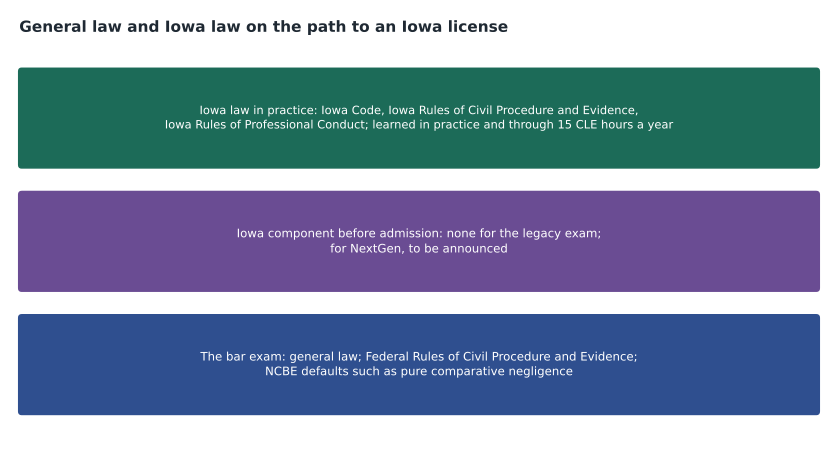
Every part of the legacy UBE tests law that is not tied to any one state. The MBE and MEE are written to test generally accepted principles, with the federal rules governing civil procedure and evidence questions. NCBE's subject matter outline for the MBE adds specific defaults for torts: unless a question says otherwise, examinees should assume pure comparative negligence, joint and several liability and the availability of survival and wrongful death claims. The MPT supplies its own law in the library, usually from a fictional jurisdiction, and examinees must apply that law rather than any state's.
This design is what makes the UBE portable. A score earned in Iowa can be transferred to another UBE jurisdiction because the exam measures the same thing everywhere. If Iowa tested Iowa law within the UBE, the score would no longer be uniform. Jurisdictions that want to test local law do so separately, through a jurisdiction component such as an online course or a short additional test. Iowa has not added one for the legacy exam.
Why Iowa has no separate Iowa law test
Iowa's approach reflects a long debate about how lawyers should be licensed. In 2014, the Iowa State Bar Association's Blue Ribbon Committee on Legal Education and Licensure recommended a diploma privilege modeled on Wisconsin's, which would have let graduates of Iowa's two law schools be admitted without a bar exam. The committee pointed to the months graduates spend waiting for results and the loans some take out to live during that time. After a public hearing at which 25 witnesses spoke and about 155 written comments were filed, the Iowa Supreme Court announced in September 2014 that it would not adopt the proposal. It directed the Board of Law Examiners to study the admission process, including whether Iowa should adopt the Uniform Bar Examination.
The study led to Iowa's adoption of the UBE in 2016. The trade-off was clear. The UBE gave Iowa applicants a portable score and gave the board a well-tested exam, but it meant that the exam would not test Iowa law specifically. Iowa chose portability. The diploma privilege has not been adopted, and Iowa graduates must still pass the bar exam. Whether Iowa will add an Iowa component to the NextGen exam remains to be announced.
Where Iowa law and the tested law diverge
Knowing where Iowa departs from the tested general law protects against a specific kind of mistake: answering from habit. The table below lists some of the differences that matter most for an Iowa law clerk sitting the exam. In every case, the exam answer follows the general rule or the rule stated in the question, not the Iowa rule.
| Subject | What the exam assumes | What Iowa does |
|---|---|---|
| Comparative fault | Pure comparative negligence unless the question says otherwise | Modified comparative fault: a claimant whose fault is greater than the combined fault of the defendants recovers nothing (Iowa Code chapter 668) |
| Joint and several liability | Joint and several liability unless the question says otherwise | Limited: a defendant less than 50 percent at fault is only severally liable, and joint liability reaches economic damages only |
| Civil procedure | Federal Rules of Civil Procedure | Iowa Rules of Civil Procedure, which differ in pleading, discovery and timing details |
| Evidence | Federal Rules of Evidence as currently in effect | Iowa Rules of Evidence, based on but not identical to the federal rules |
| Damages caps | Generally none unless stated | Statutory caps on noneconomic damages in medical malpractice and certain commercial motor vehicle cases |
| Professional responsibility | ABA Model Rules (on the MPRE and NextGen skills questions) | Iowa Rules of Professional Conduct, based on the Model Rules with Iowa variations |
The comparative fault difference is the one Marchetti drills hardest. On the MBE, a plaintiff found 60 percent at fault against a single defendant found 40 percent at fault recovers 40 percent of the damages under pure comparative negligence. Under Iowa's chapter 668, the same plaintiff recovers nothing, because the plaintiff's fault is greater than the defendant's. An Iowa law clerk who answers zero has applied the right Iowa rule and chosen the wrong exam answer.
Reading the question for the rule
Exam questions sometimes state the governing rule, for example by saying that the jurisdiction follows modified comparative negligence or has adopted a particular statute. When a question supplies a rule, the examinee must apply it even if it differs from both Iowa law and the general default. When a question is silent, the examinee applies the general rule or the NCBE default. The habit to build is to ask, before answering, which rule the question wants.
Essays work the same way. An MEE answer is graded on whether it identifies the issues, states the generally accepted rules and applies them to the facts. An answer that cites an Iowa statute or case is not wrong in itself, but it earns nothing unless it also states and applies the general rule the grader is looking for. Iowa graders know Iowa law, but they are calibrated to NCBE's grading materials, and they reward the answer the question calls for.
How Iowa law still matters on exam day
Iowa law knowledge is not useless on the exam. It helps in three ways. First, many Iowa rules are the same as the general rules, so an Iowa clerk often has a head start: the Iowa Rules of Evidence follow the federal rules closely, and Iowa contract law largely follows the Restatement and the Uniform Commercial Code. Second, practice experience helps on the MPT and the NextGen performance tasks, which reward the ability to read a file, organize authority and write for a client or a court. Third, familiarity with Iowa's departures makes it easier to spot when a question is testing the general rule, because the contrast is already in the examinee's mind.
Marchetti suggests a simple drill. For each MBE subject, Amos writes a short list of the places where Iowa law differs from the tested rule. Before each practice set he reads the list. After each set he checks whether any wrong answers came from applying Iowa law. After three weeks of the drill, the Iowa-habit errors have nearly disappeared.
Learning Iowa law after the exam
Because the exam does not test Iowa law, new Iowa lawyers learn it in practice and through continuing legal education. Iowa requires fifteen hours of continuing legal education every calendar year, including at least one hour of legal ethics and one hour of either attorney wellness or diversity and inclusion. Many new lawyers use those hours for courses on Iowa practice: civil procedure under the Iowa rules, probate, family law, farm law and real estate. The Iowa State Bar Association, Iowa's law schools and private providers offer such courses.
Amos's firm has a different approach as well. Lorna Pettit gives every new lawyer a binder of the Iowa forms the firm uses most, from probate petitions to farm lease termination notices, and walks through each one. 'The bar exam tells me you can think like a lawyer,' she tells him. 'The binder tells me you can think like an Iowa lawyer.' Lessons 7 through 10 of this course give an overview of the Iowa law that matters most in the first year.
Worked problem
An Iowa habit on a torts question
A practice MBE question: a driver runs a stop sign and hits a cyclist who was riding without a light at night. A jury finds the cyclist 55 percent at fault and the driver 45 percent at fault, with damages of 100,000 dollars. The question says nothing about the jurisdiction's comparative fault rule. What should the cyclist recover?
Show solution
- The question is silent on the comparative fault rule.
- NCBE's outline tells examinees to assume pure comparative negligence unless the question says otherwise.
- Under pure comparative negligence, the cyclist recovers damages reduced by her share of fault: 45 percent of 100,000 dollars.
- Under Iowa law, she would recover nothing, because her fault is greater than the driver's, but Iowa law is not the tested rule.
Answer: The exam answer is 45,000 dollars, not zero.
Common mistakes
MistakeIowa graders want Iowa law on the essays.
InsteadIowa lawyers grade against NCBE's analysis of the general law; Iowa citations earn nothing unless the general rule is also stated and applied.
MistakeIowa tests Iowa law in a separate component.
InsteadThe legacy UBE has no Iowa component in Iowa; for NextGen it is to be announced.
MistakeIowa adopted a diploma privilege.
InsteadThe Iowa Supreme Court declined to adopt one in 2014 and adopted the UBE in 2016.
MistakeWhen a question states a rule, apply the general rule anyway.
InsteadA rule stated in the question controls, even if it differs from the general rule and from Iowa law.
The divergence list in practice
Amos's divergence list starts with torts and grows. For civil procedure, he notes that Iowa uses notice pleading while the federal rules, which the exam tests, require plausibility. For evidence, he notes that the Iowa Rules of Evidence closely follow the federal rules but that the exam tests the federal version as currently in effect, including recent amendments. For real property, he notes Iowa's farm tenancy notice rule and its homestead exemption, neither of which the exam tests. For contracts, he notes that Iowa follows the Uniform Commercial Code for the sale of goods, as the exam assumes, so there is little to worry about. For criminal law, he notes that the exam tests common law and Model Penal Code principles, not the Iowa Criminal Code.
The list does two things. It reminds him of the exam rule before each set, and it builds a map of Iowa law he will need in practice. Marchetti points out that the second benefit is real: an Iowa clerk who knows exactly where Iowa departs from the general rules is already thinking like an Iowa lawyer, even while preparing for an exam that does not test Iowa law.
Why a uniform exam can still feel local
The legacy UBE is uniform in content, but the experience of sitting it in Iowa has local features. Iowa lawyers grade the essays and performance tests. The exam is given in Polk County, with Iowa's board handling admission, security and logistics. And the applicants around Amos in the testing room will mostly be graduates of Iowa's two law schools and schools in neighboring states, many of whom he knows. Marchetti tells him that those local features can help, because the setting is familiar, and can distract, because conversations about answers during breaks spread anxiety. Her advice is to stay out of those conversations entirely.
The diploma privilege debate today
The diploma privilege question has not disappeared nationally. Wisconsin continues to admit graduates of its two law schools without a bar exam. Several jurisdictions adopted temporary emergency diploma privileges during the COVID-19 pandemic in 2020, and some states have since adopted or considered alternative pathways, such as supervised practice programs or portfolio-based assessments, that allow admission without a traditional bar exam. Iowa has not adopted any such pathway as of November 2026, and an Iowa applicant must pass the bar exam or qualify through transfer or admission on motion.
The 2014 debate still shapes how Iowa lawyers talk about the bar exam. Supporters of a diploma privilege argued that Iowa's two law schools produce graduates who know Iowa law and that the bar exam delays and burdens new lawyers. Opponents argued that a uniform exam protects the public, treats graduates of all law schools alike and gives Iowa graduates a portable credential. The court's choice of the UBE in 2016, and of the NextGen exam in 2023, reflects a consistent preference for a national exam with portable scores.
Using the MPT library correctly
The MPT is the part of the exam most likely to tempt an Iowa clerk to use outside knowledge. A task might involve a landlord and tenant, a probate question or a negligence claim, all areas the clerk sees at work. The library supplies the law for the task, often from a fictional jurisdiction, and graders expect the examinee to use only that law. An answer that brings in an Iowa statute, even a correct one, wastes time and may mislead. Marchetti tells Amos to treat each MPT library as if it were the only law in the world for ninety minutes.
Learning from wrong answers
Marchetti's error log has three columns: what he chose, what the right answer was and why he chose wrong. The third column is the important one. Reasons cluster: misreading the call of the question, forgetting a rule, confusing two similar rules or applying Iowa law. Once the reasons are visible, the remedy is clearer. Misreading calls for slower reading of the last sentence. Forgetting calls for review. Confusion calls for a comparison chart. Applying Iowa law calls for the divergence list. By tracking reasons rather than just scores, Amos sees his weaknesses change from week to week.
Summary and key terms
- The legacy UBE tests general law, with NCBE defaults such as pure comparative negligence in torts.
- Iowa has no separate Iowa law component for the legacy exam; for NextGen it is to be announced.
- The Iowa Supreme Court declined a diploma privilege in 2014 and adopted the UBE in 2016.
- Iowa departs from the tested rules on comparative fault, joint and several liability, procedure, evidence details and damages caps.
- New Iowa lawyers learn Iowa law through practice and fifteen hours of CLE a year.
- Diploma privilege
- Admission to the bar without an exam for graduates of in-state law schools, as in Wisconsin.
- Portability
- The ability to transfer a bar exam score from one jurisdiction to another.
- Jurisdiction component
- An additional local law requirement, such as a course or short test, that some UBE jurisdictions add.
- Pure comparative negligence
- A rule reducing a plaintiff's recovery by the plaintiff's share of fault, without barring recovery.
- Modified comparative fault
- A rule that bars recovery once the plaintiff's share of fault passes a threshold.
Lesson quiz · 5 questions
Score 60% or more to complete this lesson.
Create a free account to save your progress, take quizzes and earn a certificate.