
BAR-216 · Lesson 2 of 12 · 16 min
Eligibility, education, deadlines and fees
▶ Video coming soon A video version of this lesson is on the way.
Amos's first assignment from Marchetti is a single page: every date, fee and document his Iowa application requires, with the source for each. 'Applicants rarely fail because they cannot learn evidence,' she says. 'They fail because they miss a deadline, pay the wrong fee or forget that a document has to come from someone else. Write it down, cite the rule and check it again in a month.'
This lesson works through that page. It covers who may sit the Iowa bar exam, the education requirement, the filing deadlines and the fees, as they stand in November 2026. Because Iowa is about to change exams, the lesson also flags what changes in July 2027 and what stays the same.
The education requirement
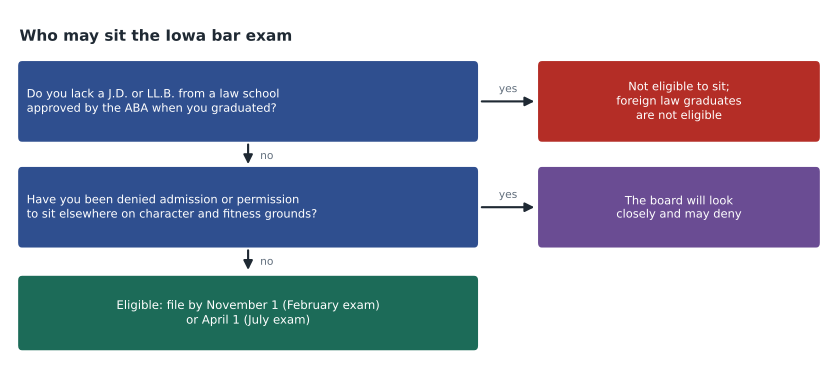
To sit the Iowa bar exam, an applicant must hold a J.D. or an equivalent first professional degree in law from a law school approved by the American Bar Association, either fully or provisionally, at the time of graduation. The board proves the degree through a certificate or affidavit from the law school dean. NCBE's jurisdiction information for Iowa confirms that an ABA-approved J.D. is required to sit for the bar exam and that graduates of foreign law schools are not eligible to sit, even with an American LL.M.
Iowa has two law schools, both ABA-approved: the University of Iowa College of Law in Iowa City and Drake University Law School in Des Moines. Many Iowa applicants come from those schools, but the rule is not limited to them. A graduate of any ABA-approved school in the country may sit, and Iowa firms regularly hire graduates of schools in neighboring states such as Nebraska, Minnesota, Illinois and Missouri.
The ABA requirement has been a subject of debate. In the 2026 session of the Iowa General Assembly, a House bill that began as House Study Bill 546 and became House File 2246 would have directed the Iowa Supreme Court to amend its rules so that applicants would not need to graduate from an ABA-accredited law school to sit for the bar exam, and would have limited continuing legal education to subjects directly related to the practice of law. A House subcommittee advanced the study bill on a two-to-one vote in January 2026, but the bill does not appear among the bills the governor acted on after the session, and the court's rules still require an ABA-approved degree. Marchetti tells the group to watch for similar proposals: several states, including Texas and Florida, opened eligibility to other accreditors in 2025 and 2026, and the question may return in Iowa.
Students and early testing
Iowa does not allow law students to sit the full bar exam before graduation. Some states let third-year students take the multiple-choice portion early, and when the Iowa Supreme Court declined to adopt a diploma privilege in 2014, it asked the Board of Law Examiners to study, among other things, whether students should be allowed to sit in February of their third year. Iowa chose instead to adopt the Uniform Bar Examination in 2016, and the rule today is simple: an applicant must hold the required degree, certified by the law school dean, before sitting.
Students can and usually should take the MPRE while still in school. Iowa places no time limit on how old an MPRE score may be, so a score earned in the second year of law school counts for an exam taken years later. What matters is that the board receives the score within one year after the bar pass is posted. Lesson 3 returns to that rule.
Filing deadlines
Iowa's filing deadlines are early and firm. According to NCBE's information for Iowa, the filing deadline for the July exam is April 1 and the filing deadline for the February exam is November 1. No late filing deadline is listed. An applicant who misses the deadline must wait for the next administration, six months later. For Amos, that would have meant missing the last legacy exam entirely and sitting the NextGen exam in July 2027.
Applications are filed electronically through the board's online system, and the vendor that runs the system may charge its own fee. The application asks for personal history, education, employment, residences, character references, bar admissions elsewhere, any criminal, civil or disciplinary history, and other matters relevant to character and fitness. Supporting documents, such as the dean's certificate, are sent separately by the people who sign them. The board can deny an application administratively when required documents or payments are missing, and the rules for the NextGen exam add that missing the deadlines for software installation or payment will lead to an administrative denial.
| Exam | Filing deadline | Late filing | Notes |
|---|---|---|---|
| July 2026 (legacy UBE) | April 1, 2026 | None | Passing score 260 for exams after July 1, 2026 |
| February 2027 (legacy UBE) | November 1, 2026 | None | Iowa's last legacy UBE; passing score 260 |
| July 2027 (NextGen) | April 1, 2027 | None | Iowa's first NextGen exam; passing score 610; computer-based |
Fees
NCBE's jurisdiction information lists Iowa's bar exam fee as 800 dollars, and the fee is the same for first-time takers, attorneys and repeat takers. Applicants who are permitted to type the written portion on a laptop pay an additional 122 dollars. The application vendor may charge a separate processing fee. Admission by transferred score costs 900 dollars under rule 31.4, and admission on motion costs 900 dollars plus a character and fitness fee. If the board requires an NCBE character report for a transfer applicant, the applicant also pays NCBE's fee.
Fees are not refundable once paid, and they change from time to time. Marchetti's advice is to read the current fee schedule on the board's page on the day you file, pay the exact amount and keep the receipt. A fee shortfall can delay a file, and with no late filing period a delay at the wrong moment can cost an exam.
| Item | Fee | Source |
|---|---|---|
| Bar exam application | 800 dollars | NCBE jurisdiction information |
| Laptop fee for the written portion | 122 dollars | NCBE jurisdiction information |
| Admission by transferred UBE score | 900 dollars | Rule 31.4 |
| Admission on motion | 900 dollars plus the character and fitness fee | NCBE jurisdiction information |
| NCBE character report, if required | NCBE's fee, paid by the applicant | Rule 31.4 |
Accommodations
An applicant with a disability may ask for testing accommodations, such as extra time, a separate room or assistive technology. Requests are made through the board's application system with supporting documentation from a qualified professional, and they should be made early, because the board must review the documentation and arrange the testing room. NCBE's own process applies to accommodations on the MPRE, which is a separate exam given at test centers.
With the move to a computer-based NextGen exam in July 2027, accommodations may look different. NCBE has published accessibility previews of the NextGen software, including options for font size, color contrast and a timer display, and Iowa's rules require applicants to install and test the exam software by the deadline the board sets. Applicants who will need accommodations on the NextGen exam should read both the board's instructions and NCBE's preparation materials well before the filing deadline.
Where and when the exam is given
Iowa gives the bar exam twice a year in Polk County, the Des Moines area, on the dates set nationally by NCBE: the last Tuesday and Wednesday of February and of July. The February 2027 exam is scheduled for February 23 and 24, 2027, and the July 2027 exam, Iowa's first NextGen administration, for July 27 and 28, 2027. Applicants receive admission instructions, including the location, check-in times and the list of permitted items, from the board before the exam.
Amos has booked a hotel in Des Moines for the nights of February 22 and 23. 'Drive in the day before,' Marchetti tells him. 'February in central Iowa means snow. Do not plan to drive from Cedar Rapids at five in the morning on exam day.'
Worked problem
Checking Amos's file
Amos filed on October 20, 2026, paid 800 dollars and requested permission to use a laptop. His law school certified his degree in June 2026. His MPRE score of 88 was reported to Iowa in April 2026. Is anything missing?
Show solution
- Deadline: October 20 is before November 1, so the application is timely.
- Fees: he needs to pay the 122-dollar laptop fee as well as the 800-dollar exam fee, plus any vendor fee.
- Education: the dean's certificate confirms an ABA-approved J.D.
- MPRE: 88 meets the requirement of 80; it is already reported, so the one-year rule after his pass is posted is satisfied in advance.
- Character and fitness: he must answer any follow-up questions from the board promptly.
Answer: His file is timely; he should confirm that the laptop fee was paid and keep watching for character and fitness inquiries.
Common mistakes
MistakeAny law degree will do for the Iowa bar exam.
InsteadAn ABA-approved J.D. or equivalent is required; foreign law graduates are not eligible to sit.
MistakeA 2026 bill removed the ABA requirement.
InsteadHouse File 2246 would have done so, but it did not become law in the 2026 session and the court's rule still requires an ABA-approved degree.
MistakeThere is a late filing period with an extra fee.
InsteadNo late filing deadline is listed for Iowa; the deadlines are April 1 and November 1.
MistakeThe laptop fee is included in the exam fee.
InsteadTyping the written portion on a laptop costs an extra 122 dollars.
Building the application calendar
Marchetti's page for Amos becomes a calendar, worked backward from the exam. The exam is on February 23 and 24, 2027. The filing deadline was November 1, 2026. Before that, the dean's certificate had to be requested, references had to be asked and given time to respond, and records of old addresses, jobs and any citations had to be collected. Most applicants find that the application itself takes longer than they expect, because it asks for complete histories rather than summaries, and because the information has to match what other sources will report.
She suggests a simple rule of thumb for future applicants: start gathering documents three months before the filing deadline, finish a complete draft six weeks before it and file at least two weeks early. Filing early leaves time to fix a rejected payment, a missing signature or a technical problem with the online system. With no late filing period in Iowa, there is no second chance if a problem appears on the last day.
Matching the record
The board compares the application with records from other sources, including the law school, prior employers, courts, credit reports and, where relevant, other licensing bodies. Inconsistencies, even innocent ones, lead to follow-up questions and can slow the file. Amos checks his application against his law school application, his résumé and his driving record before filing. He finds that he listed a summer job under the wrong year and that he forgot a parking ticket in Iowa City that went to collections before he paid it. He corrects both and discloses the ticket, with a short explanation and proof of payment.
Applicants from other jurisdictions
Some applicants who sit the Iowa exam are not Iowa graduates and do not live in Iowa. A graduate of a law school in Nebraska who has accepted a job in Council Bluffs, for example, may sit in Iowa rather than in Nebraska. Such applicants follow the same rules and deadlines and should plan travel to Polk County early, especially for the February exam, when weather can disrupt driving across the state. Applicants already admitted elsewhere who choose to sit rather than transfer pay the same exam fee as first-time takers, according to NCBE's information.
Thinking about July 2027 now
Applicants who expect to graduate in May 2027 face a different decision from Amos's. They will sit Iowa's first NextGen exam in July 2027 unless they choose to sit a legacy UBE elsewhere. Marchetti's advice is to choose early and commit: preparation for the two exams overlaps heavily on the law, but the formats differ, and switching midway wastes time. For most May 2027 graduates who plan to practice in Iowa, the July 2027 Iowa exam is the natural choice, with the filing deadline of April 1, 2027 in the calendar from the start of the spring semester.
Paying attention to the small print
Three small items cause problems every year. The first is the laptop fee, which some applicants forget. The second is the vendor's separate fee for the online system, which is charged on top of the board's fee. The third is the requirement that the dean's certificate come directly from the law school, not from the applicant. Marchetti adds a fourth for the NextGen exam: the software installation deadline, which the rules treat as seriously as the filing deadline. Missing it can lead to an administrative denial even when everything else in the file is complete.
A checklist for the filing week
Amos's filing-week checklist fits on one card. The application is complete and every answer has been checked against his source documents. Every disclosure includes an explanation and supporting papers. The exam fee, the laptop fee and the vendor fee are paid and the receipts are saved. The dean's certificate has been requested from the law school and the request has been confirmed. The references have agreed to respond and know the deadline. The MPRE score is reported to Iowa. A copy of the complete application, as filed, is saved where he can find it. When each item is ticked, he files, and then he stops worrying about the application and goes back to studying.
Summary and key terms
- An ABA-approved J.D. is required to sit; foreign law graduates are not eligible.
- Filing deadlines are April 1 for July and November 1 for February, with no late filing.
- The exam fee is 800 dollars; the laptop fee is 122 dollars; transfer and motion applications cost 900 dollars.
- The exam is given in Polk County on the last Tuesday and Wednesday of February and July.
- The July 2027 NextGen exam is computer-based and requires installing the exam software by the board's deadline.
- Dean's certificate
- A sworn statement from the law school dean confirming the applicant's degree or completion of its requirements.
- Filing deadline
- The last day to file a complete application for a given exam.
- Accommodation
- A change in testing conditions, such as extra time, granted to an applicant with a documented disability.
- ABA approval
- Accreditation of a law school by the American Bar Association's Council of the Section of Legal Education and Admissions to the Bar.
- Administrative denial
- Denial of an application for a procedural failure, such as a missing payment or document, rather than on the merits.
Lesson quiz · 5 questions
Score 60% or more to complete this lesson.
Create a free account to save your progress, take quizzes and earn a certificate.