
BAR-216 · Lesson 3 of 12 · 16 min
Character and fitness and the MPRE
▶ Video coming soon A video version of this lesson is on the way.
Amos has one item on his application that worries him. During his second year of college he received a citation for possession of alcohol under the legal age at a campus party. He paid a fine and the case was closed. He disclosed it on his law school application, and he disclosed it again on the bar application. 'Will they hold that against me?' he asks.
'Almost certainly not,' Marchetti says. 'What they would hold against you is not mentioning it. Character and fitness boards see youthful mistakes all the time. What they care about is candor now and a record of responsible conduct since. The same goes for debts, traffic matters and anything else that makes you nervous. Disclose, explain briefly and attach the records.'
This lesson covers the two requirements that sit beside the bar exam itself: the character and fitness review run by the Iowa Board of Law Examiners and the Multistate Professional Responsibility Examination. Both must be satisfied before the Iowa Supreme Court will admit an applicant, and both can delay admission if they are handled carelessly.
What character and fitness means
Every jurisdiction requires lawyers to show that they have the honesty, trustworthiness, diligence and reliability that the practice of law demands. In Iowa, the rules direct the Board of Law Examiners to investigate the moral character and fitness of every applicant, whether the applicant seeks admission by examination, by transferred score or on motion. The board may use outside agencies or individuals to help, and in some cases, such as a transfer application that raises substantial concerns, it may require the applicant to obtain an investigative report from NCBE at the applicant's own expense. The board's decision to require such a report is not reviewable.
The standard is forward-looking. The question is not whether the applicant has ever made a mistake, but whether the record as a whole shows that the applicant can be trusted to handle clients' money, keep their confidences, meet deadlines, tell the truth to courts and follow the rules of the profession. A long-past mistake followed by years of responsible conduct counts for much less than a recent pattern of dishonesty or neglect.
Constitutional limits apply. In Schware v. Board of Bar Examiners and Konigsberg v. State Bar of California, both decided in 1957, the United States Supreme Court held that a state may require high standards of qualification for the bar, but any qualification must have a rational connection with the applicant's fitness or capacity to practice law, and the state may not deny admission arbitrarily or for reasons such as past political associations. Those cases still frame how boards approach character and fitness.
Candor is the central requirement
The most common reason an application runs into trouble is not the underlying conduct but the failure to disclose it. Applicants must answer every question completely and truthfully, and the duty continues until admission: if something changes after filing, such as a new traffic citation, a lawsuit or a change of address, the applicant must update the application. An omission that comes to light later, for example through a background check, raises a question of honesty that is more serious than most of the conduct applicants are tempted to hide.
Rule 8.1 of the Iowa Rules of Professional Conduct reinforces this. It provides that an applicant for admission to the bar must not knowingly make a false statement of material fact in connection with the application and must not fail to disclose a fact necessary to correct a misapprehension known to have arisen in the matter. A lawyer who helps an applicant, for example by writing a reference, is bound by the same rule. A false statement discovered after admission can lead to discipline, including revocation of the license.
Common areas of concern
The board sees the same categories again and again. Criminal history, including juvenile matters where the application asks for them, must be disclosed even if the record was expunged or sealed, unless the application expressly says otherwise. Financial history matters because lawyers handle other people's money: unpaid student loans in default, unpaid taxes, judgments and bankruptcies are not disqualifying in themselves, but the board will want to see that the applicant has acted responsibly to address them. Academic discipline, including honor code violations in law school, must be disclosed, and the law school's certificate will usually report it in any event. Employment history, including terminations, must be described accurately.
Mental health deserves a specific note. Many jurisdictions have narrowed or removed questions about mental health diagnosis and treatment in recent years, focusing instead on conduct, and the national trend reflects concern that broad questions deter applicants from seeking help. Applicants should answer whatever questions the current Iowa application asks, and they should know that seeking treatment is not itself a sign of unfitness. The Iowa Lawyers Assistance Program offers confidential help to law students and lawyers.
| Area | What to disclose | What helps |
|---|---|---|
| Criminal and traffic matters | Every matter the application asks about, including dismissed or expunged ones unless told otherwise | Court records showing the outcome; a short factual explanation |
| Financial history | Defaults, judgments, tax debts, bankruptcies | Payment plans, current statements, evidence of steady progress |
| Academic discipline | Any finding of misconduct in college or law school | The school's records; a candid account of what changed |
| Employment | All jobs in the period asked, including terminations | An accurate description; references from supervisors |
| Litigation | Lawsuits as a party, including small claims | Pleadings and outcome documents |
When the board has concerns
If the board has concerns about an applicant's character and fitness, it can ask for more information, interview the applicant or hold a hearing. The rules allow the board to impose conditions, such as a monitoring arrangement or proof that a debt has been resolved, and to withhold its recommendation for admission until the conditions are met. An applicant who is denied may seek review by the Iowa Supreme Court, which has the final word.
An applicant in this position should take the process seriously. That means responding to every request on time, providing documents rather than characterizations, being consistent across every account given, and considering whether to consult a lawyer who handles admission matters. Most applicants with concerns are eventually admitted, often with conditions, when they show candor and a record of responsible conduct.
The MPRE
The Multistate Professional Responsibility Examination is a separate exam, written by NCBE, that tests knowledge of the rules governing lawyer conduct. It consists of 60 multiple-choice questions, of which 50 are scored and 10 are unscored pretest questions, and it is given at Pearson VUE test centers several times a year. Scores are reported on a scale of 50 to 150. NCBE's fee for 2026 is 185 dollars.
The MPRE tests the American Bar Association's Model Rules of Professional Conduct, the ABA Model Code of Judicial Conduct and controlling constitutional and procedural law, rather than the rules of any one state. The Iowa Rules of Professional Conduct are based on the Model Rules, so most of what an Iowa applicant learns for the MPRE will carry over, but the MPRE answers follow the Model Rules where Iowa differs. Lesson 10 discusses some of Iowa's differences.
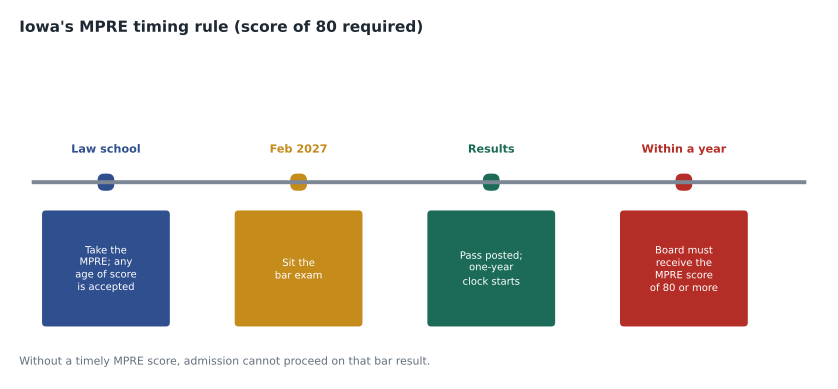
Iowa requires a scaled score of at least 80. Iowa places no time limit on when the score must have been earned, which is generous; some jurisdictions require the score to be no more than two or three years old. But rule 31.3 adds a firm deadline in the other direction: the board must receive the passing score within one year after the applicant's bar exam pass is posted, or the bar passage becomes void for purposes of admission in Iowa.
Planning the MPRE
Most Iowa applicants take the MPRE during law school, usually after or during a professional responsibility course. Marchetti recommends that applicants who have not yet passed the MPRE schedule it before the bar exam rather than after, for three reasons. First, MPRE preparation takes several weeks that compete with bar study. Second, test center seats fill up near popular dates. Third, an applicant who passes the bar but delays the MPRE can lose the bar pass entirely under the one-year rule.
Applicants must also direct NCBE to send the score to Iowa. NCBE reports MPRE scores to the jurisdictions the examinee designates; a score that sits in an NCBE account but is never reported does not satisfy the board. Amos checked his NCBE account and confirmed that his score of 88 had been reported to Iowa in April 2026.
Worked problem
Two applicants and the MPRE
Applicant A scored 82 on the MPRE in 2019 and passed the February 2027 Iowa exam. Applicant B passed the February 2027 Iowa exam, results posted in April 2027, but did not take the MPRE until May 2028, scoring 84. Who satisfies Iowa's MPRE requirement?
Show solution
- Applicant A: Iowa has no limit on the age of an MPRE score, so a 2019 score of 82 counts, provided it is reported to the board.
- Applicant B: the score of 84 is high enough, but the board must receive a passing MPRE score within one year after the bar pass is posted.
- Results were posted in April 2027, so the deadline fell in April 2028.
- Applicant B's May 2028 score came too late, so the bar pass is void for Iowa admission.
Answer: Applicant A satisfies the requirement; Applicant B does not, because the score arrived more than a year after the pass was posted.
Common mistakes
MistakeAn old, minor offense need not be mentioned.
InsteadAnswer every question the application asks; failing to disclose is usually more serious than the conduct itself.
MistakeCharacter and fitness only applies to bar exam takers.
InsteadThe board investigates applicants on every route, including transfer and admission on motion.
MistakeAn MPRE score must be recent.
InsteadIowa places no age limit on the MPRE score, but the board must receive it within one year after the bar pass is posted.
MistakeThe MPRE tests the Iowa Rules of Professional Conduct.
InsteadThe MPRE tests the ABA Model Rules and Model Code of Judicial Conduct; Iowa's rules are based on them but differ in places.
Writing explanations that help
A disclosure on a character and fitness application has two parts: the facts and the explanation. The facts must be complete and accurate. The explanation should be short, specific and honest. Marchetti gives the group a simple pattern: say what happened, when it happened, what the outcome was, what you did about it and what has changed since. She warns against two common mistakes. The first is minimizing, such as calling a criminal charge a misunderstanding without saying what the charge was. The second is over-explaining, such as a three-page account of a speeding ticket. Both suggest poor judgment, which is the opposite of what the applicant wants to show.
Supporting documents strengthen an explanation. A court record showing a dismissal, a letter from a creditor confirming that a debt was paid or a certificate showing completion of a program speaks more convincingly than the applicant's own account. Where records are hard to obtain, the applicant should say what steps were taken to obtain them. The board is looking for candor and responsibility, and evidence of both helps the file.
Financial responsibility
Many applicants worry about student loans. Debt alone is not a character problem; most law graduates carry substantial loans. What matters is how the applicant handles obligations. Loans in good standing, in deferment or on an income-driven repayment plan raise no issue. Defaults, accounts in collection and unpaid judgments raise questions, especially if the applicant has not addressed them. An applicant with a financial problem in the past should show what was done to resolve it and that current obligations are being met.
Mental health and the application
Applicants sometimes ask whether seeking counseling or treatment will hurt their application. National bar organizations, including the Conference of Chief Justices, have encouraged jurisdictions to focus character and fitness questions on conduct rather than on diagnosis or treatment, and many jurisdictions have revised their questions accordingly. An applicant should answer the questions Iowa actually asks, as worded in the current application, and should not assume that a question asks more than it does. Seeking help is a sign of responsibility, and the Iowa Lawyers Assistance Program exists for exactly that purpose.
Planning the MPRE
For applicants who have not yet taken the MPRE, timing matters. NCBE offers the MPRE several times a year at test centers and, in some windows, by remote proctoring. Registration closes weeks before each administration, and popular test centers fill. Most law students take it in the second or third year, after a course in professional responsibility. Because Iowa places no limit on the age of the score, there is no advantage to waiting, and a passing score earned early removes one item from the list.
The MPRE is a two-hour exam. Preparation usually takes a few weeks of focused study using NCBE's subject matter outline, sample questions and a short commercial or free course. The most heavily tested areas include conflicts of interest, the client-lawyer relationship, confidentiality and the regulation of the legal profession. Candidates should study the ABA Model Rules as written, with their comments, rather than any state's version, because the exam tests the Model Rules and generally accepted principles.
When the MPRE score arrives late
Iowa's rule requires the board to receive a passing MPRE score within one year after the applicant's bar pass is posted. An applicant who passes the bar exam first and the MPRE later is not admitted until the MPRE score arrives. If more than a year passes, the bar exam result may be lost. Marchetti tells applicants who still need the MPRE after the bar exam to register for the first available administration and to confirm that NCBE has sent the score to Iowa as soon as it is released.
Summary and key terms
- The Board of Law Examiners investigates the character and fitness of every applicant, on every route.
- Candor is the central requirement; the duty to disclose continues until admission.
- The board may impose conditions and withhold its recommendation; the Iowa Supreme Court has the final word.
- Iowa requires an MPRE scaled score of 80, with no age limit on the score.
- The board must receive the MPRE score within one year after the bar pass is posted, or the pass is void for Iowa admission.
- Character and fitness
- The qualities of honesty, trustworthiness, diligence and reliability required for admission, and the review that tests them.
- MPRE
- The Multistate Professional Responsibility Examination, a 60-question exam on lawyer conduct written by NCBE.
- Rehabilitation
- Evidence that an applicant has addressed past misconduct and now meets the standards for admission.
- Conditional admission
- Admission subject to conditions, such as monitoring, that the board may require.
- Rule 8.1
- The professional conduct rule barring false statements and material omissions in bar admission matters.
Lesson quiz · 5 questions
Score 60% or more to complete this lesson.
Create a free account to save your progress, take quizzes and earn a certificate.