
BAR-216 · Lesson 7 of 12 · 16 min
Iowa courts and civil procedure
▶ Video coming soon A video version of this lesson is on the way.
Amos's first month at the Pettit firm was spent learning where things go. A petition goes to the clerk of the district court in the right county through the state's electronic filing system. An appeal goes to the Iowa Supreme Court, even if it ends up decided by the Court of Appeals. A small claim goes to a magistrate. 'None of that is on the bar exam,' Pettit told him, 'and all of it is on the job.'
This lesson gives an overview of the Iowa court system and the Iowa Rules of Civil Procedure. The legacy UBE tests the Federal Rules of Civil Procedure, not the Iowa rules, so the details here are for practice rather than for the exam. But the structure of Iowa's courts and the main features of Iowa procedure are things every new Iowa lawyer needs from the first week.
The structure of Iowa's courts
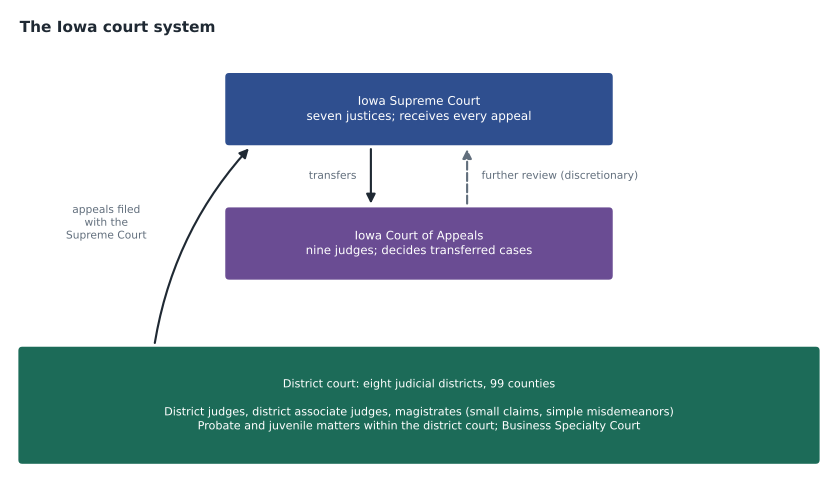
Iowa has a unified court system with three levels. The Iowa Supreme Court, with seven justices, is the highest court. It hears appeals, regulates the practice of law and supervises the lower courts. The Iowa Court of Appeals, with nine judges, is an intermediate appellate court. The district court is the general trial court, organized into eight judicial districts that cover Iowa's 99 counties, with a courthouse in every county.
Iowa handles appeals in an unusual way. A party appealing from the district court files the appeal with the Iowa Supreme Court, not the Court of Appeals. The Supreme Court then keeps some cases for itself, usually those raising substantial questions of law or broad public importance, and transfers the rest to the Court of Appeals for decision. A party who loses in the Court of Appeals may ask the Supreme Court for further review, which the court grants in a limited number of cases. This system lets the Supreme Court control its own docket while ensuring that every appeal is decided.
Within the district court there are several kinds of judicial officers. District judges hear the full range of civil and criminal cases. District associate judges hear many family, juvenile and criminal cases and some civil cases. Magistrates hear small claims, simple misdemeanors and other limited matters. Probate and juvenile matters are handled within the district court rather than in separate courts. Iowa also has a Business Specialty Court, which handles complex commercial cases assigned to it under the court's rules.
How Iowa judges are chosen
Iowa selects judges through a merit system. When a vacancy arises, a nominating commission screens applicants and sends a short list to the governor, who appoints one of the nominees. After an initial period in office, the judge stands for a retention election, in which voters decide only whether to keep the judge, without an opposing candidate. Judges who are retained serve full terms and then face retention again. The composition of the nominating commissions has been changed by the legislature in recent years, and the system remains a subject of debate.
Retention elections are usually quiet, but not always. In 2010, voters declined to retain three justices of the Iowa Supreme Court after the court's unanimous decision in Varnum v. Brien in 2009, which held that Iowa's statute limiting marriage to a man and a woman violated the equal protection clause of the Iowa Constitution. The episode is a reminder that Iowa judges answer to voters at retention time, and it is often discussed in Iowa law school courses on the courts.
The Iowa Rules of Civil Procedure
Civil actions in the Iowa district court are governed by the Iowa Rules of Civil Procedure, chapter 1 of the Iowa Court Rules. Many of the rules resemble their federal counterparts, and an applicant who knows the Federal Rules will recognize the structure: a petition, an answer, motions, discovery, summary judgment and trial. But the Iowa rules use different numbering and some different terms, and they differ from the federal rules in pleading, discovery and timing details that matter in practice.
An Iowa civil action begins with a petition rather than a complaint. Iowa follows notice pleading: the petition must give fair notice of the claim and the relief sought, and Iowa courts have not adopted the plausibility standard that federal courts apply under Bell Atlantic v. Twombly and Ashcroft v. Iqbal. A motion to dismiss for failure to state a claim is therefore harder to win in Iowa state court than in federal court. Lawyers who practice in both systems learn to draft for the stricter federal standard when a case might be removed.
| Topic | Federal practice | Iowa practice |
|---|---|---|
| First pleading | Complaint | Petition |
| Pleading standard | Plausibility under Twombly and Iqbal | Fair notice of the claim; plausibility not adopted |
| Small cases | No special track | Expedited civil actions for claims of 75,000 dollars or less; small claims for smaller amounts before a magistrate |
| Rules of evidence | Federal Rules of Evidence | Iowa Rules of Evidence, closely modeled on the federal rules |
| Appeals | To the federal court of appeals | Filed with the Iowa Supreme Court, which keeps or transfers to the Court of Appeals |
Expedited civil actions and small claims
Iowa offers two tracks for smaller cases. Small claims, heard by magistrates or district associate judges, cover money claims up to a statutory limit, which the legislature raised to 6,500 dollars in 2018. Small claims procedure is informal: parties often appear without lawyers, the rules of evidence are relaxed and hearings are short.
Rule 1.281 of the Iowa Rules of Civil Procedure created a second track, the expedited civil action, for cases in which the plaintiff seeks a money judgment of 75,000 dollars or less. In an expedited civil action, discovery is limited, the case is set for trial on a shorter schedule and the trial itself is shortened. The rule is designed to make it economical to try modest cases that would otherwise settle simply because full litigation costs more than the claim is worth. Plaintiffs elect the expedited track by certification, and judgments in expedited actions are capped at the 75,000-dollar limit.
Time limits
Iowa's statutes of limitations, in chapter 614 of the Iowa Code, set the time for filing many common claims. The period for most personal injury claims is two years, and the periods for contract claims are longer, with written contracts allowed more time than unwritten ones. Medical malpractice claims have their own rules, including a discovery provision and an outer limit. Claims against the state and local governments have special notice and filing rules under the Iowa Tort Claims Act and the Iowa Municipal Tort Claims Act, discussed in Lesson 8. A new lawyer should calendar every limitation period on the first day a file is opened.
Appeals
An appeal from a final judgment of the district court is begun by filing a notice of appeal within the time set by the Iowa Rules of Appellate Procedure, generally thirty days after the final order. The record and briefs follow on deadlines set by the rules. The Supreme Court then decides whether to retain the case or transfer it. Interlocutory appeals, from orders that are not final, require permission. Iowa's appellate courts publish their opinions, and Court of Appeals opinions are frequently cited in Iowa practice, though they do not bind the Supreme Court.
Worked problem
Choosing a track for a small injury case
Pettit's firm represents a client who slipped on an icy sidewalk outside a store in Cedar Rapids and broke her wrist. Her medical bills and lost wages total about 18,000 dollars, and the firm estimates total damages between 40,000 and 60,000 dollars. How might the firm proceed in Iowa state court?
Show solution
- Small claims is not available, because the claim exceeds the 6,500-dollar small claims limit.
- The claim fits within the 75,000-dollar limit for an expedited civil action under rule 1.281.
- Electing the expedited track would limit discovery and speed trial, lowering costs, but would cap the judgment at 75,000 dollars.
- The firm must file within Iowa's two-year limitation period for personal injury and plead under Iowa's notice pleading standard.
Answer: The firm could file a petition in district court and consider certifying the case as an expedited civil action.
Common mistakes
MistakeIowa appeals are filed in the Court of Appeals.
InsteadAll appeals are filed with the Iowa Supreme Court, which keeps some and transfers the rest to the Court of Appeals.
MistakeIowa state courts apply the federal plausibility pleading standard.
InsteadIowa follows notice pleading and has not adopted Twombly and Iqbal.
MistakeIowa has separate probate courts.
InsteadProbate matters are handled within the district court.
MistakeThe bar exam will test the Iowa Rules of Civil Procedure.
InsteadThe legacy UBE tests the Federal Rules of Civil Procedure; Iowa procedure is for practice.
Electronic filing and the clerk's office
Iowa's district courts use a statewide electronic document management system for filing and service. Lawyers register for an account, file petitions and other documents electronically and receive notice of filings by the other side through the system. Self-represented parties may also use it. The clerk of the district court in each county maintains the official record and assists with procedural questions, though clerks do not give legal advice. A new lawyer's first filings usually go more smoothly with a call to the clerk's office to confirm local practices, such as how a county schedules hearings on motions.
Service of original notice
An Iowa civil action begins with the filing of a petition, but the defendant must be served with an original notice, the Iowa equivalent of a federal summons, together with a copy of the petition. The Iowa Rules of Civil Procedure set the methods of service, including personal service by a sheriff or other authorized person, and provide for service on businesses through their registered agents. The rules also set a time limit for completing service after the petition is filed, and a case can be dismissed if service is not completed in time without good cause. Calendaring the service deadline is as important as calendaring the limitation period.
Discovery in Iowa practice
Iowa discovery follows the familiar tools: interrogatories, requests for production, requests for admission and depositions. The Iowa rules include initial disclosure requirements and limits on the number of interrogatories, and they require parties to confer in good faith before bringing many discovery motions. In expedited civil actions, discovery is further limited. Iowa practitioners also pay close attention to expert witness disclosure deadlines, which are set by rule and by the court's scheduling order, because a late disclosure can lead to exclusion of a key witness.
Summary judgment and trial
Summary judgment in Iowa resembles federal practice: the court grants it when there is no genuine issue of material fact and the moving party is entitled to judgment as a matter of law. Iowa courts view the record in the light most favorable to the nonmoving party. Jury trials are available in most actions at law, and Iowa civil juries generally have eight members. Equity cases, such as many property and dissolution matters, are tried to the court, and on appeal the Iowa appellate courts review equity cases de novo, giving weight to the trial court's findings but not being bound by them.
Law and equity in Iowa
Iowa preserves the distinction between actions at law and actions in equity for several purposes, including the standard of review on appeal and the right to a jury. Actions at law, such as most tort and contract claims for damages, are reviewed on appeal for correction of errors at law, and findings of fact supported by substantial evidence are binding. Actions in equity, such as dissolution, partition and foreclosure, are reviewed de novo. A new Iowa lawyer should know which kind of action a case is from the start, because the choice affects the trial and the appeal.
The Iowa Rules of Evidence
The Iowa Rules of Evidence, chapter 5 of the Iowa Court Rules, are closely modeled on the Federal Rules of Evidence and use parallel numbering, so Iowa rule 5.803 corresponds to federal rule 803. Iowa courts often look to federal decisions when interpreting rules with the same language. But Iowa has not adopted every federal amendment, and some Iowa rules differ in wording or content. For the bar exam, the federal rules control. For practice, a lawyer should read the Iowa rule and the Iowa cases interpreting it.
Criminal cases
Criminal cases in Iowa are prosecuted by county attorneys in the district court, with the Iowa Attorney General's office handling many appeals and some specialized prosecutions. Iowa classifies crimes as felonies, ranging from class A to class D, and misdemeanors, which include aggravated, serious and simple misdemeanors. Simple misdemeanors are usually tried before magistrates. The Iowa Rules of Criminal Procedure govern the process, and the State Public Defender's office coordinates indigent defense, using both staff public defenders and contract attorneys. Many new Iowa lawyers handle court-appointed criminal cases early in their careers, especially in rural counties.
Rural practice and the court system
Iowa's court system has a courthouse in every county, but not every county has a full-time judge or many lawyers. Judges in rural districts travel among counties, and hearings are scheduled around their calendars. Some counties have few practicing lawyers, and the state has explored programs to encourage new lawyers to practice in rural areas. For a new lawyer like Amos, rural practice offers early responsibility and a broad general practice, and the Iowa court system's structure, with uniform rules and electronic filing across the state, makes it possible to practice in several counties from one office.
Reading the local rules
Each judicial district may adopt local rules and orders on matters such as scheduling, motions practice and courtroom procedures. Pettit keeps a folder of the local rules for the districts where her firm practices and checks them before every first appearance in a new county. Most local rules are short and practical, but they can make the difference between a smooth hearing and an awkward one, and judges notice which lawyers have read them.
Summary and key terms
- Iowa has a unified court system: the Supreme Court, the Court of Appeals and the district court in eight districts.
- Appeals go to the Supreme Court, which keeps some and transfers the rest to the Court of Appeals.
- Iowa judges are chosen by a merit system with retention elections.
- The Iowa Rules of Civil Procedure use notice pleading and provide an expedited track for claims of 75,000 dollars or less.
- Small claims up to 6,500 dollars are heard informally; limitation periods are in Iowa Code chapter 614.
- District court
- Iowa's general trial court, organized into eight judicial districts.
- Transfer
- The Iowa Supreme Court's assignment of an appeal to the Court of Appeals for decision.
- Further review
- Discretionary review by the Iowa Supreme Court of a Court of Appeals decision.
- Retention election
- An election in which voters decide only whether a sitting judge should remain in office.
- Expedited civil action
- An Iowa procedure under rule 1.281 for money claims of 75,000 dollars or less, with limited discovery and a quick trial.
Lesson quiz · 5 questions
Score 60% or more to complete this lesson.
Create a free account to save your progress, take quizzes and earn a certificate.