
BAR-216 · Lesson 4 of 12 · 16 min
The Iowa bar exam: the final legacy UBE, scoring and the 260 passing score
▶ Video coming soon A video version of this lesson is on the way.
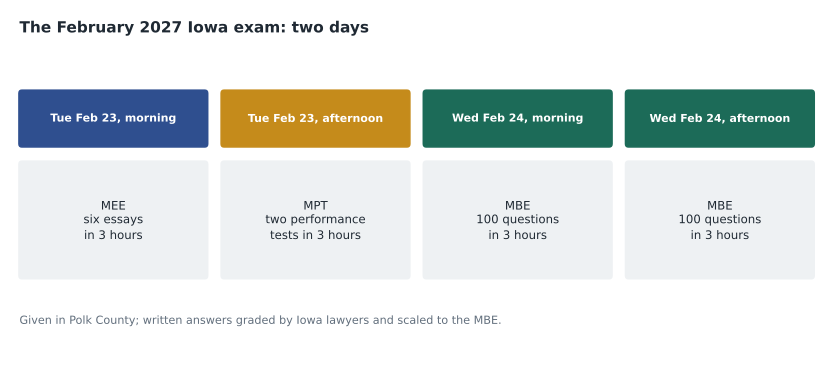
At their second session Marchetti draws two days on the whiteboard. 'Tuesday is writing: six essays in the morning, two performance tests in the afternoon. Wednesday is the MBE: one hundred multiple-choice questions in the morning and one hundred in the afternoon. That is the exam you will sit in Des Moines on February 23 and 24. It is the same Uniform Bar Examination Iowa has given since 2016, with one important change in content and one important change in the score you need.'
This lesson describes the legacy Uniform Bar Examination as Iowa gives it for the last time in February 2027: its parts, how it is scored, what Iowa's passing score of 260 means and how results are approved and released. Lesson 5 turns to the NextGen exam that replaces it in July 2027.
The three parts of the legacy UBE
The legacy Uniform Bar Examination has three parts, all written by NCBE. Iowa's rule 31.3 describes them. The Multistate Essay Examination (MEE) consists of six essay questions answered in three hours. The Multistate Performance Test (MPT) consists of two performance tests answered in three hours. The Multistate Bar Examination (MBE) consists of two three-hour sessions of 100 multiple-choice questions each. To earn a score that other UBE jurisdictions will accept, an applicant must take all three parts in the same administration in the same jurisdiction.
The MBE's 200 questions include 175 scored questions and 25 unscored pretest questions mixed in with them, and an examinee cannot tell which are which. The scored questions are spread evenly across seven subjects: civil procedure, constitutional law, contracts, criminal law and procedure, evidence, real property and torts. Each subject has 25 scored questions. The MBE tests generally accepted principles, with the Federal Rules of Civil Procedure and the Federal Rules of Evidence as currently in effect, rather than the law of any one state.
The MEE asks examinees to analyze fact patterns and write organized answers. Beginning with the July 2026 exam, NCBE removed four subjects from the MEE: conflict of laws, family law, trusts and estates, and secured transactions. For February 2027, the MEE can test the seven MBE subjects and business associations, which covers agency, partnerships, corporations and limited liability companies. Family law and trusts and estates may still appear on the MPT, but there the law is supplied in the library. Older outlines and practice essays that cover the dropped subjects are still useful for practice in Iowa, but they no longer reflect what the February 2027 MEE can test.
The MPT tests lawyering skills rather than memorized law. Each task gives the examinee a file of facts, such as interview notes, letters and documents, and a library of cases and statutes, often from a fictional jurisdiction, and asks for a document such as an objective memo, a persuasive brief, a client letter or a set of proposed terms. The examinee must work only from the materials provided.
How the score is built
The legacy UBE produces a single combined score on a 400-point scale. The MBE is weighted 50 percent of the total, the MEE 30 percent and the MPT 20 percent. NCBE scores the MBE and converts the raw number of correct answers into a scaled score through a process called equating, which adjusts for small differences in difficulty between exam forms so that a scaled score means the same thing from one administration to the next.
The written portions are graded by graders in the jurisdiction where the examinee sits. In Iowa, Iowa lawyers grade the MEE and MPT answers, using grading materials and calibration sessions provided by NCBE. Graders rank answers relative to one another rather than against a fixed standard. The raw written scores are then scaled to the MBE, meaning they are converted to the same scale as the MBE scores of the same group of examinees. This scaling step keeps the written score from drifting with the leniency or strictness of a particular group of graders and links the written portion to the equated MBE.
The combined score is the weighted sum of the scaled MBE score and the scaled written score. An examinee who does very well on the MBE can make up for a weaker written score, and the reverse is true. There is no separate passing score for each part on the legacy UBE in Iowa; only the combined score matters.
| Part | Format | Weight | Who grades |
|---|---|---|---|
| MBE | 200 multiple-choice questions (175 scored) in two 3-hour sessions | 50 percent | NCBE, by machine, then equated |
| MEE | Six essays in 3 hours | 30 percent | Iowa lawyers, using NCBE materials; scaled to the MBE |
| MPT | Two performance tests in 3 hours | 20 percent | Iowa lawyers, using NCBE materials; scaled to the MBE |
Iowa's passing score of 260
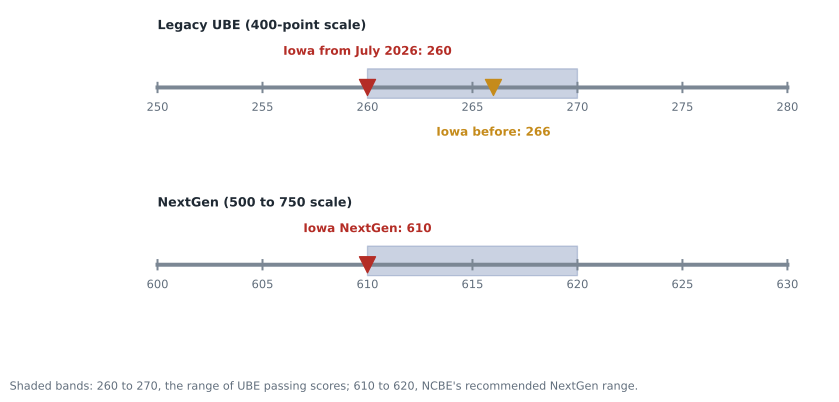
For many years Iowa required a combined scaled score of 266. On February 24, 2026, the Iowa Supreme Court amended rule 31.3, effective July 1, 2026, to lower the passing score to 260 for legacy exams given after July 1, 2026. The July 2026 and February 2027 exams are therefore graded against 260. The rule keeps 266 for exams given on or before July 1, 2026, which matters mainly for transferred scores and for applicants whose earlier results are being reviewed.
A score of 260 is at the bottom of the range used by UBE jurisdictions, which runs from 260 to 270. Several other jurisdictions have used 260 over the years. The change brings Iowa's last legacy exams into line with its NextGen standard: NCBE's guidance treats legacy scores of 260 to 270 as roughly corresponding to NextGen scores of 610 to 620, and Iowa chose 610 for NextGen. The court did not change the exam itself, only the score required to pass it.
Marchetti warns the group not to read too much into the lower number. 'Two hundred and sixty is still a real exam. Most people who fail the bar miss by more than a few points, and they miss because they did not practice enough under timed conditions. Plan to clear 270. Then the passing score is somebody else's problem.'
Results and approval
After grading and scaling are complete, the Board of Law Examiners approves the results. Rule 31.3 requires that at least four members of the board who are admitted to practice in Iowa vote to approve them. Results are then released to applicants and posted. The time from the exam to results varies; February results are typically released in the spring. Applicants who pass receive a score report, and those who fail receive their scores for each part, which helps in planning a retake.
A passing score does not by itself make the applicant a lawyer. The applicant must also have satisfied the board on character and fitness and have a passing MPRE score on file, and must then be recommended to the court, approved and sworn in. An applicant whose character and fitness review is still open when results come out may have to wait before taking the oath.
Retaking after the last legacy exam
An applicant who fails the February 2027 exam cannot retake the legacy UBE in Iowa, because Iowa's next exam, in July 2027, is the NextGen exam. A February 2027 score cannot be combined with later NextGen scores, and NCBE cautions that legacy and NextGen scores should not be compared numerically. Iowa's rules allow an applicant to transfer a legacy UBE score earned elsewhere if it meets the threshold, but a legacy score that does not pass in Iowa will not pass by transfer either.
For that reason Marchetti treats February 2027 as a one-shot exam. She builds Amos's plan around full-length timed practice, starting with MBE sets in November and adding timed essays and performance tests from December onward. 'Pretend there is no July,' she says. 'Because for you, on this version of the exam, there isn't.'
Worked problem
Reading a combined score
Amos takes a full-length practice exam in mid-November. His scaled MBE score is 136 and his scaled written score is 128, on the 200-point scales used for each half. Would that combined score pass in February 2027?
Show solution
- On the legacy UBE, the MBE and the written portion each make up half of the total and each is reported on a 200-point scale.
- The combined score is the sum of the two: 136 plus 128 equals 264.
- Iowa's passing score for exams after July 1, 2026 is 260.
- 264 is above 260, so a score like this would pass, but with little margin; a weak day on either half could drop it below.
Answer: A combined score of 264 would pass in February 2027, but Marchetti wants Amos to aim for 270 or more.
Common mistakes
MistakeEach part of the UBE has its own passing score in Iowa.
InsteadOnly the combined scaled score matters; strong performance on one part can offset another.
MistakeThe February 2027 MEE can test family law and trusts and estates.
InsteadNCBE removed those subjects, with conflict of laws and secured transactions, from the MEE starting in July 2026; they may still appear on the MPT with the law supplied.
MistakeNCBE grades the essays.
InsteadIowa lawyers grade the written portions using NCBE materials; the scores are then scaled to the MBE.
MistakeA failed February 2027 applicant can retake the same exam in July 2027.
InsteadIowa's July 2027 exam is the NextGen exam; the legacy UBE is not offered again in Iowa.
How to study for each part
Marchetti divides Amos's preparation by part, because each part rewards a different kind of practice. For the MBE, the work is volume and review: thousands of practice questions over the months before the exam, with every wrong answer logged and the rule behind it rewritten in his own words. She recommends licensed NCBE questions where possible, because they are written by the same drafters as the real exam, and she asks him to review each set the same day, while his reasoning is still fresh. Speed comes from familiarity, not from rushing: an examinee who knows the rules well reads faster because fewer answer choices need a second look.
For the MEE, the work is writing. Amos writes at least two timed essays a week and compares each with NCBE's analysis or a model answer. He checks three things: whether he spotted every issue, whether he stated each rule accurately and whether he applied the rule to the specific facts, not just in general terms. Graders reward organized answers that use headings for each issue and reach a conclusion on each. A good MEE answer is usually not long; it is clear.
For the MPT, the work is reading and following instructions. Each task comes with a memo from a supervising lawyer that sets out the assignment, the audience and often the format. Many examinees lose points not because they misunderstand the law but because they write the wrong kind of document, ignore the format instructions or spend too long reading. Amos practices with released MPTs, timing himself at ninety minutes each and, later, two in three hours.
Using the score to plan
Because only the combined score matters, an examinee can plan around strengths. An examinee whose MBE practice scores are consistently strong can afford a slightly weaker written score, and an examinee who writes well can absorb a weaker MBE. Marchetti uses practice scores to decide where the next hour of study does the most good. For most examinees, that means steady MBE work all the way to the exam, because the MBE is half of the score and practice gains there are the most reliable.
She is careful about one thing. Practice scores from commercial courses are estimates, not predictions. Different courses scale practice exams differently, and an examinee's performance on the real day may differ. She treats a practice score as a signal of trend rather than as a forecast. If the trend is rising and the most recent scores are comfortably above 260, the plan is working.
Handling the subjects removed from the MEE
Iowa applicants who used older study materials should check what they are studying. Family law, trusts and estates, conflict of laws and secured transactions no longer appear as MEE subjects from July 2026. Commercial courses have updated their materials, but used books and older outlines may not reflect the change. Amos's law school classes covered trusts and estates and family law in depth, and he is tempted to review them because they are familiar. Marchetti redirects him: those hours are better spent on business associations, which can still appear on the MEE, and on the seven MBE subjects, which can appear on both the MBE and the MEE.
Results day
When results are released, applicants learn whether they passed. Those who pass can expect to hear from the board about the next steps toward admission, including any remaining character and fitness items and the date of the admission ceremony. Those who do not pass receive their scores by part. Marchetti tells the group that the score report is useful whatever the result: it shows which part was strongest, which was weakest and how far the combined score was from the passing line. That information is the starting point for any further plan.
A note on grading fairness
Applicants sometimes ask whether they can see their essays or challenge a grade. Rules on review and appeal of results differ by jurisdiction, and applicants should read Iowa's current rules if the question arises. In general, the scaling process means that a single grader's view of a single essay rarely changes an overall result, and the time spent on regrading requests is usually better spent preparing for the next exam. For Iowa applicants failing in February 2027, that next exam would be the NextGen exam, which makes early planning especially important.
Summary and key terms
- The legacy UBE has three parts: the MEE (six essays), the MPT (two performance tests) and the MBE (200 multiple-choice questions).
- The weights are 50 percent MBE, 30 percent MEE and 20 percent MPT, combined on a 400-point scale.
- Iowa lowered its passing score from 266 to 260 for legacy exams after July 1, 2026.
- Iowa lawyers grade the written answers, which are scaled to the MBE; at least four board members must approve the results.
- February 2027 is Iowa's last legacy exam, so a failed applicant's next Iowa exam will be the NextGen exam.
- MBE
- The Multistate Bar Examination, 200 multiple-choice questions on seven subjects.
- MEE
- The Multistate Essay Examination, six essay questions answered in three hours.
- MPT
- The Multistate Performance Test, lawyering tasks completed from a supplied file and library.
- Equating
- A statistical process that adjusts MBE scores for differences in difficulty between exam forms.
- Scaling
- Converting written scores to the MBE scale of the same group of examinees.
Lesson quiz · 5 questions
Score 60% or more to complete this lesson.
Create a free account to save your progress, take quizzes and earn a certificate.