
ITIL-101 · Lesson 10 of 12 · 27 min
Study strategies and resources
Passing an ITIL exam is less about how many hours you spend and more about how you spend them. Reading the official book from cover to cover twice feels productive but is one of the least effective ways to prepare. Research on learning points to a handful of strategies that work far better: retrieval practice, spaced repetition, interleaving, elaboration and learning from errors. This lesson explains these strategies and applies them to ITIL, covers the resources available and how to judge them, shows how to use practice exams well, and discusses specific challenges such as similar-sounding practices, terminology and exam anxiety. It ends with advice for candidates studying in a second language and for those with accessibility needs. The study plan itself, how to allocate hours across weeks, is the subject of Lesson 11.
Why rereading is not enough
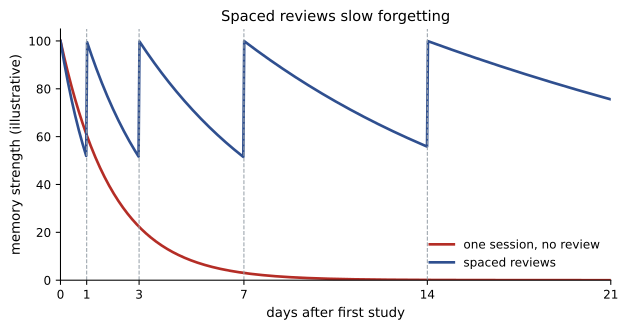
Rereading and highlighting create a feeling of familiarity: the material looks known, so it feels learned. But recognizing text on a page is different from recalling or applying it in an exam. Studies of learning have repeatedly found that actively retrieving information from memory, even when it is hard, produces stronger and longer-lasting learning than passive review. The practical lesson is to spend most study time testing yourself and explaining ideas rather than reading.
Five effective strategies
- Retrieval practice: test yourself without looking. Use flashcards, write down everything you remember about a topic, or answer practice questions before checking notes.
- Spaced repetition: review material at increasing intervals, such as one day, three days, a week and two weeks after first learning it. Flashcard apps can schedule this automatically.
- Interleaving: mix topics in a study session rather than studying one topic for hours. For example, alternate questions on guiding principles, practices and the four dimensions.
- Elaboration: explain why and how, and connect ideas to your own experience. For each practice, ask how it works in your organization and how it differs from related practices.
- Learning from errors: when you get a practice question wrong, work out why. Was it a gap in knowledge, a misread question or confusion between similar terms?
Applying the strategies to ITIL
ITIL Foundation has a large number of terms, principles and practice purposes to remember, which makes it well suited to flashcards with spaced repetition. A practical approach:
- After each study session, write 10–20 flashcards in your own words: a term on one side, a short definition and an example on the other.
- Review flashcards daily for 10–15 minutes, letting an app or a simple box system schedule them.
- For each practice, write a one-sentence purpose in your own words and one example from work.
- Draw the main models (such as the service value system or the four dimensions) from memory, then check them.
- Explain a guiding principle to a colleague or friend in two minutes without notes.
Worked problem
Planning flashcard reviews
Ali writes 15 new flashcards on each of 5 study days a week for 4 weeks. Each card takes about 10 seconds to review, and on average he reviews each card 6 times before the exam. How much total review time is that, and how much per day over the 4 weeks?
Show solution
- Total cards: 15 × 5 × 4 = 300.
- Total reviews: 300 × 6 = 1,800.
- Total review time: 1,800 × 10 s = 18,000 s = 300 minutes = 5 hours.
- Over 28 days: 300 ÷ 28 ≈ 11 minutes a day.
Answer: About 5 hours in total, or around 11 minutes a day, which is a small and very effective part of preparation.
Resources and how to judge them
The core resource for any ITIL exam is the official publication and syllabus for that module and version. Around it, candidates use course materials from accredited training, official eLearning and sample exams, independent study guides, video courses, flashcard apps and practice question banks. To judge an unofficial resource:
- Check the version and date: it should state clearly which version and exam it covers and when it was updated.
- Check the author's credentials and whether the resource is reviewed by others.
- Sample its practice questions: are they clearly written, with explanations, and consistent with the official material?
- Avoid anything advertised as real exam questions.
| Resource | Best use | Watch for |
|---|---|---|
| Official publication | Authoritative content | Density; read selectively with the syllabus |
| Official syllabus | Planning and weightings | Using an outdated version |
| Official sample exams | Realistic practice | Limited number; save one for the end |
| Accredited course materials | Structured learning | Access periods |
| Independent study guides | Clear explanations | Version and accuracy |
| Flashcard apps | Spaced retrieval | Cards written by others may be wrong |
| Practice question banks | Volume of practice | Quality; avoid dumps |
Using practice exams well
Practice exams are the most valuable resource in the final weeks, but only if used carefully. Take at least one under real conditions: timed, closed book, no interruptions. Review every question afterwards, including those you got right by guessing. Keep an error log with the topic, the reason for the error and the correct idea. Save at least one official sample exam for the last week to check readiness. Taking the same practice exam repeatedly inflates scores because you remember the answers rather than the ideas.
Worked problem
Reading an error log
After two practice exams, Hana's error log lists 14 errors: 6 on practices, 4 on guiding principles, 2 on the four dimensions and 2 on misread negative questions. Where should she focus?
Show solution
- Practices account for 6 of 14 errors, about 43 %, the largest share.
- Guiding principles account for 4, about 29 %.
- The 2 misread negative questions are a technique problem, fixed by slowing down on NOT and LEAST.
- She should spend most of her next week on practices, some on principles, and practise reading negative questions.
Answer: Focus first on practices, then principles, and fix the reading habit; the log turns vague worry into a specific plan.
Tackling similar-sounding practices
Many candidates confuse practices with similar names or overlapping purposes, such as incident management and problem management, or service request management and the service desk. A comparison table in your own words helps: for each pair, write the purpose of each, a typical example and the key difference. For instance, incident management restores normal service as quickly as possible, while problem management reduces the likelihood and impact of incidents by finding causes. Testing yourself on the differences, not just the definitions, prepares you for options designed to be confusing.
Terminology
ITIL uses everyday words with specific meanings, such as service, value, outcome, output, cost, risk and utility. In the exam, the ITIL meaning counts. Make flashcards for words that have both an everyday and an ITIL meaning, and practise using them precisely. Also learn the difference between closely related terms, such as output (something created by an activity) and outcome (a result for a stakeholder enabled by outputs).
Managing exam anxiety
Some anxiety improves performance; too much harms it. Practical steps help: take timed practice exams so the real one feels familiar; prepare for the logistics of online proctoring in advance; sleep well before the exam; and use a simple breathing technique, such as slow breaths with a longer exhale, if you feel panic during the exam. Remind yourself of the arithmetic: you can miss 14 of 40 Foundation questions and still pass.
Studying in a second language
Many candidates in Canada and the United States take ITIL exams in a language other than their first. Check which languages the exam is offered in and whether extra time is available for non-native speakers; at the time of writing, PeopleCert has offered extra time in some cases, so check current policy. Build a bilingual glossary of key terms, and practise with questions in the language of the exam.
Accessibility
Candidates with disabilities or medical conditions can usually request accommodations, such as extra time, breaks or assistive technology. Requests generally need to be made in advance with supporting documentation, so contact PeopleCert early in your preparation rather than close to the exam.
Studying with others
Study groups and study partners can improve learning when used well. The most useful group activities are retrieval-based: quizzing each other, explaining concepts without notes, debating why an answer is right and others wrong, and comparing how practices work in different workplaces. The least useful are long sessions of reading aloud or copying each other's notes. Keep group sessions short and focused, with a clear topic each time, and continue individual flashcard reviews between sessions.
Online communities can serve a similar purpose. Posting your own explanation of a concept and inviting correction is an effective way to test understanding. Be careful with answers given by others, though; check them against official material.
Making your own practice questions
Writing your own multiple-choice questions is a powerful study method. To write a good question, you must understand the concept well enough to create plausible wrong options, which forces you to think about common confusions. Try writing two or three questions for each study session, in the styles described in Lesson 6, and swap them with a study partner. Your questions will not match the real exam, and they should not try to, but the process deepens understanding.
Using study time on the move
Short periods of time, such as a commute by transit, a lunch break or waiting for an appointment, are ideal for flashcard reviews. Ten minutes of retrieval practice on a phone app several times a day adds up quickly and uses spacing naturally. Save longer, focused sessions for new material and full practice exams, which need concentration and a quiet place.
| Time available | Best activity |
|---|---|
| 5–10 minutes | Flashcard review |
| 20–30 minutes | One topic: read, then recall and explain |
| 45–60 minutes | New material plus self-testing |
| 60–90 minutes | Full timed practice exam |
| 30 minutes after an exam | Review errors and update the error log |
Building comparison tables for practices
A comparison table is one of the most useful study tools for Foundation and Practice Manager modules. For each pair or group of practices that are easy to confuse, write a row for each practice with its purpose in your own words, a typical trigger, a typical output and a workplace example. Writing the table forces elaboration; testing yourself on it later is retrieval practice. Keep it short: a single page for the practices in your syllabus is enough.
| Practice | Purpose in your own words | Typical trigger | Example |
|---|---|---|---|
| Incident management | Restore normal service quickly | Something stops working | Email outage fixed by restart |
| Problem management | Find and manage causes of incidents | Repeated or major incidents | Root cause of repeated outages |
| Service request management | Handle predefined user requests | User asks for something standard | New laptop or password reset |
| Change enablement | Make changes safely | Proposed change to a service | Approval of a software update |
Sleep, exercise and learning
Memory consolidation depends heavily on sleep. Studying late into the night before an exam often harms performance more than it helps, because tired candidates read questions less carefully and recall less. Regular physical activity also supports concentration and mood. Treat sleep and movement as part of your study plan, not as time taken away from it.
Measuring progress
Track a few simple measures: hours studied each week, flashcards reviewed, practice exam scores and the number of entries in your error log by topic. A small chart of practice scores over time shows whether you are improving and when you are ready. Seeing steady improvement is also motivating during the middle weeks of preparation, when enthusiasm often dips.
Avoiding over-preparation
It is also possible to over-prepare. Some candidates keep studying for months because they never feel completely ready, while their knowledge plateaus and motivation fades. Clear readiness criteria, such as consistent scores around 80 % on good-quality practice exams, protect against this. When you meet them, book the exam. Remember that Foundation is a starting point; deeper understanding comes from applying ideas at work and from later modules, not from endless revision of the first one.
Choosing a few good resources
More resources do not mean better preparation. Switching between many books, videos and question banks often leads to shallow coverage and confusion when sources describe ideas differently. A strong combination for Foundation is the official syllabus, one core text (official or a reliable study guide), your own flashcards and comparison tables, and two or three sets of good-quality practice exams. Add other resources only to fill a specific gap, such as a short video explaining a model you find hard.
Common mistakes
MistakeRereading the book repeatedly.
InsteadSpend most time on retrieval practice.
MistakeCramming one topic for hours.
InsteadSpace and interleave topics.
MistakeRetaking the same practice exam.
InsteadUse new exams and save one for the end.
MistakeIgnoring why answers were wrong.
InsteadKeep an error log and act on it.
MistakeRequesting accommodations at the last minute.
InsteadContact PeopleCert early.
Summary and key terms
- Rereading creates familiarity, not reliable recall.
- Use retrieval practice, spacing, interleaving, elaboration and error analysis.
- Flashcards with spaced repetition suit ITIL terminology well.
- Judge resources by version, author, question quality and honesty.
- Use practice exams under real conditions with an error log.
- Compare similar practices and precise terms in your own words.
- Plan for anxiety, language and accessibility needs early.
- Retrieval practice
- Recalling information from memory to strengthen it.
- Spaced repetition
- Reviewing at increasing intervals.
- Interleaving
- Mixing topics within a session.
- Elaboration
- Explaining and connecting ideas.
- Error log
- Record of mistakes and their causes.
- Forgetting curve
- Decline of memory over time without review.
- Flashcard
- Card with a prompt and an answer.
- Output
- Something created by an activity.
- Outcome
- A result for a stakeholder enabled by outputs.
- Accommodation
- Adjustment to exam conditions for a need.
Practice problems
Work each problem on paper first, then reveal the answer to check.
Why is rereading weak?
Show answer
It creates familiarity rather than recall.
Name the five strategies.
Show answer
Retrieval, spacing, interleaving, elaboration, learning from errors.
Give example review intervals.
Show answer
One, three, seven and fourteen days.
Compute 1,800 × 10 seconds in minutes.
Show answer
300 minutes.
What should every resource state clearly?
Show answer
Its version and date.
How should you take at least one practice exam?
Show answer
Timed, closed book, uninterrupted.
What goes in an error log?
Show answer
Topic, reason and correct idea.
Distinguish incident and problem management.
Show answer
Restore service quickly versus reduce incidents by finding causes.
Distinguish output and outcome.
Show answer
Created by an activity versus result for a stakeholder.
When should you request accommodations?
Show answer
Early, with documentation.
Lesson quiz · 5 questions
Score 60% or more to complete this lesson.
Create a free account to save your progress, take quizzes and earn a certificate.