
ITIL-101 · Lesson 4 of 12 · 27 min
ITIL 4 and ITIL (Version 5)
In 2026, ITIL candidates face a choice that did not exist a year earlier: study ITIL 4, which has been the current version since 2019 and is still widely used, or study ITIL (Version 5), released in February 2026. Both are available at the time of writing, they share much of their content, and the certification rules link them together. This lesson compares the two at the level a certification candidate needs: the core ideas each version emphasizes, how the practices are treated, how the modules and designations differ, how transition works for people who already hold ITIL 4 certificates, and how to decide which version to study. It does not teach the content of either version in depth; that is the job of the official materials and the training for each module. Where details of Version 5 have not yet been confirmed by several independent sources, this lesson says so.
The core ideas of ITIL 4
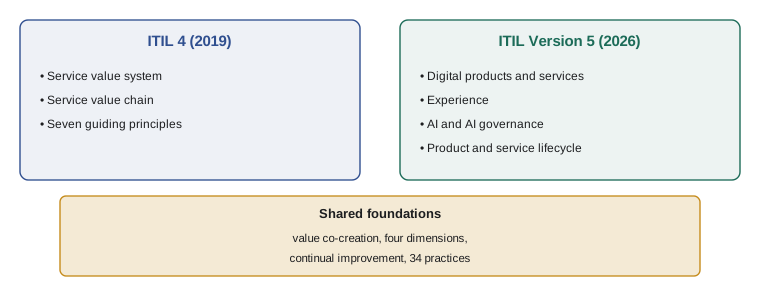
ITIL 4 describes service management through the service value system (SVS). Opportunity and demand enter the system, and value for the organization and its stakeholders comes out. Inside the system are five components: the guiding principles, governance, the service value chain, practices and continual improvement. The service value chain has six activities (plan; improve; engage; design and transition; obtain/build; deliver and support) that can be combined into value streams for particular situations. ITIL 4 also describes four dimensions of service management (organizations and people; information and technology; partners and suppliers; value streams and processes) that must all be considered, and seven guiding principles, such as "focus on value" and "progress iteratively with feedback". Value is described as co-created by providers and consumers rather than delivered from one to the other.
Candidates who have studied ITIL 4 Foundation will recognize these terms. They form the backbone of the ITIL 4 Foundation exam, which tests understanding of the key concepts, the guiding principles, the four dimensions, the SVS and value chain, and the purpose and key terms of a selection of practices.
What changes in ITIL (Version 5)
ITIL (Version 5) broadens the scope from managing IT services to managing digital products and services across the whole organization. Public descriptions of Version 5 emphasize several themes:
- Products as well as services: the guidance treats digital products and the services built on them as a combined subject, recognizing that many organizations now manage products with product teams.
- Experience: explicit attention to the experience of customers, users and employees, not only to outputs and service levels.
- Artificial intelligence: guidance on using AI in service management and on governing AI responsibly, with a dedicated AI Governance module.
- A lifecycle view of products and services: training materials describe a model covering how products and services are conceived, built, operated and retired.
- Continuity with ITIL 4: value co-creation, the four dimensions and continual improvement remain central, and the 34 management practices are kept.
Some descriptions of the Version 5 Foundation syllabus name specific components, such as a Product and Service Lifecycle Model and an AI Capability Model. At the time of writing (October 2026), these names come from training-provider summaries rather than from multiple independent confirmations, so candidates should check the official syllabus for exact terms before studying.
Practices in both versions
Both versions describe 34 management practices, grouped as general management practices, service management practices and technical management practices in ITIL 4. Examples include incident management, change enablement, service level management, problem management, information security management and relationship management. The number is the same in Version 5, but the way practices are described and delivered differs. At the time of writing, the full descriptions of all 34 Version 5 practices are available through the PeopleCert Plus membership, and the 15 practices covered by the Practice Manager modules are also included with those courses. Candidates should not assume that practice names and groupings are identical between versions; check the current materials.
Modules and designations compared
The two versions have different module structures, which is the most important difference for certification planning. ITIL 4 offered Foundation; four Managing Professional modules (Create, Deliver and Support; Drive Stakeholder Value; High-velocity IT; Direct, Plan and Improve); a Digital and IT Strategy module (with Direct, Plan and Improve, leading to Strategic Leader); a Practice Manager designation built from practice modules; and several extension modules on topics such as sustainability and business relationship management. ITIL (Version 5) reorganizes this into Foundation, eight advanced modules and one extension, with designations built from combinations of them (Lesson 5).
| Feature | ITIL 4 | ITIL (Version 5) |
|---|---|---|
| Released | February 2019 (Foundation) | February 2026 |
| Central model | Service value system and value chain | Digital products and services with a lifecycle view |
| Practices | 34 | 34, described differently |
| AI | Limited coverage | Integrated, plus AI Governance module |
| Foundation exam | 40 questions, 60 minutes, 65 % (widely reported) | 40 questions, 60 minutes, 65 % |
| Designations | Managing Professional, Strategic Leader, Practice Manager | Practice Manager, Managing Professional, Strategic Leader, Master |
| Extension modules | Several | AI Governance only, at the time of writing |
Transition rules
For people who already hold ITIL certificates, the transition rules matter more than the content changes. At the time of writing, the following rules have been published by PeopleCert and its partners:
- ITIL 4 Foundation holders do not need to retake Foundation; ITIL 4 Foundation is recognized as the prerequisite for Version 5 advanced modules.
- Holders of the older ITIL v3 Foundation are advised to take the Version 5 Foundation, since v3 is two generations behind.
- A short Foundation bridge course with a shorter exam has been offered for ITIL 4 Foundation holders who want the Version 5 Foundation certificate.
- A Managing Professional (Version 5) transition module for ITIL 4 Managing Professional holders was reported to be in final validation; check its status before planning around it.
- ITIL 4 and Version 5 are expected to run in parallel for at least 12 months, and no retirement date for ITIL 4 has been announced.
- Unused ITIL 4 exam vouchers can be exchanged for Version 5 equivalents, and training and exam costs were reported as unchanged.
Passing a Version 5 certification also counts as renewing existing ITIL certificates in the same product suite under PeopleCert's renewal rules (Lesson 12).
Which version should you study?
For most new candidates in late 2026, Version 5 Foundation is the forward-looking choice: it is the current generation, materials are available, and certificates will remain current for longer. ITIL 4 Foundation remains a reasonable choice in some situations: your employer has standardized on ITIL 4 and is paying for an ITIL 4 class, you have ITIL 4 materials and a voucher already, or the training offered in your area or language is still ITIL 4 only. Because ITIL 4 Foundation is recognized as a prerequisite for Version 5 advanced modules, choosing ITIL 4 Foundation now does not block a future Version 5 path.
Worked problem
Choosing a version
Three people are deciding which Foundation to take in November 2026. Amir is new to IT service management and is paying himself. Bea works for a US government contractor whose internal processes and job descriptions use ITIL 4 terminology, and her employer has bought an ITIL 4 Foundation class. Chen passed ITIL 4 Foundation in 2022 and wants to move on to Managing Professional. What should each do?
Show solution
- Amir: no existing certificate or constraints, so take Version 5 Foundation, which is current and longest-lasting.
- Bea: the employer-paid ITIL 4 class matches her workplace terminology, and ITIL 4 Foundation remains a valid prerequisite for Version 5 modules, so accepting it is sensible.
- Chen: he does not need another Foundation. His ITIL 4 Foundation is recognized for Version 5 advanced modules, so he can start Version 5 Managing Professional modules (with accredited training).
- Chen should note that his 2022 certificate needs renewal three years after certification under current rules; passing a Version 5 module would renew it.
Answer: Amir takes Version 5 Foundation; Bea takes the employer-paid ITIL 4 Foundation; Chen goes straight to Version 5 advanced modules, which also handles his renewal.
Exam implications
The two Foundation exams have the same reported format, but the content differs. Practice questions written for ITIL 4 Foundation will test concepts such as the service value chain and its six activities, which may not be tested in the same way in Version 5. If you study for Version 5, use materials written for Version 5. If you study for ITIL 4, avoid Version 5 materials, which may introduce terms that will not appear on your exam. Always answer exam questions using the terminology of the version you are sitting. The safest single source for what each exam covers is its official syllabus, which is published by PeopleCert and usually provided by training organizations.
Living with two versions at work
In many organizations, both versions will coexist for years. Teams may run processes designed under version 3, describe their work in ITIL 4 language, and begin adopting Version 5 ideas about digital products and experience. A useful habit for certified practitioners is to translate between versions when talking with colleagues, focusing on the underlying ideas, such as restoring service quickly, managing risk in changes and improving continually, rather than insisting on one version's vocabulary.
Translating between versions
Because colleagues and materials will use terms from different versions for years, a small translation table is a practical study aid. It does not need to be exact; the point is to recognize when two terms refer to similar ideas.
| Older term | ITIL 4 term | Idea behind it |
|---|---|---|
| Process (version 3) | Practice | A set of organizational resources for work |
| Change management | Change enablement | Assessing and authorizing changes |
| Service lifecycle | Service value system and value chain | How services create value |
| Function | Practice and team structure | People organized to do work |
| Business value | Value co-creation | Value created with consumers |
When you study Version 5, extend the table with any new terms you meet, and note where an idea is genuinely new rather than renamed. This habit reduces confusion and helps you explain ideas to colleagues who learned an earlier version.
What the change means for employers
Employers face their own choices in 2026. Some will move training to Version 5 quickly to keep their teams current; others will continue with ITIL 4 until materials, translations and trainers are widely available. Organizations that have built processes and tools around ITIL 4 terminology may adopt Version 5 ideas gradually. If you are asked to advise your employer, focus on the practical questions: which version current staff hold, what training budgets allow, how soon renewal deadlines fall, and whether Version 5 themes such as experience and AI governance address the organization's current priorities.
A worked comparison of two study routes
Worked problem
Cost of switching versions mid-study
Tomás bought an ITIL 4 Foundation self-study bundle in late 2025 and has studied for 10 of a planned 25 hours. Version 5 is now available. Should he switch?
Show solution
- If his voucher can be exchanged for a Version 5 voucher, switching costs no money but means relearning some content.
- Much of his learning carries over: value co-creation, the four dimensions, continual improvement and practice purposes are shared.
- He estimates that switching adds about 5 hours, giving 30 hours in total instead of 25.
- Staying with ITIL 4 is quicker, and ITIL 4 Foundation is still recognized for Version 5 advanced modules.
Answer: If he wants the quickest certificate, he should finish ITIL 4; if he values a current-version certificate and can spare about 5 extra hours, an exchange to Version 5 is reasonable. Either choice keeps a Version 5 path open.
Decisions like this rarely have one right answer. The key is to know the facts, which are the exchange rules, the overlap in content and the recognition of ITIL 4 Foundation, and to weigh them against your own time and goals.
Common mistakes
MistakeBelieving ITIL 4 certificates became invalid in 2026.
InsteadThey remain recognized; ITIL 4 Foundation is a prerequisite for Version 5 modules.
MistakeRetaking Foundation unnecessarily.
InsteadITIL 4 Foundation holders can go straight to Version 5 advanced modules.
MistakeMixing ITIL 4 and Version 5 practice questions.
InsteadUse materials for the version you will sit.
MistakeAssuming the practices are identical in both versions.
InsteadThe number is the same, but descriptions and packaging differ.
MistakeRelying on unconfirmed component names.
InsteadCheck the official syllabus for exact Version 5 terms.
Summary and key terms
- ITIL 4 centres on the service value system and value chain.
- Version 5 broadens to digital products and services, experience and AI.
- Both versions describe 34 practices, packaged differently.
- The Foundation exams have the same reported format but different content.
- ITIL 4 Foundation is recognized for Version 5 advanced modules.
- The versions run in parallel for at least 12 months; no ITIL 4 end date was announced.
- Most new candidates should choose Version 5; constraints may favour ITIL 4.
- Service value system
- ITIL 4 model turning demand into value.
- Service value chain
- Six ITIL 4 activities combined into value streams.
- Value stream
- Series of steps to create a product or service.
- Value co-creation
- Value created jointly by provider and consumer.
- Digital product
- A product delivered or enabled by technology.
- Experience
- How stakeholders perceive their interactions.
- AI governance
- Directing and controlling the use of AI responsibly.
- Bridge course
- Short course moving a certificate to a newer version.
- Transition module
- Module for upgrading a designation.
- Syllabus
- Official list of what an exam covers.
Practice problems
Work each problem on paper first, then reveal the answer to check.
Name the five components of the ITIL 4 SVS.
Show answer
Guiding principles, governance, service value chain, practices, continual improvement.
How many value chain activities are there?
Show answer
Six.
Name the four dimensions.
Show answer
Organizations and people; information and technology; partners and suppliers; value streams and processes.
Name two Version 5 themes.
Show answer
Digital products and services, experience, AI.
How many practices are in Version 5?
Show answer
34.
Do ITIL 4 Foundation holders need Version 5 Foundation for advanced modules?
Show answer
No.
What should ITIL v3 Foundation holders do?
Show answer
Take Version 5 Foundation.
How long will versions run in parallel at minimum?
Show answer
12 months.
What is the extension module in Version 5?
Show answer
AI Governance.
Which terminology should you use in the exam?
Show answer
That of the version you are sitting.
Lesson quiz · 5 questions
Score 60% or more to complete this lesson.
Create a free account to save your progress, take quizzes and earn a certificate.