
ITIL-101 · Lesson 11 of 12 · 30 min
Building a study plan
A study plan turns good intentions into a schedule you can follow. Without one, preparation tends to expand to fill whatever time is available or, more often, gets pushed aside by work and family until the exam date looms. With one, you know how many hours you need, when you will study, what you will cover each week and how you will know you are ready. This lesson shows how to build a plan for ITIL Foundation and for an advanced module: estimating total hours from your background, allocating hours by syllabus weighting, choosing a weekly rhythm, setting milestones, building in buffers and adjusting the plan when life intervenes. The hour estimates here are rules of thumb based on common experience and training-provider guidance at the time of writing (October 2026), not official requirements.
Step 1: estimate total hours
The time needed for Foundation depends on your background. A common range is 15–40 hours of total preparation, including any course time.
| Background | Typical Foundation hours | Notes |
|---|---|---|
| Experienced in IT service management | 15–20 | Mostly learning ITIL terms for familiar ideas |
| Some IT experience, new to ITIL | 20–30 | The most common situation |
| New to IT or studying in a second language | 30–40 | More time on terms and context |
| Advanced module (with training) | 30–60 | Course time plus study and practice |
If you take a two-day course, count about 14 hours of course time toward your total, then add self-study for review and practice exams.
Step 2: allocate hours by syllabus weighting
The official syllabus lists learning outcomes with weightings, often expressed as a number of questions or a percentage of the exam. Allocating study time in proportion to weightings ensures that you spend the most time where most marks are. Adjust for your strengths: spend less on areas you already know and more on unfamiliar ones. Reserve about a fifth of total time for practice exams and review.
Worked problem
Allocating hours by weighting
Sam plans 25 hours for Foundation. He reserves 5 hours for practice exams and review, leaving 20 hours for content. Suppose (illustratively) the syllabus areas carry these shares of the questions: key concepts 15 %, guiding principles 20 %, four dimensions 10 %, value system and lifecycle 20 %, practices 35 %. How should he allocate the 20 content hours?
Show solution
- Key concepts: 0.15 × 20 = 3 hours.
- Guiding principles: 0.20 × 20 = 4 hours.
- Four dimensions: 0.10 × 20 = 2 hours.
- Value system and lifecycle: 0.20 × 20 = 4 hours.
- Practices: 0.35 × 20 = 7 hours.
- Check: 3 + 4 + 2 + 4 + 7 = 20 hours, plus 5 for practice and review = 25.
Answer: Sam allocates 3, 4, 2, 4 and 7 hours to the five areas and 5 hours to practice exams, replacing the illustrative weightings with those in the official syllabus.
Step 3: choose a weekly rhythm
Divide total hours by the hours you can realistically study each week to get the number of weeks. Be honest: most working adults can sustain 4–8 hours a week. Short, frequent sessions, such as 45 minutes on weekdays and a longer session on the weekend, work better than occasional marathons because they allow spacing and reduce fatigue.
Worked problem
A four-week Foundation plan
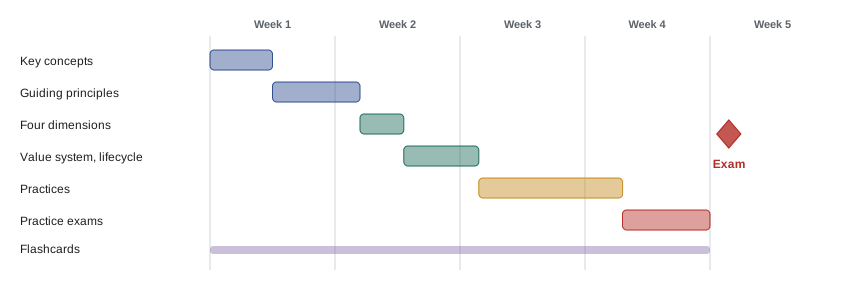
Using Sam's 25 hours, build a plan for someone who can study about 6–7 hours a week.
Show solution
- 25 hours ÷ 6.5 hours a week ≈ 3.8 weeks, so plan 4 weeks.
- Week 1 (6 h): key concepts (3 h), guiding principles (3 h); start flashcards.
- Week 2 (6 h): guiding principles (1 h), four dimensions (2 h), value system and lifecycle (3 h).
- Week 3 (7 h): value system and lifecycle (1 h), practices (6 h, beginning the comparison tables).
- Week 4 (6 h): practices (1 h), two full timed practice exams with review (4 h), error-log revision (1 h).
- Exam: early in week 5, after scoring around 80 % on practice exams; daily 10-minute flashcard reviews throughout.
Answer: A four-week plan of 6–7 hours a week covers the content in proportion to weightings and leaves the final week for practice and review, with the exam booked for early week 5.
Step 4: set milestones and readiness checks
Milestones turn a plan into checkpoints you can measure. Useful Foundation milestones include: finishing the first pass through all syllabus areas; scoring at least 70 % on a first practice exam; completing comparison tables for all practices in scope; and scoring around 80 % on two different full practice exams. Book the exam when you can see the last milestone approaching, rather than booking first and hoping. If your voucher has an expiry date, work backwards from it to set a latest booking date.
Step 5: build in buffers
Life interrupts study: busy weeks at work, illness, family events. A buffer of about 20 % extra time, such as one spare week in a five-week plan, absorbs disruptions without derailing the exam date. If you do not need the buffer, you can take the exam early or use the time for extra practice.
Worked problem
Adding a buffer
Rosa plans 30 hours at 5 hours a week. How many weeks should she plan, including a 20 % buffer?
Show solution
- Base plan: 30 ÷ 5 = 6 weeks.
- Buffer: 0.20 × 6 = 1.2 weeks, rounded up to 1 or 2; choose 1 week for a total of 7.
- She schedules content in weeks 1–5, practice exams in week 6, and keeps week 7 as a buffer.
Answer: Plan 7 weeks: 6 weeks of planned study and 1 buffer week before the exam.
Plans for advanced modules
Advanced modules require accredited training, so the plan has three phases: pre-course reading (about 5–10 hours, using any materials the provider sends), the course itself, and post-course preparation (about 10–20 hours of practice exams and review), followed by the exam within two to four weeks. For open-book exams, include practice in finding information in the publication under time pressure. Spacing modules two to three months apart allows time to apply ideas at work.
| Phase | Typical time | Activities |
|---|---|---|
| Pre-course | 1–2 weeks, 5–10 h | Read the syllabus, skim materials, list workplace examples |
| Course | 3–5 days or equivalent | Attend, take part in exercises, ask questions |
| Post-course | 2–4 weeks, 10–20 h | Sample exams, error log, book navigation practice |
| Exam | Within 2–4 weeks of course | Timed, following the plan |
Adjusting the plan
Review the plan weekly. If you fall behind, adjust rather than abandon it: reduce time on strong areas, extend into the buffer, or move the exam date if the voucher allows. If practice scores are consistently high early, consider booking sooner. Keep notes on what worked; they will help with the next module.
Making the plan stick
Plans succeed when they fit into real life. Put study sessions in your calendar as appointments. Study at the same time each day where possible, so it becomes a habit. Tell family or colleagues about your exam date for support and accountability. Use small rewards for milestones. If you study with a colleague, quiz each other weekly. And keep sessions short enough that you look forward to them rather than dread them.
A plan template
A simple template keeps your plan visible and easy to update. Copy it into a spreadsheet, a notebook or a calendar note.
| Item | Your entry |
|---|---|
| Exam and version | For example, ITIL (Version 5) Foundation |
| Target exam date | Date, and latest date allowed by voucher |
| Total hours estimate | From Step 1 |
| Weekly hours | Realistic, typically 4–8 |
| Weeks including buffer | Total ÷ weekly hours, plus about 20 % |
| Hours by syllabus area | From weightings |
| Milestones | First pass, first practice exam, 80 % twice |
| Weekly review day | For example, Sunday evening |
Fitting study around shift work and travel
Not everyone has regular evenings free. People on rotating shifts, in field roles or travelling often need a different rhythm. Plan in terms of hours per fortnight rather than per week if your schedule varies, and assign tasks to the type of time available: flashcards for short breaks, new material for days off, practice exams for quiet periods. If you travel across time zones, avoid booking an online exam soon after a long flight.
Plans for teams
When several colleagues are preparing for the same exam, a shared plan helps. Agree a common schedule for syllabus areas, hold a short weekly session to quiz each other, and share good practice resources. Individuals still need their own flashcards and practice exams, because retrieval is personal. Managers supporting a team can help by protecting a small amount of study time each week and by scheduling exams after busy periods rather than during them.
When to postpone
Sometimes the right decision is to postpone. If practice scores are well below the pass mark a week before the exam, or if a work crisis or personal event has consumed your study time, rescheduling is usually better than sitting the exam unprepared. Check your voucher's rescheduling rules and deadlines in advance so that you know your options. Postponing with a clear revised plan is part of good planning, not a failure.
Reviewing your plan after the exam
Whatever the result, spend half an hour after the exam reviewing your plan. Which strategies worked? Were your hour estimates accurate? Which areas were harder than expected? Notes from this review will make your next plan, for an advanced module or another certification, more accurate and less stressful.
A worked example: a plan for an advanced module
Worked problem
Planning the Transformation module
Grace holds Foundation and Strategy and has booked a five-day live virtual Transformation course starting 1 March. She can study 5 hours a week outside the course. Her exam is open book. Build her plan.
Show solution
- Pre-course (two weeks before 1 March): 8 hours reading the syllabus, skimming the publication and listing workplace examples of change.
- Course week: attend all sessions; spend 30 minutes each evening reviewing the day and noting where key topics sit in the book.
- Post-course week 1: 5 hours; one timed sample exam, review errors, practise finding key models in the publication.
- Post-course week 2: 5 hours; second timed sample exam, targeted review of weak areas.
- Post-course week 3: 3 hours of light review; exam at the end of the week, about three weeks after the course.
Answer: About 8 hours before the course, the course itself, and about 13 hours over three weeks after it, with the exam roughly three weeks after training while the material is fresh.
Estimating your own hours more accurately
Rules of thumb give a starting point, but a quick diagnostic gives a better estimate. Before planning, take a short practice quiz or skim the syllabus and rate your familiarity with each area on a scale of 1 to 3. Areas rated 1 (unfamiliar) may need twice the average time, areas rated 3 (familiar) about half. Adjust your total hours accordingly. After the first week, compare actual progress with the plan and adjust again; early weeks often reveal whether your estimate was optimistic.
Protecting study time
Plans fail most often because study time gets taken by other things. Choose a time of day when interruptions are rare, such as early morning, and treat it like a meeting. Turn off notifications during sessions. If a session is missed, move it within the same week rather than dropping it. Small, protected sessions completed reliably beat ambitious sessions that keep getting cancelled.
Common shapes of study plans
Most successful plans take one of three shapes. A sprint plan uses a short, intense period, such as a two-day course followed by a week of practice, and suits people with protected time and some background knowledge. A steady plan uses a moderate weekly load over four to eight weeks and suits most working adults. A long plan spreads study over two or three months at a light weekly load and suits people with heavy commitments or who are new to IT. None is best for everyone; choose the shape that fits your life, then apply the same steps of estimating, allocating, scheduling, setting milestones and adding a buffer.
Common mistakes
MistakePlanning more weekly hours than you can sustain.
InsteadPlan realistic hours, typically 4–8 a week.
MistakeAllocating time equally to all topics.
InsteadAllocate by syllabus weighting and your strengths.
MistakeBooking the exam before any practice tests.
InsteadBook when readiness milestones are in sight.
MistakeHaving no buffer.
InsteadAdd about 20 % extra time.
MistakeAbandoning the plan after a bad week.
InsteadAdjust it and continue.
Summary and key terms
- Estimate total hours from your background; 15–40 for Foundation is common.
- Allocate content hours in proportion to syllabus weightings.
- Reserve about a fifth of time for practice exams and review.
- Choose a sustainable weekly rhythm and compute the number of weeks.
- Set measurable milestones and book the exam near the last one.
- Add a buffer of about 20 %.
- Advanced modules need pre-course, course and post-course phases.
- Study plan
- Schedule of what to study and when.
- Weighting
- Share of the exam for a syllabus area.
- Content hours
- Time spent learning material.
- Review hours
- Time for practice exams and revision.
- Weekly rhythm
- Regular pattern of study sessions.
- Milestone
- Measurable checkpoint in a plan.
- Readiness check
- Test that shows you are ready to book.
- Buffer
- Spare time for disruptions.
- Voucher expiry
- Date by which an exam must be taken.
- Pre-course reading
- Preparation before accredited training.
Practice problems
Work each problem on paper first, then reveal the answer to check.
What is a common Foundation hour range?
Show answer
15–40 hours.
How much time should be reserved for practice and review?
Show answer
About a fifth.
Compute 0.35 × 20.
Show answer
7 hours.
Compute 25 ÷ 6.5 rounded up.
Show answer
4 weeks.
What weekly hours can most working adults sustain?
Show answer
4–8.
Name two Foundation milestones.
Show answer
First pass complete; 80 % on two practice exams.
What buffer is suggested?
Show answer
About 20 %.
How many weeks for 30 hours at 5 per week plus buffer?
Show answer
7.
Name the three phases for advanced modules.
Show answer
Pre-course, course, post-course.
What should you do after a bad week?
Show answer
Adjust the plan rather than abandon it.
Lesson quiz · 5 questions
Score 60% or more to complete this lesson.
Create a free account to save your progress, take quizzes and earn a certificate.