
ITIL-101 · Lesson 12 of 12 · 31 min
Maintaining certification and capstone
For many years, an ITIL certificate lasted for life. That changed with the introduction of renewal requirements: at the time of writing (October 2026), ITIL 4 and ITIL (Version 5) certificates must be renewed three years after certification. Planning for renewal is now part of planning a certification path. This lesson explains the renewal rules and options, compares their costs, shows how to track renewal dates, and considers how to keep skills current beyond formal requirements. It then pulls the whole course together in a capstone exercise in which you build a complete certification plan: choose a path, estimate time and cost, build a study plan, plan renewal and estimate return. The renewal rules described here are those published by PeopleCert at the time of writing; they have changed before and may change again, so check your PeopleCert account and the official renewal page.
The renewal rule
Under PeopleCert's current rules, ITIL 4 and ITIL (Version 5) certifications must be renewed within three years of the certification date. The certificate shows a renew-by date. If you do not renew, the certificate is no longer shown as current, although you have still passed the exam. Employers increasingly check whether certificates are current, so a lapsed certificate may carry less weight.
There are three ways to renew at the time of writing:
- CPD through PeopleCert Plus: maintain a PeopleCert Plus membership and log 20 CPD points per year for three consecutive years. CPD activities include reading, attending webinars and events, training, mentoring and other professional development.
- Pass another certification in the same product suite: passing another ITIL exam renews all your ITIL certifications. For example, passing Version 5 Foundation renews existing ITIL 4 certificates, and passing an advanced module renews Foundation.
- Retake the same exam: pass the exam for the certificate again.
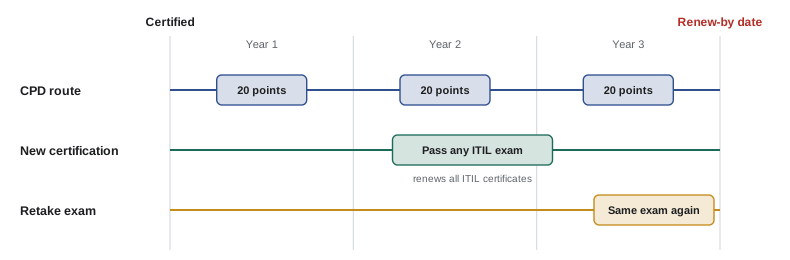
Comparing renewal routes
The best route depends on your plans. If you intend to take further ITIL modules within three years, the "new certification" route renews everything at no extra cost beyond the module you were taking anyway. If you hold several certificates and do not plan new modules, CPD through membership may be cheapest. Retaking the same exam is usually the least attractive option, unless you hold only Foundation and want a cheap one-off renewal.
Worked problem
Comparing renewal costs
Kim holds ITIL 4 Foundation and Managing Professional, earned in 2024. She does not plan new modules soon. Option 1: PeopleCert Plus membership for three years at an assumed US$100 per year, logging 20 CPD points a year. Option 2: take Version 5 Foundation at an assumed US$540 in year three. Option 3: take one Version 5 advanced module at an assumed US$2,500 in year three. Which is cheapest, and what else matters?
Show solution
- Option 1: 3 × US$100 = US$300, plus time to log about 60 points over three years.
- Option 2: US$540, plus study time; it renews all her ITIL certificates and adds a Version 5 Foundation certificate.
- Option 3: US$2,500, but it also moves her toward a Version 5 designation; worthwhile only if she wants that.
- Membership also gives her access to publications, including all Version 5 practice descriptions.
Answer: With these assumptions, CPD through membership is cheapest at about US$300; Version 5 Foundation costs more but adds a current-version certificate. She should check actual membership prices and whether her employer pays.
| Route | Effort | Typical cost | Best for |
|---|---|---|---|
| CPD with PeopleCert Plus | 20 points a year for 3 years | Annual membership fee | Several certificates, no new modules planned |
| New certification in the suite | One exam | Cost of that module | Candidates progressing through the scheme |
| Retake the same exam | One exam | Exam fee | Single certificate, rarely preferred |
Tracking renewal dates
With several certificates from different years, tracking dates matters. Keep a simple table with each certificate, its date, its renew-by date and your planned renewal route. Because passing a new ITIL certification renews all of your ITIL certifications, a single exam can reset several dates at once. Set calendar reminders a year and six months before the earliest renew-by date. Check older certificates as well: ITIL v3 and 2011 certificates are not subject to the same renewal scheme, but employers may view them as out of date compared with current-version certificates.
Worked problem
Planning renewal around a path
Omar earned ITIL 4 Foundation in March 2025 and plans Strategic Leader (Version 5) with Strategy in 2027 and Transformation in 2028. When does his Foundation need renewal, and will his plan cover it?
Show solution
- Foundation renewal is due three years after March 2025: March 2028.
- Passing Strategy in 2027 renews all his ITIL certifications, including Foundation.
- Its new renew-by date would be three years after the Strategy pass, in 2030.
- Passing Transformation in 2028 renews them again, to 2031.
Answer: His Foundation is due in March 2028, but passing Strategy in 2027 renews it, so his path keeps everything current without extra renewal costs.
Logging CPD effectively
If you choose the CPD route, treat it as a habit rather than a chore. Many activities you already do may count: attending itSMF events, webinars or conferences; reading professional publications; completing training in related areas; mentoring colleagues; or presenting at work on service management. Log activities as they happen with short notes on what you learned, rather than trying to remember them at the end of the year. Check which activities PeopleCert accepts and how points are calculated.
Keeping skills current beyond renewal
Renewal keeps a certificate current; it does not by itself keep skills current. ITIL is most valuable when applied. Ways to stay sharp include joining improvement initiatives at work, applying a practice you studied to a real problem, following developments in Version 5 and AI governance, attending local itSMF chapter events in Canada or the United States, and teaching others. Experience combined with certification is what employers value most.
Capstone: building your certification plan
This capstone brings together the course. Work through it for your own situation, or use the example below as a model.
- Step 1, role and goal (Lesson 8): describe your current role, target role and what employers ask for.
- Step 2, version and path (Lessons 4 and 5): choose the version and the modules and designations you need.
- Step 3, training (Lesson 9): choose formats and providers, and compare total costs.
- Step 4, study plan (Lessons 10 and 11): estimate hours, allocate them by weighting, set a weekly rhythm, milestones and a buffer.
- Step 5, exam strategy (Lessons 6 and 7): plan timing and know the format.
- Step 6, renewal and return (this lesson and Lesson 8): plan renewal and estimate return on investment.
Worked problem
A complete capstone plan
Elena is a service desk supervisor in Ottawa with no ITIL certification. She wants to become an IT operations manager within three years. She can study 5 hours a week and her employer will fund one course a year. Build her plan.
Show solution
- Role and goal: operations management fits Practice Manager via Monitor, Support and Fulfil.
- Version: with no existing certificate, take Version 5 Foundation; then the specialization and Transformation.
- Year 1: Foundation by self-paced official eLearning (employer-funded), about 25 hours: 25 ÷ 5 = 5 weeks, plus a 1-week buffer = 6 weeks; exam in week 7 after scoring 80 % on two practice exams.
- Year 2: Monitor, Support and Fulfil with accredited live virtual training: 10 hours pre-course, the course, then 15 hours post-course over 3 weeks.
- Year 3: Transformation with accredited training, completing Practice Manager; each pass also renews her Foundation, so no separate renewal is needed.
- Return: if the operations manager role pays an assumed CA$12,000 a year more, and she estimates a 50 % chance that the designation and experience help her get it, the expected annual benefit is 0.5 × CA$12,000 = CA$6,000, well above her personal cost, which is mainly time.
Answer: Foundation in year 1, the specialization in year 2 and Transformation in year 3 earn Practice Manager within three years, keep her certificates current and offer a strong expected return given employer funding.
Final advice
ITIL certification is a means, not an end. The most successful candidates choose a path that fits their goals, prepare efficiently using proven study strategies, check facts with official sources because the scheme changes, and above all apply what they learn. Whatever path you choose, keep a record of your certificates, dates and renewal plans, and revisit your plan once a year.
A renewal record
A short renewal record makes it easy to see what needs attention and when.
| Certificate | Date passed | Renew-by date | Planned route |
|---|---|---|---|
| ITIL 4 Foundation | March 2025 | March 2028 | Renewed by Strategy in 2027 |
| ITIL (Version 5) Strategy | Planned 2027 | Three years after pass | Next module or CPD |
| ITIL (Version 5) Transformation | Planned 2028 | Three years after pass | CPD if no new modules |
Combining ITIL with other credentials over time
Over a career, many professionals hold several certifications from different bodies, each with its own renewal rules. Project management, security and cloud credentials, for example, commonly require continuing education or periodic re-examination. Some professional development activities, such as attending a service management conference or completing a course on governance, may count toward more than one credential, subject to each body's rules. Keeping a single log of all development activities, with dates, hours and evidence, makes it easier to meet several sets of requirements without duplicating effort.
Reflecting on the course
Before closing the course, return to the questions you answered in Lesson 1 about your goals, time and funding. Compare your original answers with your capstone plan. Many learners find that their goals have become more specific: instead of "get ITIL certified", the goal becomes "pass Version 5 Foundation by March, then the Monitor, Support and Fulfil specialization next year with employer funding". A specific goal with dates, hours and costs is much more likely to be achieved.
Finally, remember the habits that run through every lesson: check facts with official sources and note when you checked them; use study methods that require active recall; plan time realistically with a buffer; compare options by total cost and expected benefit; and apply what you learn at work. These habits will serve you well beyond ITIL, in any certification or learning goal you choose next.
A worked example: CPD points over three years
Worked problem
Planning 60 CPD points
Pablo chooses the CPD route. Assume (for illustration) that a one-hour webinar earns 1 point, a full-day conference earns 6 points and mentoring a colleague earns 1 point per hour. He needs 20 points a year for three years. Draft a simple yearly plan.
Show solution
- One full-day itSMF conference: 6 points.
- Eight one-hour webinars spread across the year: 8 points.
- Six hours of mentoring a new service desk analyst: 6 points.
- Total: 6 + 8 + 6 = 20 points per year; repeat for three years for 60 points.
Answer: A conference, eight webinars and six hours of mentoring give 20 points a year. He must check how PeopleCert actually values each activity before relying on these assumptions.
When certificates lapse
If a certificate passes its renew-by date without renewal, it is shown as no longer current. Check PeopleCert's current rules for what happens next: in general, passing a new certification in the suite or retaking the exam restores current status. If you are close to a renew-by date and cannot complete CPD in time, consider whether a module you planned anyway can be brought forward. Note any lapsed period honestly on your CV if an employer asks for current certification.
Explaining your certifications to employers
Employers may not know the details of the scheme. On a CV, list each certificate with its full name, version and date, and the designation if you hold one. In interviews, explain briefly what each module covered and give an example of applying it. If your certificates are from an older version, show how you have kept up to date through recent study, CPD or work on current practices. Clear explanations make your certifications more valuable.
Common mistakes
MistakeAssuming ITIL certificates last for life.
InsteadITIL 4 and Version 5 certificates must be renewed every three years.
MistakePaying for renewal separately while progressing through modules.
InsteadA new ITIL certification renews all ITIL certificates.
MistakeLogging CPD only at year end.
InsteadLog activities as they happen.
MistakeRelying on certificates without applying skills.
InsteadCombine certification with practical experience.
MistakeTreating published rules as permanent.
InsteadCheck PeopleCert for current renewal rules.
Summary and key terms
- ITIL 4 and Version 5 certificates must be renewed three years after certification.
- Routes: CPD with PeopleCert Plus, a new certification, or retaking the exam.
- CPD requires 20 points a year for three consecutive years.
- Passing another ITIL certification renews all ITIL certificates.
- Track renew-by dates and plan renewal around your path.
- Keep skills current by applying ITIL at work.
- A complete plan covers goal, path, training, study, exam, renewal and return.
- Renewal
- Keeping a certificate current.
- Renew-by date
- Date by which a certificate must be renewed.
- CPD points
- Credits for professional development activities.
- PeopleCert Plus
- Membership supporting CPD renewal.
- Product suite
- Group of related certifications, such as ITIL.
- Lapsed certificate
- Certificate no longer shown as current.
- Capstone
- Exercise that brings a course together.
- Certification plan
- Complete plan from goal to renewal.
- Expected annual benefit
- Probability times annual gain.
- Applied knowledge
- Using what was learned in real work.
Practice problems
Work each problem on paper first, then reveal the answer to check.
How often must ITIL 4 and Version 5 certificates be renewed?
Show answer
Three years after certification.
Name the three renewal routes.
Show answer
CPD with PeopleCert Plus, new certification, retake.
How many CPD points are needed per year?
Show answer
20, for three consecutive years.
What does passing another ITIL certification renew?
Show answer
All ITIL certifications.
Compute 3 × 100.
Show answer
300.
When is renewal due for a March 2025 certificate?
Show answer
March 2028.
Name two CPD activities.
Show answer
Webinars, events, reading, training, mentoring.
When should you log CPD?
Show answer
As activities happen.
Name the six capstone steps.
Show answer
Role and goal, path, training, study plan, exam strategy, renewal and return.
Compute 0.5 × 12,000.
Show answer
6,000.
Lesson quiz · 5 questions
Score 60% or more to complete this lesson.
Create a free account to save your progress, take quizzes and earn a certificate.