
ITIL-101 · Lesson 2 of 12 · 25 min
A short history of ITIL
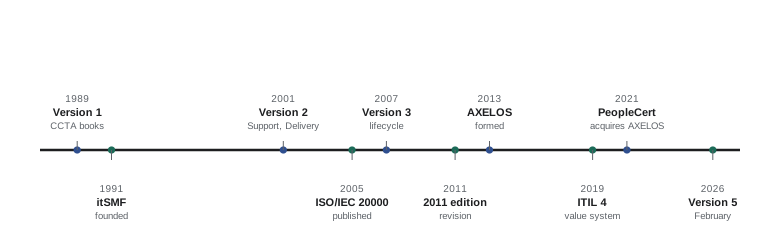
ITIL has been evolving for almost four decades. It began as a set of guidance books written for the British government in the late 1980s, grew into an international standard of practice, passed through several major revisions and changes of ownership, and in 2026 entered a new generation with ITIL (Version 5). Knowing this history is useful for exam candidates for practical reasons: colleagues, employers and job postings refer to old versions such as "ITIL v3", older certificates are still held by many people, and the reasons behind each revision help explain why the current guidance looks the way it does. This lesson traces the story from the original IT Infrastructure Library to the present, explains how ownership moved from government to a joint venture and then to PeopleCert, and shows how each version changed the content and the certification scheme. Dates are given as they are generally reported; the exact month of some early publications varies between sources.
Origins: the IT Infrastructure Library
In the 1980s, the United Kingdom government's Central Computer and Telecommunications Agency (CCTA) was concerned that the quality of IT services provided to government departments was inconsistent and that departments were each developing their own practices. It commissioned guidance based on the approaches used by successful organizations in the public and private sectors. From around 1989, a series of more than 30 books was published under the name IT Infrastructure Library, each covering a specific topic such as help desk, problem management, change management or capacity management. This first generation is now usually called ITIL version 1.
The original books were practical and detailed, but the large number of separate volumes made the guidance hard to absorb as a whole. Even so, they spread beyond government. A professional association, the IT Service Management Forum (itSMF), was founded in the United Kingdom in 1991 to share experience, and national chapters followed in many countries, including Canada and the United States. Organizations began to train staff, and the first ITIL examinations were introduced through exam institutes.
ITIL version 2: consolidation
Between 2000 and the early 2000s, the guidance was revised and consolidated into a smaller number of books, published under the Office of Government Commerce (OGC), which had absorbed the CCTA. The two best known, Service Support and Service Delivery, became the core of ITIL version 2. Service Support covered the service desk and the processes of incident, problem, configuration, change and release management; Service Delivery covered service level, financial, capacity, availability and IT service continuity management. Version 2 defined the vocabulary that many experienced practitioners still use, and its process focus shaped how many organizations organized their operations.
In parallel, ITIL's ideas fed into formal standards. The British Standard BS 15000 for IT service management, first published in 2000, was based closely on ITIL concepts and later became the international standard ISO/IEC 20000, first published in 2005. This created a pairing that continues today: ITIL as guidance for people, and ISO/IEC 20000 as a standard against which organizations can be certified.
ITIL version 3 and the 2011 edition: the service lifecycle
ITIL version 3, published in 2007, reorganized the guidance around a service lifecycle with five stages, each with its own core book: Service Strategy, Service Design, Service Transition, Service Operation and Continual Service Improvement. The lifecycle emphasized that services should be planned, designed, introduced, operated and improved as a continuous whole, linked to business strategy. Version 3 added many new processes and functions, such as service portfolio management and knowledge management, and greatly expanded the material.
A revised version, known as the ITIL 2011 edition, clarified and corrected the version 3 books without changing their structure. The certification scheme of this era had several levels: Foundation; intermediate modules organized in Lifecycle and Capability streams; Managing Across the Lifecycle; the ITIL Expert designation awarded for accumulating credits; and a rarely achieved ITIL Master level. Many professionals still hold these "v3" or "2011" certificates. A Practitioner qualification added in 2016 focused on adopting and adapting ITIL in practice, foreshadowing the next major revision.
From government to AXELOS
Ownership of ITIL also changed over time. After the OGC, responsibility passed to the UK Cabinet Office. In 2013, the government formed AXELOS, a joint venture between the Cabinet Office and the outsourcing company Capita, to own and develop ITIL, PRINCE2 and related best practice products. AXELOS accredited examination institutes, such as PeopleCert, to run exams, while training was delivered by accredited training organizations around the world. The move to a commercial owner brought more investment in the products and a stronger push into international markets, along with debates about cost and commercialization that continue among practitioners.
ITIL 4: value, practices and agility
ITIL 4, launched with the Foundation publication in February 2019, was the most significant rethink since version 3. It responded to criticism that version 3 was too process-heavy and bureaucratic for an era of cloud computing, agile development and DevOps. ITIL 4 replaced the lifecycle as the central model with the service value system, in which demand and opportunity are turned into value through governance, guiding principles, a service value chain, practices and continual improvement. It introduced seven guiding principles, the four dimensions of service management and the concept of value co-creation between providers and consumers. The 26 processes and 4 functions of version 3 became 34 practices, each a set of organizational resources rather than a narrow process.
ITIL 4 also introduced a new certification scheme: Foundation, then the Managing Professional designation (with modules on creating, delivering and supporting services; driving stakeholder value; high-velocity IT; and direct, plan and improve) and the Strategic Leader designation, followed by practice-based and extension modules. Version 3 certificates continued to be recognized, and transition routes were offered.
PeopleCert takes ownership
In 2021, PeopleCert, which had been one of the main examination institutes, acquired AXELOS from the UK government and Capita, bringing ownership of the best practice guidance and the certification programs under one company. Since then, PeopleCert has managed both the frameworks and the exams directly, increasingly through online proctored exams and digital learning products. It introduced the PeopleCert Plus membership with access to publications and a continuing professional development (CPD) program, and it announced that ITIL certifications would need to be renewed periodically rather than lasting for life (Lesson 12).
ITIL (Version 5): the 2026 generation
ITIL (Version 5) was officially released in February 2026, after an early-access phase for partners. The new version broadens ITIL from service management of IT to the management of digital products and services across whole organizations, gives explicit attention to digital experience, and incorporates guidance on artificial intelligence and automation, including a dedicated AI governance module. It keeps the 34 management practices of ITIL 4, although they are described and packaged differently, and it introduces a new set of modules and designations (Lessons 4 and 5). At the time of writing, ITIL 4 and Version 5 are expected to run in parallel for at least 12 months, and no retirement date for ITIL 4 has been announced.
| Version | Period | Central idea | Typical certificate names |
|---|---|---|---|
| Version 1 | From about 1989 | Separate books on IT infrastructure topics | Early ITIL certificates |
| Version 2 | About 2000–2007 | Service Support and Service Delivery processes | ITIL v2 Foundation, Practitioner, Manager |
| Version 3 and 2011 | 2007–2019 | Five-stage service lifecycle | Foundation, Intermediate, Expert, Master |
| ITIL 4 | From 2019 | Service value system, value co-creation, 34 practices | Foundation, MP, SL, practice and extension modules |
| ITIL (Version 5) | From February 2026 | Digital products and services, experience, AI | Foundation, Practice Manager, MP, SL, Master, AI Governance |
Why the history matters for candidates
For exam candidates, the history matters in three ways. First, old terminology persists: colleagues may talk about "the service operation stage" or "ITIL v3 processes", and job postings may ask for "ITIL v3 Foundation". You should be able to translate between old and new terms, while answering exam questions using the terminology of the version you are being tested on. Second, the history explains the scheme's recognition rules: some older certificates count as prerequisites and others do not (Lesson 5). Third, each revision responded to changes in technology and ways of working; understanding the direction of travel, toward value, flexibility, digital products and responsible AI, helps you understand the intent behind the current guidance, which is what scenario-based questions often test.
Worked problem
Translating a job posting
A job posting from a Canadian bank asks for "ITIL v3 Foundation or higher". A candidate passed ITIL 4 Foundation in 2023 and is now studying for ITIL (Version 5) Foundation. How should she describe her qualifications?
Show solution
- Recognize that the posting uses an older version name; employers often update requirements slowly.
- ITIL 4 Foundation is a more recent qualification at the same level, so it meets the intent of "v3 Foundation or higher".
- State the exact certificate name and date, for example "ITIL 4 Foundation (2023)", and mention current study for the Version 5 Foundation.
- Be ready to explain in an interview how ITIL 4 concepts relate to version 3 processes the bank may still use.
Answer: List ITIL 4 Foundation with its date, note that it meets the requirement at a newer version, and mention Version 5 study; translating terminology confidently is part of the value.
The pace of change
ITIL's major versions have arrived roughly every decade, with smaller updates in between. Each transition has brought a period in which old and new certificates coexist and in which training providers, employers and candidates adjust. The 2026 transition is unusual in that it comes only seven years after ITIL 4 and in that the owner manages both guidance and exams. Candidates should expect further updates to modules and exam details during 2026 and 2027, and should check current information before booking training or exams.
Lessons from each transition
Each change of version taught the ITIL community something about how guidance is adopted. Version 1 showed that practical advice drawn from real organizations could spread far beyond its original audience. Version 2 showed the value of a common vocabulary and a manageable set of core books. Version 3 showed that connecting processes to business strategy matters, but also that very large bodies of guidance can be applied too rigidly. ITIL 4 responded by emphasizing principles, flexibility and value rather than prescriptive processes. Version 5 continues that direction and adds digital products, experience and AI.
A recurring theme is the gap between guidance and practice. Organizations often adopted parts of ITIL selectively, sometimes turning flexible advice into heavy procedures. Critics of version 3 pointed to bureaucratic change boards and long forms; supporters argued that the problem lay in how the guidance was applied, not in the guidance itself. ITIL 4's guiding principle "keep it simple and practical" can be read partly as a response to that experience. For candidates, the lesson is that exam answers usually favour proportionate, value-focused responses over rigid procedure.
How certificates from different eras are viewed
Employers tend to view certificates in light of when they were earned. A version 2 or version 3 Foundation certificate from many years ago shows long familiarity with service management, but it does not show knowledge of current ideas such as value co-creation. Pairing an older certificate with recent experience or a newer certificate gives the strongest signal. If you hold an older certificate and are unsure whether to update it, consider how often recent job postings in your field ask for a specific version and whether your employer is moving to newer guidance.
Reading old documents at work
Many organizations still have process documents written in the version 2 or version 3 era: incident procedures, change policies and service catalogues described in the language of the time. When you meet such a document, read it for its intent rather than its vocabulary. Ask what outcome the procedure was meant to achieve, whether it still achieves it, and whether a simpler approach would work today. This habit is useful at work and mirrors the way current ITIL guidance encourages organizations to start where they are and build on what already works.
Common mistakes
MistakeUsing old version terms in exam answers.
InsteadAnswer with the terminology of the version you are tested on.
MistakeAssuming ITIL v3 certificates are worthless.
InsteadKnow how they are recognized and translate them for employers.
MistakeConfusing AXELOS and PeopleCert roles.
InsteadAXELOS owned ITIL from 2013; PeopleCert acquired it in 2021.
MistakeThinking ITIL 4 retired immediately in 2026.
InsteadIt runs in parallel with Version 5 for at least 12 months.
MistakeTreating the history as trivia only.
InsteadUse it to understand the intent of the current guidance.
Summary and key terms
- ITIL began with UK government (CCTA) guidance from about 1989.
- Version 2 consolidated it into Service Support and Service Delivery.
- ITIL ideas shaped BS 15000 and ISO/IEC 20000.
- Version 3 (2007) and the 2011 edition used a five-stage lifecycle.
- AXELOS owned ITIL from 2013; PeopleCert acquired it in 2021.
- ITIL 4 (2019) introduced the service value system and 34 practices.
- ITIL (Version 5), released February 2026, focuses on digital products, experience and AI.
- CCTA
- UK government agency that commissioned the original ITIL.
- itSMF
- Professional association for IT service management.
- Service Support
- Version 2 book on operational processes.
- Service lifecycle
- Version 3 model of five stages.
- ITIL 2011 edition
- Revised version 3 guidance.
- AXELOS
- Joint venture that owned ITIL from 2013 to 2021.
- Service value system
- ITIL 4 model of how value is created.
- Guiding principles
- ITIL 4 recommendations that apply in all situations.
- Four dimensions
- Perspectives considered in service management.
- ITIL (Version 5)
- The 2026 generation of ITIL.
Practice problems
Work each problem on paper first, then reveal the answer to check.
Which agency commissioned the original ITIL?
Show answer
The UK CCTA.
When was itSMF founded?
Show answer
1991.
What were the two core version 2 books?
Show answer
Service Support and Service Delivery.
Which standard grew out of BS 15000?
Show answer
ISO/IEC 20000.
Name the five version 3 lifecycle stages.
Show answer
Strategy, Design, Transition, Operation, Continual Service Improvement.
What was AXELOS?
Show answer
A joint venture of the UK Cabinet Office and Capita.
When was ITIL 4 Foundation launched?
Show answer
February 2019.
How many practices does ITIL 4 have?
Show answer
34.
When did PeopleCert acquire AXELOS?
Show answer
2021.
When was ITIL (Version 5) released?
Show answer
February 2026.
Lesson quiz · 5 questions
Score 60% or more to complete this lesson.
Create a free account to save your progress, take quizzes and earn a certificate.