
ITIL-101 · Lesson 5 of 12 · 27 min
The qualification scheme and designations
The ITIL qualification scheme is the structure of modules, exams and designations that sits on top of the guidance. Understanding it before you start lets you plan a route that matches your goals, avoid taking modules that do not count toward anything you want, and estimate the time and money involved. This lesson explains the ITIL (Version 5) scheme as published at the time of writing (October 2026): Foundation, eight advanced modules and one extension; the Practice Manager, Managing Professional and Strategic Leader designations; the ITIL Master award; the shared Transformation module; and the rules that connect them. It also explains how a designation differs from a module certificate and how to count the modules you need when some are shared. Because the scheme is new, details such as module names and exam formats may be adjusted; confirm them with PeopleCert or an accredited training organization before you book.
Modules, certificates and designations
Three words are used carefully in this lesson. A module is a unit of learning with its own syllabus and exam, such as Foundation or Strategy. Passing a module's exam earns a module certificate. A designation is a title awarded when you hold a specified set of module certificates; you do not take a separate designation exam. For example, the Strategic Leader designation is awarded to someone who has passed Foundation, Strategy and Transformation. Employers sometimes ask for a designation ("ITIL Managing Professional") and sometimes for a specific module, so it helps to know both.
The structure of the Version 5 scheme
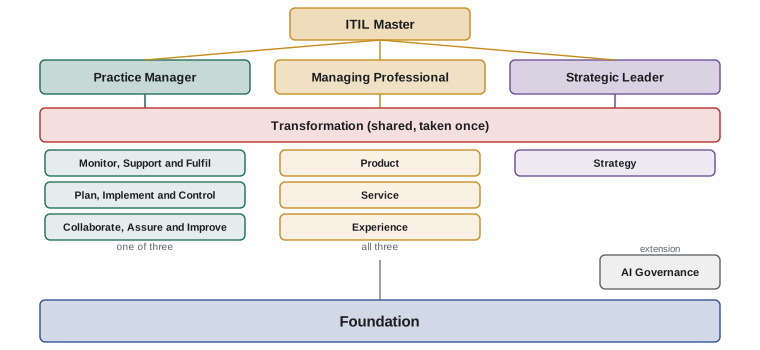
At the time of writing, the ITIL (Version 5) scheme consists of:
- Foundation: the entry-level module and the prerequisite for everything else.
- Three Practice Manager specialization modules: Monitor, Support and Fulfil; Plan, Implement and Control; and Collaborate, Assure and Improve.
- Three Managing Professional modules: Product, Service and Experience.
- Strategy: the Strategic Leader module.
- Transformation: a core module shared by all three designations.
- AI Governance: an extension module that does not form part of a designation.
Counting these, there are Foundation, eight advanced modules (three Practice Manager, three Managing Professional, Strategy and Transformation) and one extension.
The three designations
ITIL Practice Manager (PM) is aimed at people who manage or perform specific practices, such as service desk leaders, incident and problem managers, and change managers. It requires Foundation, any one of the three Practice Manager specialization modules and Transformation. Each specialization groups related practices; for example, Monitor, Support and Fulfil relates to operational practices that keep services running and fulfil requests.
ITIL Managing Professional (MP) is aimed at people who manage the creation and delivery of digital products and services, such as service owners, product managers and IT managers. It requires Foundation, Product, Service, Experience and Transformation.
ITIL Strategic Leader (SL) is aimed at people who shape digital strategy, such as senior IT leaders, enterprise architects and consultants. It requires Foundation, Strategy and Transformation.
ITIL Master is awarded to people who have achieved all three designations. This differs from the older ITIL Master of the version 3 era, which required a portfolio and interview; at the time of writing, the Version 5 Master is described as a recognition of holding PM, MP and SL.
| Designation | Modules required (after Foundation) | Typical audience |
|---|---|---|
| Practice Manager | One specialization + Transformation | Practice leads, service desk and operations managers |
| Managing Professional | Product + Service + Experience + Transformation | Service owners, product and IT managers |
| Strategic Leader | Strategy + Transformation | Senior leaders, architects, consultants |
| ITIL Master | All three designations | Senior practitioners seeking full scheme |
Shared modules: counting what you need
Transformation is shared by all three designations and is taken only once. This means that designations overlap: someone who already holds one designation needs fewer modules to earn the next. Careful counting avoids surprises when planning budgets.
Worked problem
Counting modules for designations
Priya holds ITIL 4 Foundation. She wants Strategic Leader first and Managing Professional later. How many advanced module exams does she need for each step, and in total?
Show solution
- Her ITIL 4 Foundation is recognized as the prerequisite, so she does not need a new Foundation.
- Strategic Leader needs Strategy and Transformation: 2 modules.
- Managing Professional needs Product, Service, Experience and Transformation. She already has Transformation, so she needs Product, Service and Experience: 3 modules.
- Total advanced modules for both designations: 2 + 3 = 5.
- If she later wants Practice Manager, she needs only one specialization module, since Transformation is done: 1 more, total 6, and the three designations would also earn ITIL Master.
Answer: SL takes 2 modules, MP then takes 3 more (5 in total), and adding one PM specialization (6 in total) completes all three designations and the ITIL Master.
The minimum number of advanced modules for ITIL Master is therefore eight minus two, because only one of the three Practice Manager specializations is needed: Product, Service, Experience, Strategy, Transformation and one specialization, which is six modules after Foundation.
Exam styles across the scheme
Not every module is examined the same way. At the time of writing, Foundation, the Practice Manager modules and AI Governance use closed-book multiple-choice exams. The Product, Service, Experience, Strategy and Transformation modules are described as having open-book exams, meaning candidates may consult the official publication during the exam. Open-book does not mean easy: questions are typically scenario-based and test application and analysis, and candidates who rely on looking up answers run out of time. Lesson 7 covers these exam styles in more detail.
Training requirements
Foundation can be taken by self-study, with no mandatory training. All other modules require completion of accredited training, either an instructor-led course from an accredited training organization or official eLearning, before taking the exam. Training usually includes the exam voucher. This requirement drives costs: a Foundation exam alone costs a few hundred dollars, while each advanced module with mandatory training typically costs significantly more. Lesson 9 compares training options and costs.
Where ITIL 4 certificates fit
ITIL 4 Foundation is accepted as the prerequisite for Version 5 advanced modules. For ITIL 4 holders of Managing Professional modules, a transition route to Version 5 Managing Professional has been reported but was still being validated at the time of writing. The ITIL 4 extension modules are not part of the Version 5 scheme; they remain valid certificates in their own right but do not count toward Version 5 designations. ITIL 4 designations, such as ITIL 4 Managing Professional and ITIL 4 Strategic Leader, remain valid designations under ITIL 4, subject to renewal.
Planning a route through the scheme
A sensible route begins with your current role and the next role you want. Someone running a service desk might take Foundation and then the Monitor, Support and Fulfil specialization and Transformation to become a Practice Manager. A product or service owner might aim for Managing Professional. A senior manager might go straight from Foundation to Strategy and Transformation for Strategic Leader. Lesson 8 works through choices by role in detail. Whatever the route, pace the modules so that you can apply each one at work before moving to the next; employers value applied knowledge more than a stack of certificates earned in quick succession.
| Starting point | Goal | Modules needed |
|---|---|---|
| No certificate | Foundation | Foundation |
| ITIL 4 Foundation | Practice Manager | One specialization + Transformation |
| ITIL 4 Foundation | Strategic Leader | Strategy + Transformation |
| Version 5 Strategic Leader | Managing Professional | Product + Service + Experience |
| MP and SL | ITIL Master | One PM specialization |
Keeping track of your certificates
Because designations are awarded automatically when you hold the required modules, check your PeopleCert account after each exam to confirm that designations have been issued and that modules from different versions have been linked correctly. Record each module, its date and its renew-by date in a simple table. If a designation does not appear when you expect it, contact PeopleCert with your candidate number.
Why designations exist
Designations give employers and candidates a simple way to describe a meaningful combination of learning. A single advanced module shows depth in one area, but a designation shows that someone has studied a coherent set of topics suited to a type of role. Designations also help training providers package courses and help candidates set goals. The downside is that designations encourage collecting modules for their own sake. A practice lead who takes one specialization and Transformation, and applies them well, may gain more than someone who rushes through every module.
Questions to ask before committing to a designation
- Do job postings for my target role mention this designation, or only Foundation?
- Will my employer recognize or reward the designation?
- Which modules can I apply directly in my current work?
- How much will the full designation cost, including training and exams, and over what period can I spread it?
- What will I do if the scheme changes during my journey, for example if a module is revised or a transition route appears?
Writing short answers to these questions takes only a few minutes and often clarifies whether a full designation is worth pursuing now or whether a single module is enough.
Scheme changes and how to stay informed
New schemes often change in their first years. Module names may be adjusted, exam formats may be revised after early feedback, and transition routes may be added. To stay informed, check PeopleCert's ITIL pages before each step, ask your training provider about any recent changes, and read announcements from your local itSMF chapter. Keep a note of the date you checked each fact; if months pass before you book, check again. This course gives information at the time of writing, and it deliberately flags details that were not confirmed.
A note on equivalence across versions
Candidates sometimes ask whether an ITIL 4 module "counts as" a Version 5 module. In general, modules from different versions are separate certificates. ITIL 4 Foundation is the main exception, because it is recognized as a prerequisite for Version 5 advanced modules. For other modules, follow the published transition routes rather than assuming equivalence, and confirm with PeopleCert before planning a route that depends on one.
A worked example: budgeting a designation
Worked problem
Budgeting Managing Professional
An IT manager in Winnipeg with ITIL 4 Foundation wants Managing Professional (Version 5). Assume each advanced module costs CA$2,400 with accredited training and exam, and that she will space modules three months apart. What is the total cost and duration?
Show solution
- Modules needed: Product, Service, Experience and Transformation, which is 4 modules.
- Cost: 4 × CA$2,400 = CA$9,600.
- Duration: the first module starts in month 0 and the next three follow at three-month intervals, so the last starts in month 9; allowing about a month to finish, the designation takes about 10 months.
- If her employer funds two modules per budget year, she might spread them over two budget years.
Answer: About CA$9,600 over roughly 10 months; she should replace the assumed prices with real quotes and check whether her employer will fund the modules.
This kind of simple budget is useful when asking an employer for funding, because it shows the full commitment rather than one module at a time.
Reading the scheme diagram
Official scheme diagrams can look complicated at first. A simple way to read them is to start at the bottom with Foundation, then follow one column upwards to the designation that interests you, noting each module on the way, and finally check which modules are shared across columns. Shared modules, such as Transformation, are where planning gains are found. Once you can trace a route on the diagram without help, you understand the scheme well enough to plan, explain it to a colleague and spot when a training offer does not lead where you want to go. Practise by tracing the route to each designation from a starting point of ITIL 4 Foundation.
Common mistakes
MistakeThinking a designation needs its own exam.
InsteadDesignations are awarded for holding the required modules.
MistakeCounting Transformation twice.
InsteadIt is shared and taken only once.
MistakeAssuming open-book exams are easy.
InsteadThey are scenario-based and time-pressured.
MistakeSelf-studying advanced modules.
InsteadAdvanced modules require accredited training or official eLearning.
MistakeExpecting ITIL 4 extension modules to count toward Version 5 designations.
InsteadThey remain valid but are not part of the Version 5 scheme.
Summary and key terms
- A module has an exam; a designation is awarded for a set of modules.
- Version 5 has Foundation, eight advanced modules and one extension.
- Practice Manager: one specialization plus Transformation.
- Managing Professional: Product, Service, Experience plus Transformation.
- Strategic Leader: Strategy plus Transformation; Master means all three designations.
- Transformation is shared and taken once.
- Advanced modules need accredited training; Foundation does not.
- Module
- Unit of learning with its own syllabus and exam.
- Designation
- Title awarded for holding a set of modules.
- Practice Manager
- Designation for leaders of specific practices.
- Managing Professional
- Designation for managing products and services.
- Strategic Leader
- Designation for digital strategy leaders.
- ITIL Master
- Award for holding all three designations.
- Transformation
- Core module shared by all designations.
- Specialization
- One of three Practice Manager modules.
- Extension module
- Module outside the designations, such as AI Governance.
- Open-book exam
- Exam in which the official publication may be consulted.
Practice problems
Work each problem on paper first, then reveal the answer to check.
What is the difference between a module and a designation?
Show answer
A module has an exam; a designation is awarded for a set of modules.
How many advanced modules are in the Version 5 scheme?
Show answer
Eight.
What does Practice Manager require after Foundation?
Show answer
One specialization and Transformation.
What does Managing Professional require after Foundation?
Show answer
Product, Service, Experience and Transformation.
What does Strategic Leader require after Foundation?
Show answer
Strategy and Transformation.
How is ITIL Master earned in Version 5?
Show answer
By holding all three designations.
What is the minimum number of advanced modules for Master?
Show answer
Six.
Which modules have open-book exams?
Show answer
Product, Service, Experience, Strategy and Transformation.
Which module is an extension?
Show answer
AI Governance.
Do ITIL 4 extension modules count toward Version 5 designations?
Show answer
No.
Lesson quiz · 5 questions
Score 60% or more to complete this lesson.
Create a free account to save your progress, take quizzes and earn a certificate.