
ITIL-101 · Lesson 3 of 12 · 25 min
The ITIL product family and the PeopleCert ecosystem
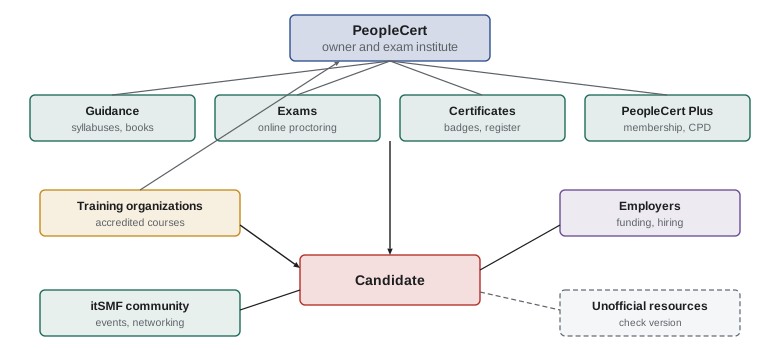
Earning an ITIL certification involves more than reading a book and taking a test. Candidates deal with an ecosystem of organizations and products: PeopleCert, which owns the framework and runs the exams; accredited training organizations, which deliver courses; publications and digital materials; online proctoring for exams; a membership program with continuing professional development; professional communities; and employers and recruiters who interpret certificates. Understanding who does what helps you buy the right products, avoid unnecessary costs and recognize unofficial or unreliable providers. This lesson maps the ecosystem: the guidance itself, the role of PeopleCert, accredited training organizations, official and unofficial study materials, the exam delivery system, the digital badge and certificate register, the PeopleCert Plus membership and professional communities such as itSMF. Specific prices and product names change often, so they are given as illustrations at the time of writing.
The guidance: publications and practices
ITIL guidance is published as books and digital content. Each certification module has a core publication or set of materials that defines what candidates need to know. In ITIL 4, these included the Foundation book and books for each higher module, plus practice guides for the 34 practices. In ITIL (Version 5), the core material has been reorganized around digital products and services, experience, strategy and transformation, and, at the time of writing, the detailed descriptions of all 34 practices are available through the PeopleCert Plus membership rather than as separate printed guides, with the practices relevant to Practice Manager modules also included in those courses' training materials. The publications are copyrighted; summaries and study notes written by others, like this course, can explain ideas but cannot reproduce the official text.
PeopleCert's role
PeopleCert is a global company that develops certification programs and runs exams in many fields. Since acquiring AXELOS in 2021, it has owned ITIL, PRINCE2 and other best practice products, and it also acts as the examination institute for them. In practical terms, PeopleCert:
- Develops and maintains the ITIL guidance and syllabuses.
- Writes, validates and delivers the exams, including online proctored exams.
- Accredits training organizations and trainers, and approves training materials.
- Issues certificates and digital badges, and maintains a register where employers can verify certificates.
- Runs the PeopleCert Plus membership and CPD program.
- Sells exam vouchers, eLearning and bundles directly to candidates as well as through partners.
Because one company controls the content, the exams and the certificates, candidates should treat PeopleCert's own website and their PeopleCert account as the authoritative source for current rules, fees and renewal dates.
Accredited training organizations
Accredited training organizations, often called ATOs, are companies and institutions that PeopleCert has approved to deliver training for its certifications. They employ accredited trainers, use approved course materials and can usually sell exam vouchers bundled with training. They offer classroom, live virtual and self-paced eLearning courses. For ITIL Foundation, accredited training is encouraged but not mandatory: candidates may self-study and book the exam directly. For higher-level ITIL modules, training through an ATO or official eLearning is required before taking the exam, which is one reason costs rise at higher levels.
Choosing an ATO involves checking its accreditation status (PeopleCert lists accredited partners), the trainer's experience, the format and schedule, the materials included, whether the exam voucher and any resit are included, pass-rate claims and how they are measured, and reviews from previous students. Large international training companies operate in both Canada and the United States, and many colleges and universities also offer ITIL courses through their continuing education departments.
Exam delivery and online proctoring
Most ITIL exams are now taken online with remote proctoring: you sit the exam at home or at work on your own computer, and a proctor monitors you through your webcam, microphone and screen-sharing software. Proctored exams can usually be booked at short notice and taken at almost any time. Requirements typically include a quiet private room, a clear desk, a government-issued photo ID, a webcam that can show the room, a stable internet connection and a computer that passes a system check. In some countries, exams can also be taken in person at an accredited partner's premises or at the end of a classroom course. Lesson 6 describes exam day in detail.
Certificates, badges and verification
After passing an exam, candidates receive an electronic certificate and, typically, a digital badge that can be shared on professional networking sites and email signatures. Employers can verify certificates through PeopleCert's online register using the candidate's details or certificate number. It is good practice to keep a copy of each certificate and to record your candidate number, exam dates and renewal dates. Since the introduction of renewal requirements, certificates carry a renew-by date (Lesson 12).
PeopleCert Plus
PeopleCert Plus is a subscription membership that gives access to digital publications, practice materials and a CPD program in which members log professional development activities. At the time of writing, it is one of the main routes for renewing ITIL certifications without retaking exams: members log 20 CPD points per year for three consecutive years. Membership also provides access to the full set of Version 5 practice descriptions. Whether membership is worth the cost depends on how many certifications you hold, how often you use the publications and whether your employer pays.
| Part of the ecosystem | What it provides | Who pays |
|---|---|---|
| PeopleCert | Guidance, exams, certificates, accreditation | Candidates and employers through fees |
| Accredited training organizations | Courses, trainers, vouchers, bundles | Candidates or employers |
| Online proctoring | Remote supervised exams | Included in exam fees |
| PeopleCert Plus | Publications, CPD program, renewal route | Annual membership fee |
| itSMF chapters | Events, networking, local knowledge | Membership fees, events |
| Unofficial resources | Books, videos, practice questions | Varies; some free |
Professional communities
The IT Service Management Forum (itSMF) is an independent, member-run professional association with chapters in many countries, including itSMF Canada and itSMF USA. Chapters hold conferences, local interest group meetings and webinars where practitioners share experience, and they often offer member discounts on training. Online communities, discussion forums and social media groups also discuss ITIL exams and adoption. Communities are valuable for understanding how ITIL is really used, which helps with scenario-based questions, and for networking. They are less reliable for exam facts, which should be checked with PeopleCert.
Unofficial study resources
Many unofficial resources exist: books from independent authors, video courses on learning platforms, flashcards, mobile apps and practice question banks. Good unofficial resources can be excellent value, but quality varies widely. Watch for three problems. First, some materials cover an older version, so check that the resource matches the version and syllabus you will be tested on. Second, some practice questions are poorly written or misleading, and a few sites sell so-called exam dumps, which claim to contain real exam questions; using them breaches exam rules and can lead to cancellation of results, and they are often inaccurate anyway. Third, unofficial resources cannot provide accredited training where it is required. This program is itself an unofficial resource and follows these principles: it explains ideas in its own words, covers the current scheme with clear dates, and never claims to contain real exam questions.
Worked problem
Comparing ways to buy Foundation
A candidate in Calgary compares three options for ITIL Foundation: (a) a PeopleCert self-study exam bundle at about US$540; (b) a two-day live virtual course from an ATO at about CA$1,600 including the exam; (c) an employer-arranged in-house class. She learns best with structured instruction but has a limited budget. How should she compare them?
Show solution
- Convert currencies roughly: US$540 is about CA$740 at an exchange rate of 1.37 (check the current rate).
- Option (a) is cheapest but relies on self-discipline; add the cost of a good study guide and practice questions.
- Option (b) costs about CA$860 more but provides a trainer, structure and usually a mock exam; check whether a resit is included.
- Option (c) may be free to her; ask her manager whether a group class is planned and whether the employer will reimburse an external course.
Answer: If her employer will not pay, the self-study bundle plus a good guide is cheapest; if she values structure, the ATO course may justify its higher price. Asking her employer first could make the choice easy.
Employers and recruiters
Employers and recruiters form the last part of the ecosystem. They decide how much weight to give certificates, which versions they accept and whether they pay for training. Many organizations have training budgets and tuition reimbursement policies that cover certifications, sometimes requiring staff to stay for a period after the training or to repay costs if they leave. Before paying yourself, ask whether your employer will sponsor you, and keep receipts for any expenses that may be reimbursable or tax-deductible (Lesson 9).
Mapping the ecosystem to your own journey
It helps to map the ecosystem onto the steps of your own certification journey. At the start, you rely on PeopleCert's website and the official syllabus to understand what is required, and on communities and colleagues for practical advice. During preparation, you use either self-study materials or an accredited course, plus practice questions. At the exam, you deal with PeopleCert's booking system and its proctoring service. Afterwards, your certificate and badge go into the register and your profiles, and in the years that follow you interact with PeopleCert again for renewal. At every step, a different part of the ecosystem is involved, and knowing which part is responsible saves time when something goes wrong.
- If a booking or proctoring problem occurs, contact PeopleCert support, not your training provider, unless the provider booked the exam for you.
- If course materials are missing or incorrect, contact the training provider.
- If an employer cannot verify your certificate, check the register entry and contact PeopleCert with your candidate number.
- If you are unsure whether an activity counts for CPD, check the PeopleCert Plus guidance.
Keeping records
Keep a simple file or folder with your PeopleCert login details stored securely, purchase receipts, voucher codes and expiry dates, exam confirmation emails, certificates and badges, and a log of any CPD activities. Many candidates lose time searching old emails for a voucher code or certificate number. A tidy record also makes it easier to claim reimbursement from an employer or to support any tax claim that may apply.
Judging claims made by providers
Training marketing often includes claims such as "99 % pass rate" or "guaranteed pass". Treat these with care. A pass rate may be measured only for students who took the exam immediately after the course, or only for a particular period. A guarantee may mean a free repeat of the course rather than a refund. Ask the provider to explain exactly how a claim is measured and what a guarantee covers. A provider that answers clearly and honestly is more likely to give good training than one that relies on bold claims.
Protecting your account and data
Your PeopleCert account holds personal information, exam bookings and certificates. Use a strong, unique password and enable any additional security the site offers. Be wary of emails that claim to come from an exam body and ask you to log in through a link or to pay a fee urgently; go to the official site directly instead. When sharing a digital badge, share the official verification link rather than an image that anyone could copy. If you change your name or email address, update your account so that certificates and renewal reminders reach you.
The role of your manager
Your manager is also part of the ecosystem, even though they do not appear in any official diagram. They may approve funding, protect study time and help you apply what you learn. Telling your manager about your plans early, and sharing your progress, often turns a personal goal into a shared one.
Common mistakes
MistakeRelying on forums for current exam rules.
InsteadCheck PeopleCert and your account for authoritative information.
MistakeBuying training from unaccredited providers for modules that require it.
InsteadConfirm ATO accreditation before paying.
MistakeUsing study materials for the wrong version.
InsteadMatch materials to the version and syllabus you will sit.
MistakeUsing exam dumps.
InsteadUse legitimate practice questions; dumps breach exam rules.
MistakePaying yourself without asking your employer.
InsteadCheck training budgets and reimbursement policies first.
Summary and key terms
- PeopleCert owns ITIL and runs exams, accreditation and certificates.
- Accredited training organizations deliver approved courses and vouchers.
- Foundation allows self-study; higher modules require accredited training.
- Most exams are online proctored; certificates can be verified online.
- PeopleCert Plus offers publications, CPD and a renewal route.
- itSMF chapters and communities share practical experience.
- Unofficial resources vary in quality; avoid exam dumps.
- ATO
- Accredited training organization approved by PeopleCert.
- Exam voucher
- Prepaid right to book an exam.
- Online proctoring
- Remote supervision of an exam by webcam.
- Digital badge
- Shareable electronic proof of a certification.
- Certificate register
- Online database for verifying certificates.
- PeopleCert Plus
- Membership with publications and CPD.
- CPD
- Continuing professional development.
- itSMF
- Independent service management professional association.
- Exam dump
- Illegitimate collection of claimed real exam questions.
- Syllabus
- Official description of what an exam tests.
Practice problems
Work each problem on paper first, then reveal the answer to check.
Name three things PeopleCert does.
Show answer
Develops guidance, delivers exams, accredits trainers, issues certificates.
What is an ATO?
Show answer
An accredited training organization.
Is accredited training required for Foundation?
Show answer
No, self-study is allowed.
Is accredited training required for higher modules?
Show answer
Yes, or official eLearning.
Name three requirements for online proctored exams.
Show answer
Private room, photo ID, webcam, stable internet, system check.
How can employers verify a certificate?
Show answer
Through PeopleCert's online register.
What renewal route does PeopleCert Plus offer?
Show answer
Logging 20 CPD points per year for three years.
What is itSMF?
Show answer
An independent professional association.
Why avoid exam dumps?
Show answer
They breach exam rules and are often inaccurate.
What should you check in unofficial materials?
Show answer
That they match the current version and syllabus.
Lesson quiz · 5 questions
Score 60% or more to complete this lesson.
Create a free account to save your progress, take quizzes and earn a certificate.