
ITIL-101 · Lesson 9 of 12 · 29 min
Training options and accredited providers
Training is where most of the money in ITIL certification goes, and where choices make the biggest difference to your experience. For Foundation, you can choose anything from self-study with a book to an intensive classroom course; for higher modules, accredited training is required, but you can still choose between providers, formats and schedules. This lesson describes the main training formats, how to evaluate an accredited training organization, what is usually included in a course price, how to compare total costs, how employers fund training, and what is known about tax treatment of training costs in Canada and the United States. Prices are given as rough illustrations at the time of writing (October 2026), and the tax notes are general information, not tax advice; check with the relevant tax authority or a qualified professional.
Training formats
Four formats dominate ITIL training.
- Classroom: in-person courses, usually two or three days for Foundation and three to five days for advanced modules, often with the exam at the end. They suit people who learn best with face-to-face interaction and who can take time away from work.
- Live virtual: the same course delivered online in real time, with a trainer and other students. It avoids travel and is now the most common format for many providers.
- Self-paced eLearning: recorded lessons, quizzes and sample exams accessed online over weeks or months. Official PeopleCert eLearning counts as accredited training for higher modules.
- Self-study: books, unofficial courses and practice questions without accredited training. This is allowed only for Foundation.
Some providers also offer blended formats, such as eLearning followed by a short live workshop, and employers sometimes arrange private courses for a team.
| Format | Typical duration | Strengths | Limitations |
|---|---|---|---|
| Classroom | 2–3 days (Foundation) | Interaction, focus, networking | Travel, time off work, higher cost |
| Live virtual | 2–3 days or spread over evenings | No travel, interaction | Screen fatigue, distractions |
| Self-paced eLearning | Weeks to months | Flexible, often cheaper | Needs self-discipline, less interaction |
| Self-study (Foundation only) | Weeks to months | Cheapest, flexible | No trainer; not accredited |
Choosing an accredited training organization
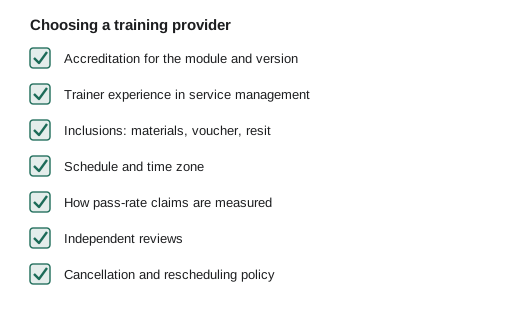
Accredited training organizations range from large international companies to small specialist firms, colleges and universities. To choose one:
- Confirm accreditation for the specific module and version, using PeopleCert's list of partners.
- Check the trainer's experience in IT service management, not only as a trainer.
- Ask what is included: official materials, exam voucher, sample exams, resit, access period for eLearning.
- Check the schedule and time zone for live virtual courses; Canadian and US providers usually schedule in local time zones.
- Treat pass-rate claims carefully: ask how they are measured and over what period.
- Read independent reviews and ask colleagues for recommendations.
- Check cancellation and rescheduling policies, and any guarantee, such as a free retake of the course.
Training providers in Canada and the United States
In Canada, ITIL training is offered by international training companies with Canadian offices, by specialist firms, and by the continuing education departments of some colleges and universities. Live virtual courses scheduled in Eastern and Pacific time are widely available, and courses in French are offered by some providers, particularly in Quebec. Some provinces offer workforce training grants, such as programs that share the cost of training between employers and government; eligibility rules vary by province and program, so check current details with your provincial government.
This course does not recommend specific providers. Use the checklist above and PeopleCert's partner listings to compare options available to you.
What a course price includes
Course prices vary widely, so compare what is included. A Foundation course price may include the trainer-led sessions, the official course book or eLearning, sample exams, the exam voucher and sometimes a resit voucher or exam insurance. Advanced courses typically include similar items plus the exam voucher. Some low prices exclude the exam, which must then be bought separately. Calculate the total cost of getting certified, not the headline course price.
Worked problem
Comparing total costs
For Foundation, Lena compares: Provider A at US$1,295 including exam and one free resit; Provider B at US$995 excluding the exam (exam about US$536 separately, resit at the same price). She estimates a 20 % chance she will need a resit. Which is cheaper in expected terms?
Show solution
- Provider A: US$1,295; the resit is free, so the expected cost is US$1,295.
- Provider B: US$995 + US$536 = US$1,531 before any resit.
- Expected resit cost with B: 0.20 × US$536 = about US$107, giving about US$1,638.
- Provider A is about US$343 cheaper in expected terms, despite the higher headline price.
Answer: Provider A costs about US$1,295 against about US$1,638 expected for Provider B, so the bundle with exam and resit is the better value.
Employer funding
Many employers fund ITIL training through training budgets, professional development allowances or tuition reimbursement. Policies may require prior approval, passing the exam, or staying with the employer for a period, often a year, with repayment if you leave earlier. Read the policy before enrolling. If your employer is adopting ITIL, it may arrange group training at a lower cost per person.
Tax treatment of training costs
Whether you can claim tax relief for certification costs depends on the country, the provider and your situation. The following is general information only.
In Canada, the tuition tax credit applies to fees paid to eligible educational institutions, such as universities, colleges and certain institutions certified by Employment and Social Development Canada for occupational skills courses, and the Canada Training Credit applies to eligible fees paid to the same kinds of institutions. Whether a particular ITIL course qualifies depends on whether the provider is an eligible institution and issues the official tuition receipt (form T2202); many private training companies do not. Exam fees for professional certifications may be treated separately in some circumstances. Check with the Canada Revenue Agency or a tax professional, and keep all receipts. Employers can generally deduct training costs they pay for employees as business expenses.
Because tax rules change and depend on individual circumstances, treat any tax relief as a possible bonus rather than part of your core budget unless you have confirmed eligibility.
Getting the most from training
Whatever the format, preparation and follow-up make a difference. Before the course, read the syllabus and skim the materials. During the course, ask how concepts apply to your workplace and take part in exercises. After the course, take sample exams under timed conditions and book the exam soon, ideally within two to four weeks. For eLearning, schedule regular study sessions in your calendar; many people who buy self-paced courses never finish them because they lack a schedule (Lesson 11).
Worked problem
Choosing a format for a busy schedule
Nadia, a team lead in Vancouver, works full time and has two children. She can study about 5 hours a week, mostly in the evenings, and her employer will pay for Foundation but not give her days off. Which format fits?
Show solution
- A two-day classroom course would need two days off work, which her employer will not provide.
- A live virtual course spread over several evenings could work if one is scheduled in Pacific time.
- Self-paced official eLearning fits her schedule best: about 20 hours of study over four weeks at 5 hours a week.
- She should check the eLearning access period and book the exam for about week five.
Answer: Self-paced eLearning, or an evening live virtual course, fits her constraints; she should schedule sessions and book the exam soon after finishing.
Questions to ask a provider before enrolling
A short list of questions, sent by email before enrolling, reveals a lot about a training provider. Clear, specific answers are a good sign.
- Is the course accredited by PeopleCert for this module and this version?
- Who is the trainer, and what is their practical experience in service management?
- What exactly is included: official materials, sample exams, exam voucher, resit, eLearning access period?
- When must the exam be taken after the course, and how long is the voucher valid?
- What happens if I need to cancel or reschedule, or if the course is cancelled?
- How do you measure the pass rate you advertise?
- Do you issue receipts suitable for employer reimbursement?
Group training for teams
When an organization trains a whole team, a private course can be cheaper per person and can use the organization's own examples. Group training also creates a shared vocabulary quickly, which helps teams adopt practices together. The drawbacks are scheduling, since everyone must be available at the same time, and the risk that people with different levels of experience find the pace too fast or too slow. A mix of group Foundation training followed by individual advanced training for selected staff is common.
Free and low-cost learning
Not everything has to be paid for. Many training providers, itSMF chapters and communities offer free webinars and introductory sessions. Public libraries in Canada and the United States sometimes provide free access to online learning platforms that include ITIL introduction courses; check with your local library. Free resources are excellent for deciding whether ITIL interests you and for supplementing paid study, though they do not replace accredited training where it is required.
| Resource | Typical cost | Use |
|---|---|---|
| Webinars from providers and communities | Free | Introductions and updates |
| Library online learning platforms | Free with a library card | Introductory courses |
| Independent study guides | Low | Foundation self-study |
| Official self-study bundle | Moderate | Foundation exam and materials |
| Accredited course | Higher | Structured learning; required for advanced modules |
Writing a funding request
A short written request makes it easier for a manager to approve training. Keep it to one page and cover five points.
- What: the module, version, provider, format and dates.
- Why: how the module relates to your current role and team goals.
- Cost: the total, including exam and any resit, and how it compares with alternatives.
- Application: one or two specific things you will do differently at work afterwards.
- Sharing: how you will pass on what you learn, such as a short session for your team.
Managers often need to justify spending to their own managers, so making the case clearly helps them say yes.
Worked problem
Cost per person for group training
A team of 8 in Halifax needs Foundation. Individual live virtual courses cost CA$1,500 each including exam. A private group course costs CA$7,200 plus CA$650 per person for exam vouchers. Which is cheaper, and by how much?
Show solution
- Individual: 8 × CA$1,500 = CA$12,000.
- Group: CA$7,200 + 8 × CA$650 = CA$7,200 + CA$5,200 = CA$12,400.
- For 8 people, individual courses are CA$400 cheaper.
- For 10 people: individual CA$15,000; group CA$7,200 + CA$6,500 = CA$13,700, so the group course becomes cheaper.
Answer: At 8 people the individual courses are slightly cheaper; at about 10 or more, the group course wins. The break-even point depends on the actual quotes.
Avoiding common pitfalls with eLearning
Self-paced eLearning is convenient, but it has typical pitfalls. Access periods can expire before you finish. Exam vouchers bundled with eLearning may have their own expiry dates. Videos can tempt you into passive watching rather than active study. Counter these by checking dates at purchase, scheduling sessions, pausing videos to recall key points, and using the included quizzes as retrieval practice rather than skipping them.
Training in French and other languages
Candidates in Canada, particularly in Quebec, New Brunswick and parts of Ontario, may prefer to train and sit exams in French. Check whether the course, the materials and the exam are all available in your preferred language, because they are not always offered together; a course might be taught in French while the official exam is available only in certain languages. In the United States, some providers offer training in Spanish. Studying and testing in your strongest language usually improves results, and where that is not possible, requesting any available extra time for a second language is worthwhile.
Keeping receipts and records
Whatever your funding arrangement, keep every receipt: course fees, exam vouchers, books and any travel. Employers usually require receipts for reimbursement, and tax claims, where they apply, depend on proper documentation. Store digital copies in one folder with your certificates so that everything related to your certification journey is easy to find later.
Common mistakes
MistakeComparing headline course prices only.
InsteadCompare total cost including exam and resit.
MistakeAssuming any ITIL course is accredited.
InsteadCheck PeopleCert's partner listings for the module and version.
MistakeAssuming training costs are tax-deductible.
InsteadCheck eligibility; many private providers do not qualify.
MistakeBuying eLearning without a study schedule.
InsteadPlan regular sessions and an exam date.
MistakeIgnoring employer repayment clauses.
InsteadRead the training policy before enrolling.
Summary and key terms
- Formats include classroom, live virtual, self-paced eLearning and self-study.
- Self-study is allowed only for Foundation.
- Choose providers by accreditation, trainer, inclusions and reviews.
- Compare total cost, including exam and resit.
- Employers often fund training, sometimes with repayment conditions.
- Tax relief depends on provider eligibility; check before relying on it.
- Book the exam soon after training.
- Classroom training
- In-person instructor-led course.
- Live virtual training
- Real-time online instructor-led course.
- Self-paced eLearning
- Online course taken at your own pace.
- Exam insurance
- Option providing a resit if needed.
- Total cost of certification
- All costs to become certified.
- Tuition reimbursement
- Employer repayment of training costs.
- Repayment clause
- Requirement to repay training if leaving.
- Eligible institution
- Provider qualifying for education tax relief.
- Workforce grant
- Public funding for training.
- Access period
- Time an eLearning course remains available.
Practice problems
Work each problem on paper first, then reveal the answer to check.
Name four training formats.
Show answer
Classroom, live virtual, self-paced eLearning, self-study.
For which module is self-study allowed?
Show answer
Foundation.
Name three things to check in a provider.
Show answer
Accreditation, trainer, inclusions, schedule, reviews.
What should you compare instead of headline price?
Show answer
Total cost of certification.
Compute 0.2 × 536.
Show answer
About 107.
What is a repayment clause?
Show answer
Requirement to repay training if you leave early.
Do all ITIL providers qualify for education tax relief?
Show answer
No.
Can employers usually deduct training they pay for?
Show answer
Yes, generally as business expenses.
When should you book the exam after training?
Show answer
Soon, within about two to four weeks.
Why do people fail to finish eLearning?
Show answer
They lack a study schedule.
Lesson quiz · 5 questions
Score 60% or more to complete this lesson.
Create a free account to save your progress, take quizzes and earn a certificate.