
ITIL-101 · Lesson 6 of 12 · 28 min
The Foundation exam in detail
For most people, ITIL Foundation is the only ITIL exam they will ever take, and for everyone it is the first. Passing it requires a solid understanding of key concepts, but it also rewards good preparation for the exam itself: knowing the format, managing time, understanding how multiple-choice questions are constructed and knowing what to expect on exam day. This lesson covers the ITIL (Version 5) Foundation exam as reported at the time of writing (October 2026), with notes on ITIL 4 Foundation, which has a widely reported identical format. It explains the format and pass mark, the arithmetic of time and scoring, question styles, the syllabus areas, booking and online proctoring, exam-day rules, results, and what to do if you do not pass. It does not reproduce exam questions; the examples are original and illustrate question styles only.
Format at a glance
At the time of writing, the ITIL (Version 5) Foundation exam has 40 multiple-choice questions, a time limit of 60 minutes and a pass mark of 65 %, which is 26 correct answers out of 40. It is closed book: no notes, books or other materials are allowed. Each question has four options and one correct answer, and there is no penalty for wrong answers. The exam can be taken online with remote proctoring or, in some countries, in person through an accredited partner. It is reported to be available in nine languages, and candidates taking it in a language other than their first language may be eligible for extra time; check current PeopleCert policy. ITIL 4 Foundation is widely reported to use the same 40 questions, 60 minutes and 65 % format.
| Feature | Version 5 Foundation (at the time of writing) |
|---|---|
| Questions | 40 multiple choice, four options each |
| Time | 60 minutes |
| Pass mark | 65 % (26 of 40) |
| Materials | Closed book |
| Delivery | Online proctored; in person in some countries |
| Prerequisites | None; training recommended but optional |
| Negative marking | None reported |
Pass-mark arithmetic
The pass mark of 65 % translates into a concrete number of questions. With 40 questions, you need 26 correct and can afford to miss 14. Thinking in numbers helps both preparation and nerves: you can miss roughly one question in three and still pass.
Worked problem
Pass-mark arithmetic from practice scores
Over three full practice exams of 40 questions, Luis scored 24, 27 and 29. What are his percentages, and is he ready?
Show solution
- Convert each score: 24/40 = 60 %, 27/40 = 67.5 %, 29/40 = 72.5 %.
- His average is (24 + 27 + 29)/3 = 26.7 correct, or about 67 %.
- The average is just above the pass mark of 26, but the margin is less than one question.
- A common rule of thumb is to aim for a consistent 80 % (32/40) on good-quality practice exams before booking, to allow for nerves and harder questions.
Answer: His average of about 67 % is borderline; he is improving, but he should keep practising until he scores around 80 % consistently.
Time per question
Sixty minutes for 40 questions gives an average of 1.5 minutes, or 90 seconds, per question. Most Foundation questions are short and can be answered in under a minute by a well-prepared candidate, so time pressure is usually moderate. Still, a plan prevents panic.
Worked problem
Planning exam timing
Design a timing plan that leaves time for review in a 60-minute, 40-question exam.
Show solution
- Plan a first pass at about 1 minute per question: 40 minutes.
- Flag any question that takes longer than about 90 seconds and move on.
- Reserve about 15 minutes for flagged questions and 5 minutes for a final check that every question has an answer.
- Set checkpoints: question 10 by about minute 10, question 20 by minute 20, question 40 by minute 40.
Answer: A 40 + 15 + 5 minute plan with checkpoints at questions 10, 20 and 40 keeps the pace steady and leaves review time.
If you receive extra time, for example 25 % more for taking the exam in a second language, recalculate: 75 minutes gives 112.5 seconds per question, and checkpoints move accordingly.
Question styles
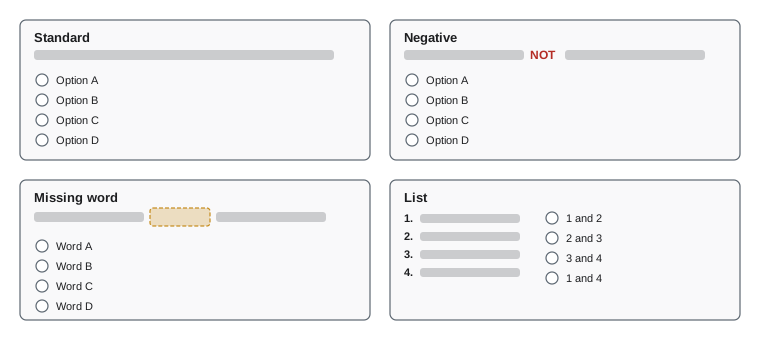
Foundation questions test recall and understanding rather than deep application. Common styles include:
- Standard: a direct question with four options, such as asking which statement describes the purpose of a practice.
- Negative: asking which option is NOT true or is LEAST appropriate; the word "not" is usually emphasized.
- Missing word: a sentence with a gap to fill from four options.
- List: a question with a numbered list of statements and options that combine them, such as "1 and 2" or "2 and 3".
An original illustration of the list style (not an exam question): "Which two of the following are examples of a stakeholder? 1. A customer. 2. A supplier. 3. A server. 4. A spreadsheet." The answer combines the two that are people or organizations. The skill is to evaluate each numbered item separately before looking at the combinations.
Syllabus areas
The official syllabus divides the exam into learning outcomes, each with a weighting that shows roughly how many questions it carries. For ITIL 4 Foundation, the areas include key concepts of service management, the guiding principles, the four dimensions, the service value system and value chain, and the purpose and key terms of selected practices, with a few practices studied in more detail. For Version 5 Foundation, training-provider summaries describe areas including value co-creation, the four dimensions, a product and service lifecycle model, continual improvement and an AI capability model; these names should be checked against the official syllabus. Whichever version you sit, obtain the official syllabus from PeopleCert or your training provider and use its weightings to plan your study time (Lesson 11).
Booking the exam
You can buy an exam voucher directly from PeopleCert, as part of a bundle with eLearning, or from an accredited training organization, often included in a course. Once you have a voucher, you book a date and time through your PeopleCert account. Online proctored exams can typically be booked with short notice and at many times of day. Vouchers have expiry dates, often twelve months from purchase, so check yours. Some bundles include a free resit or offer one at reduced cost; at the time of writing, prices for Foundation self-study bundles were reported at around US$536, with eLearning bundles above US$1,000, though one source quoted a higher exam price, so check current prices in your currency.
Online proctoring and exam-day rules
Before an online proctored exam, run the system check on the computer you will use, ideally a day or more in advance and on the same network. On exam day, expect to:
- Show government-issued photo ID to the camera.
- Show the room with your webcam: a clear desk, no papers, books or second screens, and no one else present.
- Close other applications; the proctoring software may lock the computer.
- Stay in view of the camera for the whole exam; leaving the room or looking away repeatedly can end the exam.
- Avoid speaking aloud, wearing headphones or using a phone.
Rules vary slightly, so read PeopleCert's current candidate guidance. Practical tips: use a wired connection if possible, plug in your laptop, disable notifications, tell your household, and log in 15 minutes early. Work computers sometimes block proctoring software, so a personal computer may be easier.
Results and certificates
For online multiple-choice exams, a provisional result is usually shown immediately. An official result and electronic certificate follow in your PeopleCert account, typically within a few days. Results normally include a breakdown by syllabus area, which is valuable if you need to resit. Your certificate will show the module, date and, under current rules, a renew-by date three years after certification.
If you do not pass
Failing is disappointing but common and fixable. Review the score breakdown to find weak areas, compare them with the syllabus weightings, and plan targeted study before resitting. Check whether your bundle includes a resit and any waiting period. Avoid rebooking immediately without changing your preparation.
Worked problem
Planning a resit
Maya scored 24/40 (60 %). Her breakdown showed strong results on key concepts but weak results on practices, which carry about a third of the questions. How should she plan her resit?
Show solution
- She needs at least 2 more correct answers to reach 26; aiming for 32 gives a safe margin of 8 more.
- The practices area carries about 13 questions; improving there offers the largest gain.
- She spends about 70 % of her review time (for example, 10 of 14 hours over two weeks) on practices: purposes, key terms and differences between similar practices.
- She takes two new full practice exams and books the resit only after scoring 80 % or more on both.
Answer: Targeting the heavily weighted weak area and setting a practice-score threshold before rebooking gives Maya the best chance of passing next time.
Answering technique
Good technique adds several marks for many candidates. Read the whole question stem before looking at the options, and identify exactly what is being asked: a purpose, a definition, an example or an exception. Try to answer in your head before reading the options, then look for the option that matches. If two options seem right, check for absolute words such as "always" and "never", which are often signs of a wrong option in guidance that emphasizes flexibility. Eliminate clearly wrong options first; if you can rule out two, a guess between the remaining two has a 50 % chance.
Change an answer only when you have a clear reason, such as noticing that you misread the question. First instincts are not always right, but changing answers because of vague doubt rarely helps. Before submitting, check that every question has an answer and that flagged questions have been revisited.
The day before and the morning of the exam
The day before, do a light review of flashcards and your error log rather than learning new material. Prepare your room, check the system again, charge or plug in your computer, and lay out your ID. Get a good night's sleep. On the morning of the exam, eat something, avoid heavy caffeine if it makes you anxious, and log in early. If a technical problem occurs during the exam, follow the proctor's instructions and keep a record of what happened; PeopleCert has procedures for exams interrupted by technical issues.
| When | Checklist item |
|---|---|
| One week before | System check passed; voucher and booking confirmed |
| Day before | Light review; room prepared; ID ready |
| Morning | Meal; computer plugged in; notifications off |
| 15 minutes before | Log in; room scan; deep breaths |
| After the exam | Save result; note weak areas; update records |
How confidence and guessing interact
Because there is no penalty for wrong answers, every question should be answered. When you are unsure, a structured guess beats a random one. Suppose you are certain of 22 answers and can eliminate two options on 8 other questions, leaving a 50 % chance on each, while the remaining 10 are pure guesses at 25 %. Your expected score is 22 + 8 × 0.5 + 10 × 0.25 = 22 + 4 + 2.5 = 28.5, comfortably above 26. This shows why elimination matters: turning four-way guesses into two-way guesses adds marks.
The calculation is an illustration, not a strategy to rely on; aim to know enough that guessing matters little.
What Foundation does not test
It is also useful to know what Foundation does not test, so that you do not waste effort. It does not ask you to design processes, configure tools, calculate service levels in detail or recall publication dates and authors. It focuses on understanding concepts, their purposes and how they relate. Study the syllabus learning outcomes closely: verbs such as "recall", "describe" and "explain" indicate the depth expected, and no Foundation outcome asks you to apply ideas in complex scenarios, which is the role of higher modules. Keeping your study at the right depth saves time and reduces anxiety.
Common mistakes
MistakeSkipping the proctoring system check.
InsteadRun it in advance on the same computer and network.
MistakeBooking after a single borderline practice score.
InsteadAim for consistent scores around 80 %.
MistakeSpending five minutes on one hard question.
InsteadFlag it and return later.
MistakeMisreading negative questions.
InsteadWatch for NOT and LEAST, and check each option.
MistakeLeaving questions unanswered.
InsteadThere is no negative marking, so answer every question.
Summary and key terms
- Version 5 Foundation: 40 questions, 60 minutes, 65 % (26/40), closed book.
- You can miss 14 questions and still pass.
- The average time is 90 seconds per question; plan checkpoints.
- Question styles include standard, negative, missing word and list.
- Use the official syllabus weightings to plan study.
- Online proctoring needs ID, a clear private room and a system check.
- Use the score breakdown to plan any resit.
- Pass mark
- Minimum score to pass, 65 % for Foundation.
- Closed book
- No materials allowed during the exam.
- Negative question
- Asks which option is NOT true or LEAST suitable.
- List question
- Combines numbered statements into options.
- Learning outcome
- Syllabus statement of what candidates should know.
- Weighting
- Share of exam questions for a syllabus area.
- Exam voucher
- Prepaid right to book an exam.
- System check
- Test that a computer meets proctoring requirements.
- Provisional result
- Immediate result before official confirmation.
- Resit
- A second attempt at an exam.
Practice problems
Work each problem on paper first, then reveal the answer to check.
How many questions are on Version 5 Foundation?
Show answer
40.
What is the time limit?
Show answer
60 minutes.
How many correct answers pass?
Show answer
26.
How many can you get wrong and still pass?
Show answer
14.
What is the average time per question?
Show answer
90 seconds.
Is the exam open book?
Show answer
No, closed book.
Is there negative marking?
Show answer
None is reported, so answer every question.
What practice score suggests readiness?
Show answer
About 80 % consistently.
Name three proctoring requirements.
Show answer
Photo ID, clear private room, webcam, system check.
What should you use to plan a resit?
Show answer
The score breakdown by syllabus area.
Lesson quiz · 5 questions
Score 60% or more to complete this lesson.
Create a free account to save your progress, take quizzes and earn a certificate.